Although wheat stem maggot has been a concern for some Nebraska farmers who plant corn directly into a growing cover crop, entomologists at the University of Nebraska-Lincoln want farmers to scout their fields before adding an insecticide to the herbicide during cover crop termination. Read more in this article from the Aberdeen News.
Most vegetable legume growers have yet to adopt cover crops due to the potential for reduced germination and yield in thick residue. But a new study from the University of Illinois and the U.S. Department of Agriculture’s Agricultural Research Service shows early-terminated rye could be a promising part of an integrated weed management program for some vegetable legumes, including edamame. Read more in this article from the Herald-Whig (Quincy, IL).
For vegetable growers, weeds can mean lost income from reduced yield and foreign plant matter contaminating the harvest. But for many crops, particularly vegetable legumes, weed management options are very limited. Read more in this press release from the University of Illinois.
A few wheat fields scouted this summer were found with volunteer rye infested with ergot. It is becoming more common to see cereal rye being grown as a cover crop or for seed for the cover crop market. Read more in this article from South Dakota State University Extension.
How are you going to terminate the cover crop if it produces too much biomass? What timing will you use to terminate? Read more in this article from AgWeek.
University of Georgia researchers are working on natural solutions to weed problems in row crops as government regulations of chemical herbicides grow stricter. Earlier in June, the U.S. Ninth Circuit Court of Appeals pulled registrations for the use of all dicamba products for row-crop production. Read more in this article from Southeast AgNet.
Overwintering cover crops can be planted in early to mid-fall and can provide soil cover, nitrogen production, and weed suppression. Find out more in this video from University of Arkansas Extension about what cover crop species are best for overwintering, which species produce large quantities of biomass, how to ensure cover crops enable good nitrogen fixation, and more.
Alison Robertson, Professor and Extension Field Crops Pathologist with Iowa State University discusses why cereal rye is a vector for diseases in corn, why timing of planting corn after cereal rye is very important, how pythium impacts corn yields, and more.
One important benefit of cover crops to our production system is providing an alternative selection pressure on weed populations. Cereal rye has the best potential to suppress weeds because it accumulates more biomass than other cover crop species. Read more in this article from Iowa State University Extension.
It was a cold, grey day to be counting bugs. Still, that's what they were doing moving across a field of cereal rye from one trap to the next. It's all part of the work Illinois Extension Entomologist Nick Seiter is doing with cover crops. Read more in this article from KMA Land.
The National No-Tillage Conference returns January 12-15, 2027!Build and refine your no-till system with dozens of new ideas and connections at the 35th Annual National No-Tillage Conference in Indianapolis, Jan. 12-15, 2027. Experience an energizing 4-day agenda featuring inspiring general session speakers, expert-led No-Till Classrooms and collaborative No-Till Roundtables. Plus, Certified Crop Adviser credits will be offered.
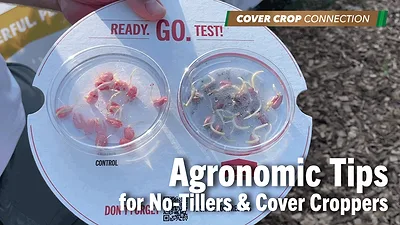
This week we are looking at a clip from Cody Hornaday, a technical agronomist with Koch Agronomic Services, as he explains a few tips that no-tillers and cover croppers should keep in mind for unlocking phosphorus in their soils.
Family Owned since 1964 – Remlinger Manufacturing was founded by Wilbur Remlinger in 1964 and the family tradition continues today with Wilbur’s grandson being the current CEO/President. Although the business has expanded and diversified, family remains a core value to the company and is evident in the company culture.
Made in USA – Remlinger Manufacturing is proudly located in Kalida, Ohio. We have dealers located across the US and Canada to conveniently serve our customers.
Quality Driven – With over 60 years of producing farm equipment, we continue our tradition of manufacturing high quality attachments and products to serve farmers around the globe.
Byron Seeds LLC is a team of individuals who have a passion for high energy forages, cover crops, and proper farming techniques. Byron personnel seek to understand our clients’ goals so that we may provide the best environment for our clients’ success through research, education, support, and...
Our years of experience and network of dealers make us the ideal choice for your mowing, no-till and horse drawn equipment needs. Use our Dealer Locator to contact your nearest I&J dealer today.