Last updated July 20, 2026
If no-till isn’t enough to stop erosion, what is?
Lucas Criswell believes the answer is big cover crops.
The Lewisburg, Pa., no-tiller does some custom application work for other growers and still sees erosion occurring on long-term no-till fields — even fields that grow short cover crops in the hilly region of central Pennsylvania.
But on Criswell’s farm, where he plants into cover crops that are as tall as his waist, he doesn’t see any erosion anymore.
Criswell recalls a 5-inch-rain that fell in an hour and a half in 2014. It cut a 3-foot-deep trench in his lawn, and he was afraid to see the condition of his fields.
In a field where he had just soybean stubble, which he intentionally left that way for a side-by-side, he saw the residue move. But on the field where he had rolled rye, it stayed in place — protecting the soil between the corn rows.
“That was another a-ha moment for me,” he says.
Erosion control isn’t the only benefit to no-tilling cash crops into living cover crops. Gerard Troisi, Criswell’s crop consultant, says that doing this allows them to continue capturing energy, which creates a bigger root system and allows them to store that energy for the following cash crop.
Jim Hershey unintentionally realized the advantage of planting green 3 years ago, when he experienced an extremely wet spring. The 700-acre corn, soybean, wheat and barley no-tiller couldn’t get in to plant and his cereal rye cover crop kept growing.
“I thought, ‘Well, if I burn it off with Roundup, I’ll have to wait several weeks until this stuff dies,’” he says, explaining that it’s very difficult to plant into a half-dead cover crop.
Located about an hour and a half south of Criswell in Elizabethtown, Pa., he borrowed a neighbor’s cultipacker to roll down the shoulder-high rye and then planted corn into it.
“We had the best stand of corn we ever had,” Hershey says. “That was the tipping point for me.”
The corn yielded 10-20 bushels higher than corn that wasn’t planted in cover crops.
Today, Criswell and Hershey are both learning and perfecting the art of planting green for the benefit of their soil, crops and overall farm productivity.
Timely Seeding
When Criswell first tried no-tilling green 3 years ago, he planted into a cereal rye-triticale mix that was 15 inches tall, which might have seemed like a radical move at the time.
Today, he’s planting into rye that’s 3-4 feet tall, and believes that allowing covers to grow that much is what has had the biggest impact on his 1,800-acre operation of no-till corn, soybeans, wheat, yellow peas and cereal rye for grain.

“You want to limit the seeds per acre and make sure you have adequate breathing room for all species involved in the mix...” –Lucas Criswell
The first step to achieving ‘big cover crops’ is to get them seeded, which Criswell does with a 30-foot, 15-inch planter that follows the combine during corn and soybean harvest.
“My goal is to have something running in the field the same day we’re harvesting,” he says. “It does take a little more labor, but it saves us a couple of days getting the covers seeded and growing.”
Troisi adds that seeding cover crops on the day of harvest usually means perfect seeding conditions.
“Now we have it established and it can be growing out there,” he says. “I can get a 5-inch rain event. Or I can get a long, prolonged period of cold, wet weather.
“And that crop is out there growing for me and it’s making me money. Because it’s capturing sunlight energy from the atmosphere, making it into plant growth, and that plant growth is time-released fertilizer for your crop.”
No-tillers who don’t have extra farm labor may consider hiring a high school student to seed covers behind the combine, Criswell suggests.
“Everybody always says, ‘Well I can’t plant cover crops because I don’t have time to do it,’” he says. “It’s so invaluable it’s priceless. So make it happen.”

WATCH YOUR RATE. If a cover-crop mixture is seeded too thick, the species will be overcrowded and compete with each other, thus resulting in smaller cover crops, say Lucas Criswell and Gerard Troisi. Don’t seed at forage rates, Criswell adds.
One option is to interseed cover crops, which Hershey first tried this past year using a Valmar 2455 to seed a mixture of radishes, annual ryegrass and crimson clover when the corn was no taller than knee-high.
He saw great results in late June and early July, but then he hit a 6-week dry spell and lost quite a bit of cover crop. He says next year he’ll be trying different corn populations, as he saw greater loss in the higher populations, as well as trying hybrids that won’t grow as tall and have a more upright leaf, which would allow more sunlight to reach the growing covers.
Hershey notes that the cover crops did well in the shorter-season corn that didn’t get as tall and dried down sooner.
Criswell’s been using shorter-season corn and soybeans the last 5 years to get his cover crops seeded earlier.
On soybeans, he went from a 3.2-3.5 maturity down to 2.2-2.4. He’s noticed the shorter-season maturities are shorter in height — about 2½ feet tall — but it hasn’t affected his yield.
Criswell has also tried some 101- and 102-day corn compared to his typical 110 days, and the yield results have been mixed. This past year the longer-season hybrids yielded 10 bushels better than the shorter-season hybrids, but in 2014 the shorter ones performed just as well as the longer ones.
Criswell thinks the yield difference for 2015 was due to the shorter ones getting caught in a dry spell. He plants longer hybrids first and finishes with the shorter ones.
With future corn crops, Criswell is going to focus on more defensive hybrids due to nitrogen (N) being tied up in the cover crops.
“A lot of these ‘racehorses’ like to be spoon-fed constantly, so you’re putting the corn in a less-than-ideal environment with having some N tied up already,” he says. “What I’ve seen is the more defensive varieties seem to shine better in the high-residue farming that we’re doing.”

CRIMP AND ROLL. Lucas Criswell says the roller-crimper no-tiller Charlie Martin designed for his Kinze planter is one of the best attachments he’s put on his planter. But he notes the cover crops have to be at least waist-high when he’s planting or they’ll stand back up a few days later.
In 2015, he started harvesting soybeans on Sept. 15 and was finished by the first week of October.
“That really opens the window up to run a diverse multispecies cover crop after our soybeans — last year particularly,” he says.
His mix following soybeans last fall included hairy vetch, winter lentils, radishes, turnips, Austrian winter peas, spring peas, a little bit of oats and cereal rye, totaling 70 pounds of cover-crop seed per acre.
After corn he typically seeds 40 pounds of cereal rye per acre. This past season he started harvest in the beginning of October and finished in the beginning of November.
The Right Rate
One piece of advice Criswell offers to no-tillers when it comes to seeding cover crops is to avoid using forage rates, as the cover crops will be seeded too thick.
“There are a lot of dairies in our area that plant 2-3 bushels an acre of rye for forage,” he says. “And if you want to let that rye get bigger to plant into it, you’re going to have it too thick.”
Instead, no-tillers can determine the right seeding rate by setting a limit on the amount of money they want to spend per acre. For Criswell, his goal was to stay under $30 per acre for the diverse mixture that followed soybeans.
It’s also important to look at each cover crop species’ seed size and the number of seeds per pound, he adds.
“I only have a half pound of turnips and 1 pound of radishes in that mix,” he says. “I’ve been to a lot of cover crop field days and guys had 5 pounds of radishes and it was overtaking everything else. You want to limit the seeds per acre and make sure you have adequate breathing room for all species involved in the mix.”
He’s also trimmed back his cereal covers from 60 pounds to 20 in his mixes because the more species he puts in, the thicker it seems to make the rye.
“They collaborate very nicely together,” he says.
Roll into It
When Criswell first tried no-tilling green he liked what he saw, but felt he could’ve done better if he had a roller on front of his planter to move cover crop plants aside.
So he worked with Loysville, Pa., no-tiller Charlie Martin — the inventor of Dawn Equipment’s ZRX Cover Crop Roller Crimper — to customize the roller-crimper for his Kinze planter.
Criswell says the roller-crimper allows him to delay planting a little bit so he can get more growth out of the cover crop, which helps create a “unique mat of residue that lasts the whole season,” holding both soil and moisture in place.
But the cover crop needs to be tall enough for the roller-crimper to be effective, he adds. If the rye isn’t at least up to his waist, the plants lay down for a couple of days and stand back up.
Criswell still does a burndown program with the roller-crimper, although it’s allowed him to get by with less herbicide.
On his corn, Criswell terminates his cover crops a few days after planting, with 1 quart of Gramoxone and 1 quart Bicep. If necessary, he’ll do a second pass with Roundup.
But for soybeans, he first applies 1 ounce of Canopy EX and ½ pint of 2,4-D a week before planting, which helps control weeds without terminating the cereal rye. About 25-30 days after soybean emergence, Criswell will make a second pass with Roundup to terminate the cover crop.
He likes to let the cereal rye grow with the soybeans to help manage slug feeding.
“The slugs want to be on something green,” he says. “They don’t care if it’s soybeans.”
As for the planting, Criswell also has Keeton seed firmers and solid closing wheels on his planter.
He used to have Thompson spiked closing wheels, but says in the 5 years he’s been planting green, the cover crops seem to wrap around the spiked closing wheels a little more every year. He hasn’t seen the same problem with solid closing wheels.
He warns no-tillers that when they switch to planting green, their seed slot will never look the same.
“It’s not going to be a perfect seedbed behind your planter. Just get that figment out of your imagination,” Criswell says. “You’ve got a lot of roots holding that seed slot open.”
This year will be the first Hershey uses Dawn’s roller-crimper on his planter instead of rolling his cover crops with the cultipacker.

LET IT GROW. Lucas Criswell waits 25-30 days after soybean emergence before killing his cereal rye cover crop. Allowing the cover to grow that long has reduced slug pressure, as the slugs will feed on the rye, he says.
When he was using the cultipacker, he ran Yetter’s SharkTooth row cleaners on front of his Case IH 1240 corn planter, along with a 6-inch, double saw-tooth closing wheel in the back. Like Criswell, Hershey recommends avoiding anything spiked — both row cleaners and closing wheels — because the cover crop will wrap.
He prefers to terminate his cover crop no more than 2 days after planting, using a quart of Roundup, 1.8 quarts of Lumax EZ and a pint of atrazine, along with 17 gallons of ammonium thiosulfate as a carrier, which also helps kill the cover crop.
“With that and the Roundup, it really made a hot mix, and within a day you could see the cover crop starting to turn white,” he says. “It really knocks it down.”
Now that he’s experimenting with the interseeder, he used an ounce of Sharpen instead of Lumax EZ because he didn’t want any residual herbicide to affect the new cover crops.
Applying Enough ‘N’
The No. 1 question Criswell gets about planting green is how the practice affects N requirements for corn.
For Criswell, it technically starts at cover crop green-up, when he applies 1,500 gallons of hog manure per acre. That provides about 25 pounds of N an acre, since only half of the N in hog manure is available the first year. But he doesn’t count that toward his N for corn.
“My goal is to grow a healthier cover, so in turn that cover breaks down to feed the corn crop,” he explains.
Criswell has been using Ag Leader’s OptRx crop sensors the last 2 years to maximize his N needs. In doing so , he noticed he wasn’t seeing a big difference in N credit when he was applying higher levels of manure, which is why he decided to go to the lower rate of 1,500 gallons.

“It seemed like once we got to 150 units of nitrogen, there was no benefit. In the past, we would put on 200 units without even looking back...” –Jim Hershey
The 1,500-gallon rate allows him to feed more of his covers. Last fall, he was able to apply manure to 100% of his acres going to corn this year, and he’ll likely make another 1,500-gallon application in the spring.
He begins applying N for corn at planting, and says his rule of thumb is at least 45-50 pounds down with the planter. For Criswell, that’s 10 gallons of 30% and 5 gallons of ammonium thiosulfate applied with his Kinze planter.
But he notes that since every soil and field is different, the right amount is a moving target.
“The more mature your cover is, like your cereals, wheat and ryes, the more tied up the N is going to be,” Criswell says, adding that it’s one of the reasons why he’s trying to ramp up the amount of legumes in his cover crop mix.
He sidedresses additional N later using the OptRx sensors to determine the appropriate rate. Since adopting the crop-sensing technology, he’s applying less N on higher-producing field areas and more N on poorer-producing areas.
He’s found it’s important to have a set yield goal for the better areas.
“You want to use your ‘sweet-spot’ yield goal, or the maximum yield you can get in that spot, vs. shooting for your field average,” Criswell explains. “If your average is only 170, but you have a spot that does 220, you want to shoot for your 220-bushel corn to get a little better average, so the sensors apply the proper amount.”

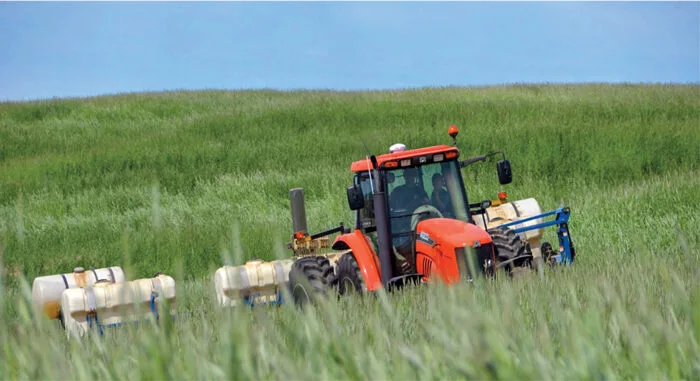
JUMP-START SEEDING. Jim Hershey is experimenting with the Valmar 2455 cover crop interseeder on his 700-acre no-till operation in Elizabethtown, Pa. In 2015, he interseeded a mix of radishes, annual ryegrass and crimson clover. Some of the higher-populated, taller corn shaded out the cover crops too much, so Hershey will be trying different populations and shorter-season corn to see where he can improve his cover crop stand without sacrificing corn yield.
He’s had the OptRx technology for 2 years and says he’s still learning how to use it, but he feels he’s broken even in terms of the return on investment.
For Hershey, he’s focused on redirecting the timing of his N application.
In the past he was putting all of his N on as a sidedress. Since he has livestock, he felt he had enough phosphorus and potassium available, and could wait until the corn was at V4-V5 to apply N.
But in 2015 he added tanks and a fertilizer system to his planter to allow him to apply N behind the press wheel at planting time. He put 10 gallons of N down at planting, and the rest was applied during sidedressing. He says he felt he got a better response this year by splitting the N up.
He notes he’s also done some test strips comparing different amounts of N applied at sidedressing, ranging from 120 units to 200.
“It seemed like once we got to 150 units of N, there was no benefit,” he says. “In the past we would put on 200 units without even looking back.”
He thinks his N-fixing species, like crimson clover, may be providing an N credit.
Like Criswell, Hershey, who raises organic broiler chickens and finishes hogs, applies his manure to his cover crops and has seen it produce more vigorous covers with bigger root masses.
He’s watched his organic matter increase as much as 1-1.5% in the last 3 years, which he credits most to the enhanced cover crop.
This article was originally published January 2016 and is updated regularly.
For more information on roller-crimpers and how to use them successfully, see the article “Rolling, Crimping Can Help No-Tillers Use Covers Better,” in the Spring 2013 issue of Conservation Tillage Guide.
Related Content:
- Tips for Getting Cover Crops to Pay Off from the Starting Gate: One thing that discourages some no-tillers from adopting cover crops is a concern they won’t bring an immediate payoff.
- From Green to Brown: Tips for Getting Better Results Terminating Cover Crops: While choosing the right cover crop, or mix of covers, for a farm can be a challenge, there’s also an art to terminating covers that don’t winterkill with the right products at the right time.
- 6 Tips for Making Cover Crops Work with Your Tillage Practices: Whether a grower is making multiple tillage passes or is a dedicated no-tiller, their reasons for adding cover crops to their operations are probably pretty similar.