The Southern High Plains of the United States have low annual rainfall. When it does rain, though, intense storms can cause severe soil erosion. Strong winds also strip away valuable topsoil. Enter cover crops. Read more in this article from the Crop Science Society of America.
Farmers around the world face different challenges, but North American growers can learn a lot from how farmers in other countries solve problems. Pennsylvania cover crop expert Steve Groff shares insights on how growers use cover crops to retain moisture in the soil in Australia, managing soil erosion in Tasmania, observations on soil types and structure in France, and more.
The National Association of Conservation Districts (NACD) announced the release of a free, first-of-its-kind curriculum, “A Guide to Conducting a Pollinator Conservation Field Day,” available for download. This new curriculum is designed to provide interactive learning experiences for grades K-8, engaging them in habitat-focused, pollinator-themed activities for the classroom and outdoors.
Only a fraction of conventional row crop farmers grow cover crops after harvest, but a new global analysis from the University of Illinois shows the practice can boost soil microbial abundance by 27%. The result adds to cover crops’ reputation for nitrogen loss reduction, weed suppression, erosion control, and more.
As attention on water quality, sustainability, farm income levels, and rural quality of life grows every year, those of us who work in the soil and water conservation arena often wonder what will be required to get the majority of landowners to adopt even the most basic soil health practices. We live in the most altered landscape in the United States, we have nearly the smallest amount of forests and public lands of any state, and we have only half of the topsoil we had in the 1860s. Read more in this article from the Globe Gazette (Mason City, IA).
Pennsylvania cover crop expert Steve Groff explains why growing two different species of crops—one cash crop and one cover crop--can be beneficial to your bottom line. Often, planting multiple crop species together can cause both species to grow better, especially if the cover crop is a legume. Find out more about this uncommon practice in this week’s podcast.
Our soils are in trouble. Over the past century, we’ve abused them with plowing, tilling and too much fertilizer. Read more in this article from the Greeneville Sun (Greeneville, TN).
Almost everyone agrees that phosphorus (P) in surface water is a major issue. Cover crops reduce P loads in both the surface water and sediment losses. Find out more in this article from Ohio's Country Journal.
A common question when incorporating cover crops into a production system is, will the cover crop interfere with the performance of residual herbicides included with the burndown treatment? This article from Iowa State University Extension will discuss the fate of residual herbicides applied to crop residue and living cover crops, and how this may influence herbicide effectiveness.
Roller-crimping is a simple task, but thorough cover crop termination with this equipment requires using the right plant varieties and carrying out operations at the right time.
The National No-Tillage Conference returns January 12-15, 2027!Build and refine your no-till system with dozens of new ideas and connections at the 35th Annual National No-Tillage Conference in Indianapolis, Jan. 12-15, 2027. Experience an energizing 4-day agenda featuring inspiring general session speakers, expert-led No-Till Classrooms and collaborative No-Till Roundtables. Plus, Certified Crop Adviser credits will be offered.
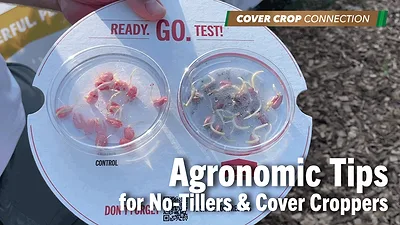
This week we are looking at a clip from Cody Hornaday, a technical agronomist with Koch Agronomic Services, as he explains a few tips that no-tillers and cover croppers should keep in mind for unlocking phosphorus in their soils.
Family Owned since 1964 – Remlinger Manufacturing was founded by Wilbur Remlinger in 1964 and the family tradition continues today with Wilbur’s grandson being the current CEO/President. Although the business has expanded and diversified, family remains a core value to the company and is evident in the company culture.
Made in USA – Remlinger Manufacturing is proudly located in Kalida, Ohio. We have dealers located across the US and Canada to conveniently serve our customers.
Quality Driven – With over 60 years of producing farm equipment, we continue our tradition of manufacturing high quality attachments and products to serve farmers around the globe.
Byron Seeds LLC is a team of individuals who have a passion for high energy forages, cover crops, and proper farming techniques. Byron personnel seek to understand our clients’ goals so that we may provide the best environment for our clients’ success through research, education, support, and...
Our years of experience and network of dealers make us the ideal choice for your mowing, no-till and horse drawn equipment needs. Use our Dealer Locator to contact your nearest I&J dealer today.