A group of California organic farmers is sharing information about their efforts to combine reduced tillage with the use of cover crops, which they have been planting on their vegetable farms for decades to protect soil while adding carbon and diversity to their production systems. "Every one of the pioneering farmers has seen tremendous benefits from the practices," said Jeff Mitchell, UC Cooperative Extension vegetable crops specialist.
In this week’s podcast, crop insurance expert and Wisconsin farmer Ryan Stockwell with the National Wildlife Federation discusses why crop insurance regulations are outdated, why crop insurance eligibility rules are unfavorable to cover crops, how crop insurance will be evolving, and more.
Taking the "long view" of farming comes more naturally to some growers than it does for others. But for Brian Gunderson it may come more naturally because his farm in Waterford, Wis., has been in the family for 170 years.
Farmers who have adopted healthy soil practices such as growing cover crops or adding compost say the techniques save money on production costs while enhancing crop yields. A farmland-conservation group says it hopes case studies documenting the benefits will encourage more farmers to use similar methods. Read more in this article from Ag Alert.
Wayne Fredericks walks out into a cornfield on his northern Iowa farm and points out the first bits of spring growth of a cover crop shooting through the cornstalks. “We didn’t use cover crops years ago,” he says. “In fact, when I first started farming in 1973 … we didn’t treat the land very well.” Read more in this article from the Rock Island Dispatch Argus (Davenport, Iowa).
Results of a three-year soil health study focusing on arbuscular mycorrhizal (AM) fungi proves there is still much to learn about soil microbes. “This is the purpose of research,” explains Mike Lehman, soil microbiologist for the U.S. Department of Agriculture - Agriculture Research Station (USDA-ARS) in Brookings, S.D. Read more in this article from Aberdeen News.
By relying on good farm data to improve their operation, Rick Clark and family are capitalizing on the non-GMO crop market while cutting costs, building soil health and stabilizing yields.
Yield doesn’t drive Rick Clark’s no-till system. Instead, the fifth generation no-tiller intensely focuses on building soil health as the driver of his family’s 7,000-acre operation near Williamsport, Ind.
Calling it a “quiet crisis” in 2018, Ohio State University professor of soil science Rattan Lal said soil loss is a major issue that has been affecting farmers around the world for centuries. “The best practices are to not plow, keep the ground covered with residue and grow a cover crop in the off-season,” Lal said. Read more in this article from Kenosha News.
Pennsylvania cover crop expert Steve Groff says black oats have impressed him the past few years as a cover crop. The winter hardy Cosaque variety of black oats seems to be most popular and can even be used as a forage.
It goes without saying that 2019 was an extremely difficult year for farmers like me. Unprecedented amounts of snow and rain led to 3.9 million acres in South Dakota that couldn’t be planted. Read more in this blog post from the Environmental Defense Fund.
The National No-Tillage Conference returns January 12-15, 2027!Build and refine your no-till system with dozens of new ideas and connections at the 35th Annual National No-Tillage Conference in Indianapolis, Jan. 12-15, 2027. Experience an energizing 4-day agenda featuring inspiring general session speakers, expert-led No-Till Classrooms and collaborative No-Till Roundtables. Plus, Certified Crop Adviser credits will be offered.
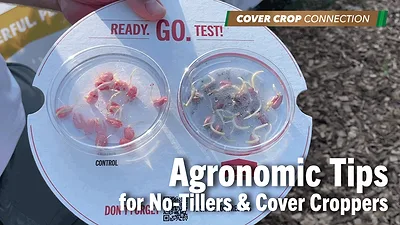
This week we are looking at a clip from Cody Hornaday, a technical agronomist with Koch Agronomic Services, as he explains a few tips that no-tillers and cover croppers should keep in mind for unlocking phosphorus in their soils.
Family Owned since 1964 – Remlinger Manufacturing was founded by Wilbur Remlinger in 1964 and the family tradition continues today with Wilbur’s grandson being the current CEO/President. Although the business has expanded and diversified, family remains a core value to the company and is evident in the company culture.
Made in USA – Remlinger Manufacturing is proudly located in Kalida, Ohio. We have dealers located across the US and Canada to conveniently serve our customers.
Quality Driven – With over 60 years of producing farm equipment, we continue our tradition of manufacturing high quality attachments and products to serve farmers around the globe.
Byron Seeds LLC is a team of individuals who have a passion for high energy forages, cover crops, and proper farming techniques. Byron personnel seek to understand our clients’ goals so that we may provide the best environment for our clients’ success through research, education, support, and...
Our years of experience and network of dealers make us the ideal choice for your mowing, no-till and horse drawn equipment needs. Use our Dealer Locator to contact your nearest I&J dealer today.