While many no-tillers say residue simply “melts away” on their farm due to high biological function in their soils, not every grower may be blessed with the same circumstances.
There are definite payoffs for growers who can ensure the biological degradation process occurs with residue ahead of the next growing season, says Dennis Klockenga.
The agronomist for ProfitProAg says he’s been walking fields in Minnesota and Iowa and seen the residue digestion portion of the company’s “Recipe for Success” has been working.
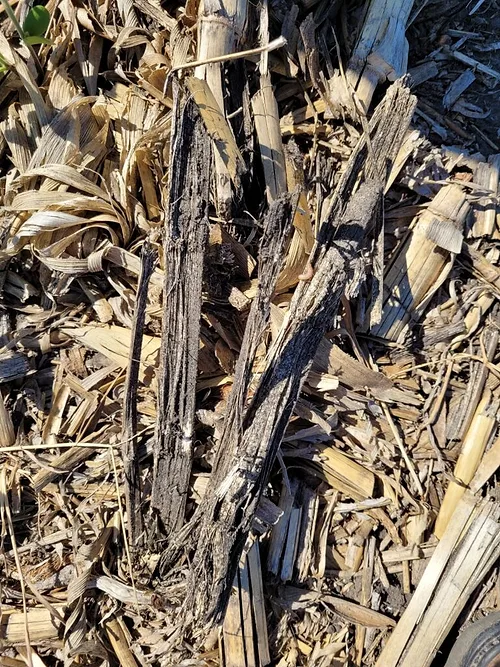
“I’m seeing corn stalk residue turning black on the outside. The pith on the inside is literally disintegrating,” he says. “In fields with no-till soybeans planted into corn stalks, the stalks were breaking down nicely.
“I also saw evidence of biological activity under the old corn roots. There were many earthworms. The soil was aggregated and crumbled nicely.”
He also saw middens aplenty, which are signs of earthworms and healthy biological activity. When growers add cereal rye or other cover crops to the equation they can see 38% more middens in those fields, he says, citing Iowa Learning Farms data.
Here’s a ‘breakdown’ of the ROI to your soil when residue decomposes in your fields:
Nutrient recovery. Roughly 4 tons of corn residue per acre are left behind by a 180 bushel-per-acre corn crop. That material contains 80 pounds an acre of nitrogen (N), 30 pounds of phosphorus, 190 pounds of potassium (K), 16 pounds of sulfur, 35 pounds of calcium and 25 pounsd of magnesium. “With the trend of increasing fertilizer prices, if we can release 190 pounds of potash for next year’s crop, we can save that money and put it towards a cover crop,” he Klockenga says.
Fewer pests, less disease. Corn residue is one of the best places for disease pathogens and insects to overwinter. By digesting the residue, the pests will have a difficult time surviving the winter without the protection of the residue, he notes.
Less hair-pinning. “Over the years, I’ve noticed corn residue that hasn’t been broken down can get in the planter furrow,” Klockenga says. “This can interfere with seed-to-soil contact and can be detrimental to seed germination and emergence. When the residue is digested, it flows better through the planter and reduces hair pinning of the trash.”
More organic matter. Residue needs to be digested by fungi, bacteria and earthworms to be turned into organic matter. ProfitProAG’s program and many other similar products and practices predigest the residue, allowing the microbes and earthworms to finish the job of creating organic matter.