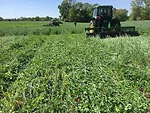

Late summer and early fall are great opportunities to plant cover crops and improve soil health. Days are shorter, but with ample sunshine left and a little rain, cover crops grow quickly. Read more in this article from Ohio's Country Journal.
Current evidence largely suggests cover crops do not raise yields or returns in the first years of adoption. It is unclear if they will raise returns or lower risk over time. Read more in this article from University of Illinois Farmdoc.
Cover crops are widely seen as one of the most promising conservation practices, improving soil health while also removing carbon from the atmosphere. But while the number of Midwestern farmers planting cover crops has increased markedly in recent years, 2017 USDA Census data show only about 5% have adopted the conservation practice. Read more in this article from KMA Land.
Greater yields and improved soil health, with an eye on sustainable farming practices. That’s what researchers at the University of Guelph are looking for in a long-term cover cropping research project currently underway. Read more in this article from Guelph Today.
Crop insurance has been perceived as a barrier to growers adopting the use of cover crops to improve their soil health and minimize risk, but that is not the case, according to a peer-reviewed study in the Journal of Environmental Management.
The Midwest Cover Crops Council (MCCC), composed of representatives from 12 Midwest states and the province of Ontario, agricultural stakeholders and universities, including Purdue, is releasing a new edition of the Cover Crops Field Guide. The popular pocket-size in-field reference helps growers effectively select, grow and use cover crops.
Cover crops are widely seen as one of the most promising conservation practices, improving soil health while also removing carbon from the atmosphere. But while the number of Midwestern farmers planting cover crops has increased markedly in recent years, 2017 USDA Census data show only about 5% have adopted the conservation practice. Read more in this article from the University of Illinois.
The practice of using cover crops still has plenty of room for growth, according to the results of the August Purdue Ag Economy Barometer. Forty-one percent of growers with production of more than $500,000 annually said they are currently using cover crops, while 65% of growers responded that they had either used cover crops in the past or were currently using covers.
Now is the time to think about fitting a cover crop into your rotation. There are many different advantages to using cover crops including reducing pest pressures, keeping the soil protected, recycling nutrients, adding organic matter, additional forage opportunities, and more. Read more in this article from the Capital Journal (Pierre, SD).
Cover crops are considered one of the most effective and economical ways to improve soil health. It is important, however, to avoid causing excessive compaction that could negatively affect following crop yield and increase runoff and erosion. Read more in this article from Lancaster Farming.
The National No-Tillage Conference returns January 12-15, 2027!Build and refine your no-till system with dozens of new ideas and connections at the 35th Annual National No-Tillage Conference in Indianapolis, Jan. 12-15, 2027. Experience an energizing 4-day agenda featuring inspiring general session speakers, expert-led No-Till Classrooms and collaborative No-Till Roundtables. Plus, Certified Crop Adviser credits will be offered.
In our latest edition of the No-Till Farmer Newsletter, you may have seen our No-Till Innovator Special Report which includes tips and advice from expert no-tillers, agronomists and researchers.
Family Owned since 1964 – Remlinger Manufacturing was founded by Wilbur Remlinger in 1964 and the family tradition continues today with Wilbur’s grandson being the current CEO/President. Although the business has expanded and diversified, family remains a core value to the company and is evident in the company culture.
Made in USA – Remlinger Manufacturing is proudly located in Kalida, Ohio. We have dealers located across the US and Canada to conveniently serve our customers.
Quality Driven – With over 60 years of producing farm equipment, we continue our tradition of manufacturing high quality attachments and products to serve farmers around the globe.
Byron Seeds LLC is a team of individuals who have a passion for high energy forages, cover crops, and proper farming techniques. Byron personnel seek to understand our clients’ goals so that we may provide the best environment for our clients’ success through research, education, support, and...
Our years of experience and network of dealers make us the ideal choice for your mowing, no-till and horse drawn equipment needs. Use our Dealer Locator to contact your nearest I&J dealer today.