The carbon-to-nitrogen ratio is a critical number to know when planning for both cover crops and cash crops, according to Pennsylvania cover crop expert Steve Groff. The C:N ratio affects decomposition rates for crop residues and impacts nitrogen cycling as well.
Understanding the C:N ratio helps growers be better managers in the context of overall soil health and fertilizer use. Groff shares why this often-overlooked aspect is critical to making good decisions when growing covers.
Jeff Frey at Future View Farm, farms 700 acres of cash grain, corn, soybeans, wheat and barley, and finishes hogs. He typically plants directly into the cover crop before terminating it, which provides better mulch by letting the cover crop grow longer.
Due to an extremely wet spring and consistent moisture through the summer, grain harvests have slowed down a bit across South Dakota. According to the USDA National Agricultural Statistics Service (as of Aug 18) only 76% of winter wheat harvest has been completed in the state well behind 95% of five-year average. Similarly, only 27% of spring wheat and 60% of oat are harvested, well behind 75% and 90% five-year average respectively. Read more in this article from Farm Forum.
In a tough year for farmers, North Dakota’s Dennis Haugen is a standout. And he may have climate change to thank for it. Haugen planted more radishes than ever this year on his Hannaford fields, he said by telephone. But not a single one will ever grace a dinner table. Instead, the radishes will remain as roots buried in the soil while Haugen harvests seeds from the delicate white flowers that grow above ground. Read more in this article from the Kenosha News.
Peter Goodge, product manager for KUHN, introduces the new 9400NT no-till drill at the 2019 Farm Progress Show. The drill featuring Helica meter design, smooth drop tubes and heavy-duty PRO openers for more precise seed flow, consistent seed depth and more even seed spacing.
Preparation is important to succeeding with cover crop management and there are several areas of decision making that can have a significant impact, says Pennsylvania cover crop expert Steve Groff.
Preparation is important to succeeding with cover crop management and there are several areas of decision making that can have a significant impact, says Pennsylvania cover crop expert Steve Groff. (Courtesy of Cover Crop Innovators)
It’s been a tough year for many producers throughout the Midwest with record acreage going into prevent plant. Dave Chance of Chance Farms in Lebanon, Ind., was no exception this spring, drilling 600 acres of his 2,200 acre corn and soybean farm with cover crops. Unable to get any corn in the ground, Dave managed to plant 1,450 acres of soybeans. Find out his tips in this article from Grassland Oregon.
Hungary is the destination for this week’s podcast, as Pennsylvania cover crop expert Steve Groff shares his observations from visiting the country for their first-ever soil health conference. Hungarian growers are just becoming more interested in cover crops and no-till, despite the fact that they plow up to 90% of their land. Groff explains why it’s important to review the basics of cover cropping, why radishes are the best choice for a beginning cover crop, what lupins are, and much more.
Thinking about applying manure soon on fields where short-season crops like sweet corn or peas have already come off or will be harvested in the next few weeks? Consider planting a cover crop to hold the nutrients in place this fall and next spring, according to this article from University of Minnesota Extension.
Using the test plots at the Peninsula Research Station near Sturgeon Bay in cooperation with Door County agricultural agent Annie Deutsch, the Extension Service's northeast area nutrient and pest management program senior outreach specialist Jamie Patton plans to grow lentils in combination with other cover crops.
The National No-Tillage Conference returns January 12-15, 2027!Build and refine your no-till system with dozens of new ideas and connections at the 35th Annual National No-Tillage Conference in Indianapolis, Jan. 12-15, 2027. Experience an energizing 4-day agenda featuring inspiring general session speakers, expert-led No-Till Classrooms and collaborative No-Till Roundtables. Plus, Certified Crop Adviser credits will be offered.
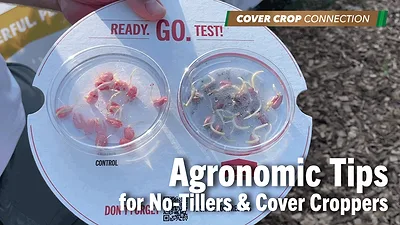
This week we are looking at a clip from Cody Hornaday, a technical agronomist with Koch Agronomic Services, as he explains a few tips that no-tillers and cover croppers should keep in mind for unlocking phosphorus in their soils.
Family Owned since 1964 – Remlinger Manufacturing was founded by Wilbur Remlinger in 1964 and the family tradition continues today with Wilbur’s grandson being the current CEO/President. Although the business has expanded and diversified, family remains a core value to the company and is evident in the company culture.
Made in USA – Remlinger Manufacturing is proudly located in Kalida, Ohio. We have dealers located across the US and Canada to conveniently serve our customers.
Quality Driven – With over 60 years of producing farm equipment, we continue our tradition of manufacturing high quality attachments and products to serve farmers around the globe.
Byron Seeds LLC is a team of individuals who have a passion for high energy forages, cover crops, and proper farming techniques. Byron personnel seek to understand our clients’ goals so that we may provide the best environment for our clients’ success through research, education, support, and...
Our years of experience and network of dealers make us the ideal choice for your mowing, no-till and horse drawn equipment needs. Use our Dealer Locator to contact your nearest I&J dealer today.