Editors' Picks

Whole Orchard Recycling Increases Carbon Sequestration, Increases Yields

Recycling trees onsite can sequester carbon, save water and increase crop yields, making it a climate-smart practice for California’s irrigated almond orchards, finds a study from the University of California, Davis. Whole orchard recycling is when old orchard trees are ground, chipped and turned back into the soil before new almond trees are planted.
Read More
Picture1.jpg

For Cover Crop Creativity, the Best is Yet to Come
Trial and error trumps comfort zone complacence in strip-tiller Trent Sanderson’s perpetual pursuit of cover cropping innovation.
The greatest of growing seasons has little affect on Trent Sanderson’s approach to cover crops across his family’s 2,000-acre corn, soybean and wheat operation in Clare, Ill. In his mind, more can always be done to maximize the value of every field, whether it’s a new seed variety, application method or frugal machinery investments.
Read More

Protecting Carbon in the Soil a Win for Farmers

Countries are struggling to keep farming sustainable while meeting the mounting demand for production — which must increase by between 25 percent and 70 percent by 2050 to feed growing populations. A groundbreaking new study reports that the secret to making this possible lies in the soil — or more specifically, in the carbon stored in the soil. Read more in this article from GreenBiz.
Read More

Add Trees to Cover Crops for More Carbon Farming

Anecdotally, the United States Department of Agriculture sees a tiny but growing number of silvopasture farms, while other methods that suck greenhouse gases from the air—collectively known as carbon farming—are experiencing greater resurgences. Cover crops, typically sown in the offseason and left in fields to decompose, are also rising in popularity. Read more in this article from Popular Science magazine.
Read More

Organic Soybean Producers Can Be Competitive with Reduced Tillage, Cover Crops

Organic soybean producers using no-till and reduced-tillage production methods that incorporate cover crops — strategies that protect soil health and water quality — can achieve similar yields at competitive costs compared to tillage-based production. That’s the conclusion of a new study by researchers in Penn State’s College of Agricultural Sciences. Read more in this article from Penn State University Extension.
Read More
Best Cover Crops for Spring.png

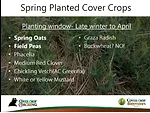
[Podcast] Best Cover Crops for Spring
In this week’s podcast, Pennsylvania cover crop expert Steve Groff discusses cover crop species that are best for planting in late winter/early spring. (Courtesy of Cover Crop Innovators)
Read More

Harvest Cover Crops as Hay or Straw

With the shortage and increasing price of quality hay and an increase in straw prices as well, spring of 2020 may be a season to harvest our winter cereal crops as either hay or straw, depending on your needs. Recent auction reports have hay averaging over $200/T (up to $350 in one report) and straw averaging $150/T. Read more in this article from the Akron Beacon Journal.
Read More

Too Early to Tell If Cover Crop Seed Availability Will Be An Issue

With much of the cover crop planted last fall just starting its spring growth, it’s too early to tell if cover crop seed availability will be an issue after this season, according to seed dealer Arvin Vos. Delays in planting last fall could mean lower supply or higher prices for 2020. Read more in this article from Kenosha News.
Read More
NNTC_Logo_2026_4c_Outlined.png

The National No-Tillage Conference returns January 12-15, 2027! Build and refine your no-till system with dozens of new ideas and connections at the 35th Annual National No-Tillage Conference in Indianapolis, Jan. 12-15, 2027. Experience an energizing 4-day agenda featuring inspiring general session speakers, expert-led No-Till Classrooms and collaborative No-Till Roundtables. Plus, Certified Crop Adviser credits will be offered.

Learn More

Top Articles

Current Issue

View More

Must Read Free Eguides

Download these helpful knowledge building tools

View More

Get all things Cover Crop all the time!

Start Your Membership