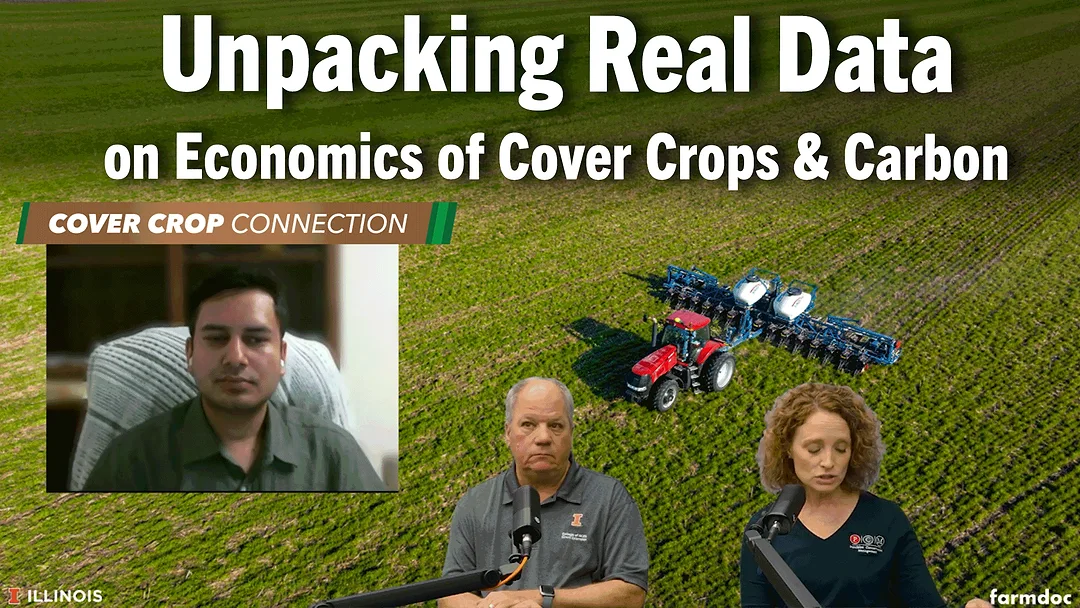
Many no-tillers often wonder about the economics of providing carbon services through cover crops. In this webinar from FarmDoc Daily, experts from the University of Illinois and Texas Tech University dive into data from the Precision Conservation Management program to explore the field-level economics of cover crop adoption.
Laura Gentry from Illinois Corn Growers Association and Saurav Kunwar from Texas Tech University discuss the trade-offs between production costs, greenhouse gas emissions and soil carbon sequestration.
“This new approach utilizes a new type of analysis, a mathematical programming analysis, and it develops a better understanding, a more direct understanding of the connection between the net benefits of the greenhouse gas emissions reductions with the cost to the producer of generating those benefits. So it captures the benefits of both the reduced greenhouse gas emissions as well as the increase in carbon sequestration, so the increase in soil carbon. It does that. We can look at it separately and we can look at it collectively. It's just a net greenhouse gas emissions change too. And the way this works, this analysis treats cover crops as a type of technology. So the technology is something that the farmer pays for in this type of an analysis. They pay for it in terms of the direct costs and the power costs and any yield differences. And it quantifies the cost of that new technology to the producer while capturing the benefit of using the technology in terms of reduced net greenhouse gas emissions. So it's just a different and it's certainly a more specialized analysis of cover cropping that focuses on the greenhouse gas benefits specifically.”
The full webinar has more details about how conservation incentives and carbon markets can help offset the private costs for farmers adopting these practices. Plus, we will have a full article on this topic in an upcoming issue of the No-Till Farmer newsletter.