A sign that reads “Ohio Bicentennial Farm” stands outside Kris and Lacie Green’s house, honoring the family’s legacy in the village of Wakeman. Kris Green’s ancestors founded the operation known as Willow Brook Farm in 1817 after moving from Connecticut. The family business is still going strong with Green and his dad, Ken, running the 2,000-acre operation about 45 miles southwest of Cleveland.
The Greens started no-tilling soybeans almost 25 years ago but continued to conventionally till corn up until 2019 when Kris fully transitioned to strip-till with corn. The conservation practices are helping to solve their two biggest challenges — soil erosion and labor shortages.
“With heavier rain falling in shorter amounts of time more frequently, soil erosion is a major problem in our area,” Green says. “Labor has been an even bigger issue. We just don’t have the workforce anymore. We have one full-time employee. Cutting down on passes has made a huge difference.”
Cover Crop Adoption
Looking for another way to build soil health and reduce inputs, the 7th-generation farmer became interested in cover crops. His light bulb moment came in 2016 at a local field day hosted by longtime northeast Ohio no-tiller Dale Daniels.
“They performed a rain simulator test, and I had never seen one of those before,” Green says. “There were two soil samples — one from Dale’s no-till and cover crop farm and the other from a neighbor’s conventionally tilled farm. It really opened my eyes when I saw how much water ran off the neighbor’s sample and how little ran off Dale’s.”
Green was immediately sold.
“I jumped in with both feet and bought a cover crop seeder that mounted on my Apache sprayer,” he says.
“I was listening to a podcast and heard someone say, ‘Treat your cover crop like a cash crop.’ That really stuck with me. My dad is supportive of cover crops to an extent, but he probably thinks I’m crazy sometimes.”
Green usually seeds cereal rye in the fall ahead of soybeans at a rate of 55-70 pounds per acre in 15-inch rows with his 30-foot Kinze 3650 planter. Rye has lived up to the hype, Green says, but other species haven’t delivered the same return on investment.
“Treat your cover crop like a cash crop’ — that really stuck with me…”
“Oats and radishes are fine, but they freeze out,” Green says. “We need cover crops that overwinter and provide the erosion protection we’re looking for.
“We tried rapeseed last fall. I wasn’t super impressed. The stand wasn’t what I wanted, and honestly it was hard to kill in the spring. Our herbicide wasn’t touching it. There was still rapeseed trying to flower in mid-June when corn was knee high.”
Green will be the first to admit he doesn’t have all the answers yet when it comes to cover cropping. One of his biggest challenges is figuring out how to seed covers into standing corn.
“By the time we get corn off, it’s usually a little late to put a cover crop on, especially for erosion control,” he says. “Yes, it’s there in the spring, but it didn’t really help us out over the winter. We’re looking at different ways to solve the puzzle. One of our local dealers tried applying cover crops in between rows while sidedressing — that’s something I’d like to look at.”
No-Tilling the Green Way
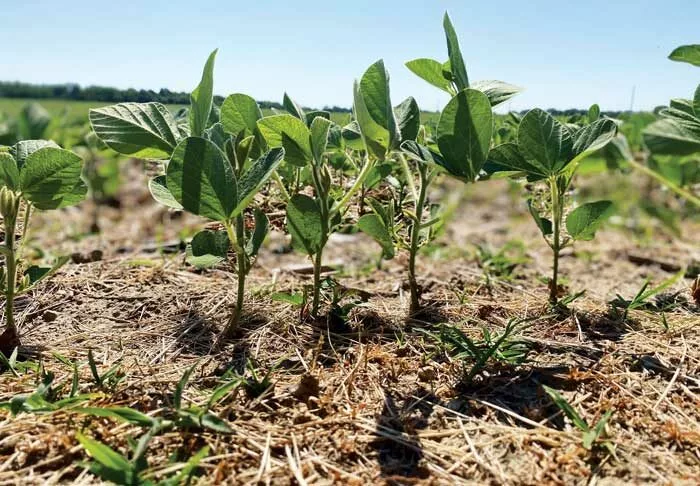
Cereal rye has paid off the most in the weed suppression department for Green. He interseeds soybeans into standing rye with his Kinze planter and sometimes holds off on herbicide applications for up to 2 weeks.
Green’s biggest no-till truth is, “Be patient before planting to make sure the ground is ready.” He’d like to plant in early April every year, but if conditions aren’t right, he’s not scared to wait until June to get started.
 EQUIPPED FOR THE JOB. Green recently upgraded from this 40-foot Kinze 3665 to a 30-foot Kinze 3650 planter. He uses the Kinze to no-till soybeans in 15-inch rows in the spring and seed cover crops in the fall.
Shooting for soybean yields around 60 bushels per acre, Green takes a unique approach to seeding rates. He’s trying rates as low as 70,000 on his best ground and as high as 140,000 in other areas.
“We seeded at a rate of 90,000 on a few check blocks one year,” Green says. “That probably sounds pretty crazy to some people. But the 90,000 check block actually outyielded the 140,000 outside of the check block. We realized we could continue to drop our rates comfortably on our best ground.”
Green applies phosphorus (P) and potassium (K) to soybeans at variable rates, determined by soil test results. A local co-op sends a file to his iPad that shows where they need to pull soil samples. Lacie and the kids, Hazel, Ezra and Haddie, drive an ATV out to the recommended spots, collect the samples and send them off for testing.
“With fertilizer prices as high as they are, we’re not putting any more on than we have to,” Green says. “We’re only 12 miles away from Lake Erie so we’re also trying to be conscientious of water quality, and we don’t want to see our dollars flow off into the lake.”
Read the full story in the September 2025 issue of No-Till Farmer »