Summer is nearing its end and it is time to plant cover crops. Extension agronomist Sjoerd Duiker says many cover crops need to be planted early to derive the substantial benefits. Read more in this article from Lancaster Farming.
Interseeding cover crops into soybean is not a common practice in North Dakota due to limited soil water, a short growing season and the need for adapted winter hardy species to produce a good established stand of a cover crop. A study from North Dakota State University Extension evaluated the impact of interseeded winter camelina and winter rye using two soybean varieties with different relative maturities and row spacing.
In this podcast from Hoosier Ag Today, Purdue Extension Forage Specialist Dr. Keith Johnson and Forage Agronomist Greg Downing with Cisco Seed discuss harvesting cover crops as forage.
What are “greedy beans,” you ask? That’s simply what some are calling double-cropped soybeans. Find out why the author no longer plants them in this article from Lancaster Farming.
Fourth generation farmer Tony Wagner, Jamestown, ND, has experimented with different cover crops for different fields to achieve various soil health goals for those particular fields.
Source: North Dakota State University Extension press release
Planting cover crops is an option to consider in managing your prevented plant acres, says Ron Haugen, North Dakota State University Extension farm management specialist. Rules for planting cover crops on prevented plant acres must be followed. Read more in this article from North Dakota State University.
Last fall, two farms in California’s Sacramento Valley planted a wildflower cover crop mix as part of a commitment to restore habitat within 325 acres of pecan orchards. The farms, Pacific Gold Agriculture and Bypass Farms, are participating in a project called “Orchards Alive” in hopes that wildflowers will attract pollinators and naturally reduce pest pressure. Read more in this article from the Environmental Defense Fund.
On a hot, dry, and extremely windy day in early June, Neal Hentzen surveys the dryland field on the edge of Seward where his corn is ankle high. The leaves on the plants whip in the wind like green streamers running in long, straight rows from the road to a faraway fencepost. Read more in this article from the York News Times (York, NE).
Warm season cover crops grow in the summer but die with the first frost while cool season species generally survive the winter. Major categories include brassicas, grasses, legumes, and other broadleaves with over 60 species. Read more in this article from Ohio's Country Journal.
If you’re on Twitter, you’ve likely seen a lot of buzz around wide-row corn (44-inch or 60-inch) with cover crops seeded between rows. The goal is to space the corn rows out to provide more light for the cover crops to establish and put on some biomass for grazing, attract pollinators or to add diversity to the system. Read more in this article from AgWeek.
The National No-Tillage Conference returns January 12-15, 2027!Build and refine your no-till system with dozens of new ideas and connections at the 35th Annual National No-Tillage Conference in Indianapolis, Jan. 12-15, 2027. Experience an energizing 4-day agenda featuring inspiring general session speakers, expert-led No-Till Classrooms and collaborative No-Till Roundtables. Plus, Certified Crop Adviser credits will be offered.
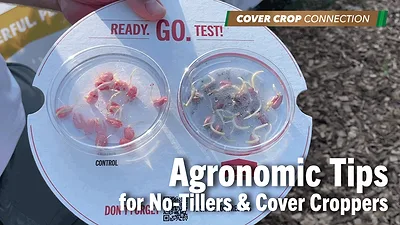
This week we are looking at a clip from Cody Hornaday, a technical agronomist with Koch Agronomic Services, as he explains a few tips that no-tillers and cover croppers should keep in mind for unlocking phosphorus in their soils.
Family Owned since 1964 – Remlinger Manufacturing was founded by Wilbur Remlinger in 1964 and the family tradition continues today with Wilbur’s grandson being the current CEO/President. Although the business has expanded and diversified, family remains a core value to the company and is evident in the company culture.
Made in USA – Remlinger Manufacturing is proudly located in Kalida, Ohio. We have dealers located across the US and Canada to conveniently serve our customers.
Quality Driven – With over 60 years of producing farm equipment, we continue our tradition of manufacturing high quality attachments and products to serve farmers around the globe.
Byron Seeds LLC is a team of individuals who have a passion for high energy forages, cover crops, and proper farming techniques. Byron personnel seek to understand our clients’ goals so that we may provide the best environment for our clients’ success through research, education, support, and...
Our years of experience and network of dealers make us the ideal choice for your mowing, no-till and horse drawn equipment needs. Use our Dealer Locator to contact your nearest I&J dealer today.