Each grower has their own reasons for growing a cover crop – whether it’s to improve organic matter, hold onto nutrients from manure, provide a nitrogen credit or protect against erosion. Read more in this article from the St. Thomas Times-Journal (Toronto, Ontario).
Now is the time to think about fitting a cover crop into your rotation. There are many different advantages to using cover crops including reducing pest pressures, keeping the soil protected, recycling nutrients, adding organic matter, additional forage opportunities, and more. Read more in this article from the Capital Journal (Pierre, SD).
There are many benefits cover crops offer when they are properly established. These benefits range from protecting soil, to reducing run-off of soil particles in an effort to retain nutrients, to increasing soil productivity and overall farm profitability. Read more in this article from Ohio's Country Journal.
BASF Vice President of U.S. Crop Protection Scott Kay lead the discussion featuring farmers Dan Luepkes (Illinois) and Kelly Garrett (Iowa). The panel shared insights on pushing the boundaries of productivity, driving innovation and increasing collaboration.
Some farmers are still debating whether to plant soybeans after wheat harvest. Double crop soybeans are risky but high soybean prices, early summer planting and good weather favor farmers taking the risk. Read more in this article from the Crescent News (Defiance, OH).
Now is the time to make plans for cover crop planting if you have not already done so. There are several cover crop species that are often talked about, however, cereal rye, oats and radish are the most commonly used cover crops. Read more in this article from Iowa State University.
Are you looking for cover crops to fill a fallow period as small grains, snap beans, or other crops are harvested? Extension agronomist Heidi Reed explains that establishing cover crops in summer grants an opportunity to branch out beyond our fall-planted standbys. Read more in this article from Lancaster Farming.
USDA's crop progress report for the week ended August 22 reported 41% of corn dented, in line with the 41% reported dented in the same week last year. The 5-year average for corn dented in this week was 38%.
The National No-Tillage Conference returns January 12-15, 2027!Build and refine your no-till system with dozens of new ideas and connections at the 35th Annual National No-Tillage Conference in Indianapolis, Jan. 12-15, 2027. Experience an energizing 4-day agenda featuring inspiring general session speakers, expert-led No-Till Classrooms and collaborative No-Till Roundtables. Plus, Certified Crop Adviser credits will be offered.
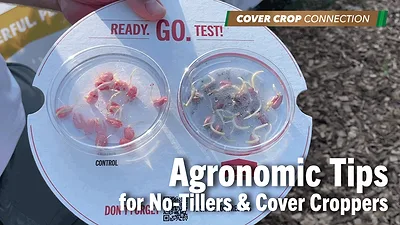
This week we are looking at a clip from Cody Hornaday, a technical agronomist with Koch Agronomic Services, as he explains a few tips that no-tillers and cover croppers should keep in mind for unlocking phosphorus in their soils.
Family Owned since 1964 – Remlinger Manufacturing was founded by Wilbur Remlinger in 1964 and the family tradition continues today with Wilbur’s grandson being the current CEO/President. Although the business has expanded and diversified, family remains a core value to the company and is evident in the company culture.
Made in USA – Remlinger Manufacturing is proudly located in Kalida, Ohio. We have dealers located across the US and Canada to conveniently serve our customers.
Quality Driven – With over 60 years of producing farm equipment, we continue our tradition of manufacturing high quality attachments and products to serve farmers around the globe.
Byron Seeds LLC is a team of individuals who have a passion for high energy forages, cover crops, and proper farming techniques. Byron personnel seek to understand our clients’ goals so that we may provide the best environment for our clients’ success through research, education, support, and...
Our years of experience and network of dealers make us the ideal choice for your mowing, no-till and horse drawn equipment needs. Use our Dealer Locator to contact your nearest I&J dealer today.