Mackane Vogel here, with this week’s cover crop connection. I had the opportunity to visit with Brandon, Minnesota farmer John Ledermann and check out his unique strategy for planting cereal rye and corn.
Good morning, from Alexandria, Minn., Mackane Vogel here, with this week’s cover crop connection. I’m here at the Soil Management Summit and this morning we are going through some live demonstrations. Why don’t we check in with Anna Cates of University of Minnesota Extension for a live cover crop demonstration.
Cereal rye can be used to suppress weeds. At this Brooklyn, Wisconsin, field day, Jose Nunes, a graduate student at weed scientist Rodrigo Werle’s UW-Madison research and extension lab, shared his findings about how much cereal rye biomass is needed for optimal weed suppression.
Charles Baron with Farmers Business Network told me all about the organization’s latest innovation, Norm the AI Agronomist. Norm is an online tool that uses artificial intelligence to scan the internet and agronomic research to answer questions about agronomy, farm management practices and more.
Roger Murdock, director of sales & marketing for Montag Manufacturing, took some time to show me one of the company’s newest cover crop innovations. Check out this clip of Murdock talking about the key features of Montag’s Cover Crop Plus and what makes it ideal for planting cover crops of all different species, especially those with smaller seeds.
Gary Zimmer, a grower in Spring Green, Wis., who some refer to as the “father of biological farming,” hosted a field day on his farm over the summer and explained why soil fertility has to involve the exchange of nutrients in a carbon biological cycle. According to Zimmer, too many farmers simply lay fertilizer on top of their land and fail to connect their nutrients to a carbon source. Here is Gary talking about his unique approach to cover crops and how they help with soil fertility on his farm.
Jim Stute, an independent research agronomist and farmer member of the watershed protection committee of Racine County in Wisconsin, is helping to lead a long-term comparison of conventional tillage vs. no-till and cover crops. After just 1 year, the study still has a long way to go, but initially, Stute is seeing a 26.3 bushel per acre yield advantage with conventional. And most importantly, Stute says what he thinks they can do next year to shift those results.
Today we’re talking with Jeff Schluckbier, who grows corn, sugar beets and wheat in Tuscola County, Mich. Jeff uses sunflowers, radish, clover, oats, cereal rye and Austrian winter peas. He says cover crops are paying off big time in his 7,500-acre operation, especially during heavy rainfall events.
As always, cover crops are a hot topic at this year’s Farm Progress Show. I caught up with Andy Unverferth, who told me about a new cover crop seeder with an electric drive metering system.
Last week I attended a field day hosted by the Michael Fields Agricultural Institute in East Troy, Wisconsin. I had the opportunity to learn from one of their research agronomists, Esther Durairaj, who told us about her research trials looking into alternative cover crops, including buckwheat.
The National No-Tillage Conference returns January 12-15, 2027!Build and refine your no-till system with dozens of new ideas and connections at the 35th Annual National No-Tillage Conference in Indianapolis, Jan. 12-15, 2027. Experience an energizing 4-day agenda featuring inspiring general session speakers, expert-led No-Till Classrooms and collaborative No-Till Roundtables. Plus, Certified Crop Adviser credits will be offered.
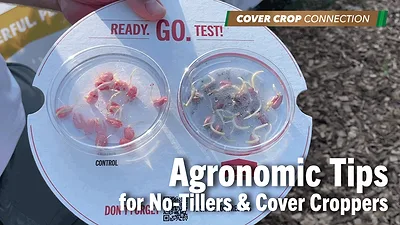
This week we are looking at a clip from Cody Hornaday, a technical agronomist with Koch Agronomic Services, as he explains a few tips that no-tillers and cover croppers should keep in mind for unlocking phosphorus in their soils.
Family Owned since 1964 – Remlinger Manufacturing was founded by Wilbur Remlinger in 1964 and the family tradition continues today with Wilbur’s grandson being the current CEO/President. Although the business has expanded and diversified, family remains a core value to the company and is evident in the company culture.
Made in USA – Remlinger Manufacturing is proudly located in Kalida, Ohio. We have dealers located across the US and Canada to conveniently serve our customers.
Quality Driven – With over 60 years of producing farm equipment, we continue our tradition of manufacturing high quality attachments and products to serve farmers around the globe.
Byron Seeds LLC is a team of individuals who have a passion for high energy forages, cover crops, and proper farming techniques. Byron personnel seek to understand our clients’ goals so that we may provide the best environment for our clients’ success through research, education, support, and...
Our years of experience and network of dealers make us the ideal choice for your mowing, no-till and horse drawn equipment needs. Use our Dealer Locator to contact your nearest I&J dealer today.