There is a lot of talk about climate change. Many people point to agriculture as one of the potential sources to the answer of mitigating it. Read more in this article from Seed World.
Anastasia Fyke doesn’t have time for millennials. Sort of. The fourth-generation buckwheat farmer from Manitoba (and a millennial herself) wants to help farmers transform agriculture from Canada’s sixth-largest greenhouse gas producer into a carbon sink. Read more in this article from The Humboldt Journal.
Cover crops combined with no-tillage systems can increase soil organic carbon, which could help slow climate change on farms, according to a recent study by University of Kentucky College of Agriculture, Food and Environment scientists. Located at UK’s Spindletop Research Farm in Lexington, the plots are only one of a few sites in the world that have been continuously in no-till agriculture for more than 50 years. Read more in this article from The Lane Report.
Farmers aren't immune to changing weather patterns affecting the Midwest. That's why those who are adopting conservation practices hope other farmers follow suit. Read more in this article from Public News Service.
Major farm and livestock groups held a press conference in February to project a united voice on an issue they’ve long avoided. The coalition leaders said they wanted to join the fight against climate change rather than remain cast as villains avoiding the responsibility. Read more in this article from Roll Call.
“I knew we were already doing good things for the environment and not getting recognized. And I wanted to reframe what we were doing, and get really serious and focused about what we were doing with carbon," says farmer Johnny Parker, Sandy Lake, Pennsylvania. Read more in this article from Lancaster Farming.
Countries are struggling to keep farming sustainable while meeting the mounting demand for production — which must increase by between 25 percent and 70 percent by 2050 to feed growing populations. A groundbreaking new study reports that the secret to making this possible lies in the soil — or more specifically, in the carbon stored in the soil. Read more in this article from GreenBiz.
“I’ve experienced weird weather personally,” reported Hans Schmitz, showing a slide depicting his Posey County, Indiana, family farm’s destruction after a tornado.
“Weather is the day-to-day variations in the earth’s atmosphere measured at a single moment in time. Climate, meanwhile, is by definition ... the average of a weather variable," said the agricultural meteorologist. Read more in this article from The Herald Bulletin (Anderson, IN).
Mitchell Hora grows corn and soybeans in Washington County on a farm his family has owned for 115 years. He started planting cover crops four years ago and just recently started seeing economic progress after losing $100 an acre in his first year. Read more in this article from The Daily Iowan.
In a tough year for farmers, North Dakota’s Dennis Haugen is a standout. And he may have climate change to thank for it. Haugen planted more radishes than ever this year on his Hannaford fields, he said by telephone. But not a single one will ever grace a dinner table. Instead, the radishes will remain as roots buried in the soil while Haugen harvests seeds from the delicate white flowers that grow above ground. Read more in this article from the Kenosha News.
The National No-Tillage Conference returns January 12-15, 2027!Build and refine your no-till system with dozens of new ideas and connections at the 35th Annual National No-Tillage Conference in Indianapolis, Jan. 12-15, 2027. Experience an energizing 4-day agenda featuring inspiring general session speakers, expert-led No-Till Classrooms and collaborative No-Till Roundtables. Plus, Certified Crop Adviser credits will be offered.
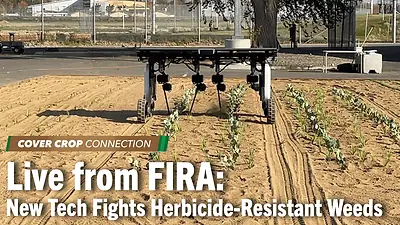
I'm in Yakima, Washington this week at FIRA USA where there's always lots of great ag technology on display. Why don't we go take a look at the newest edition of the Aigen robot. We'll hear from Kenny Lee, the CEO of Aigen.