Each month, the conservation ag group at Cornell University offers an analysis of the latest scientific papers dealing with conservation agriculture research from around the world. For this on-going web series, our editors will be selecting several research papers from the Cornell list that will be of special interest to North American no-tillers, strip-tillers and cover croppers.
Planting ground cover in fields between cash crop growing seasons is an effective way to prevent farmland from losing soil carbon from erosion, a factor that’s underestimated in considering the carbon sequestration potential of cover crops, according to a new study by an Iowa State University ecologist.
Traditional methods of soil assessment have given way to sophisticated, data-driven technologies that provide unprecedented insights into soil conditions.
Newly published research from Michigan State University demonstrates how to evaluate soil carbon stock changes more accurately. This calculation has significant implications on measuring the actual environmental benefits of regenerative agriculture practices and economic consequences through emerging carbon markets.
In this video from the National Center for Appropriate Technology, hear from experts on soil carbon markets as they discuss how the agriculture industry can be more sustainable in the future, on-farm practices and soil biology, and carbon markets and public policy.
The largest terrestrial carbon sink on earth is the planet’s soil. One of the fears that many scientists have is that a warming planet will liberate significant portions of the soil’s carbon, turning it into carbon dioxide (CO2) gas, and so further accelerate the pace of planetary warming. One of the key players in this story is the microbe: invisible, and yet the predominant form of life on earth. Read more in this article from the University of Massachusetts.
Carbon is number 6 on the periodic table and is made up of six building blocks—six protons and six neutrons. Contracts too, have their own building blocks. Read more in this article by agricultural attorney Todd Janzen.
Farmers who improve soil health increase the amount of soil carbon being stored, and recycled. The increased carbon flow increases microbial numbers and efficiency leading to improved plant photosynthesis. Read more in this article from Ohio's Country Journal.
The National No-Tillage Conference returns January 12-15, 2027!Build and refine your no-till system with dozens of new ideas and connections at the 35th Annual National No-Tillage Conference in Indianapolis, Jan. 12-15, 2027. Experience an energizing 4-day agenda featuring inspiring general session speakers, expert-led No-Till Classrooms and collaborative No-Till Roundtables. Plus, Certified Crop Adviser credits will be offered.
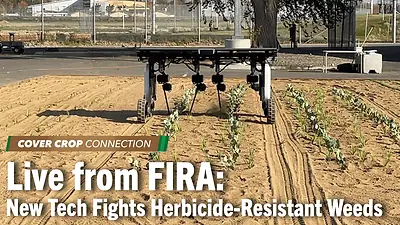
I'm in Yakima, Washington this week at FIRA USA where there's always lots of great ag technology on display. Why don't we go take a look at the newest edition of the Aigen robot. We'll hear from Kenny Lee, the CEO of Aigen.