A fair question for row crop operations is what happens to corn yield when planting gets pushed back behind a legume cover. The short answer from MSU trial data: delayed planting dates can reduce yield, but the mechanism matters more than the delay itself.
In much of the Southeast, the yield penalty from delayed corn planting is driven primarily by pushing pollination and grain fill into hotter late-summer conditions — not by cooler soils at planting. By late April in Mississippi, cover crop residue generally does not hold soil temperatures meaningfully below bare ground levels observed earlier in the month.
The practical implication is that shorter-maturity corn hybrids may align better with delayed planting windows in legume-based systems. Rather than accepting a penalty by planting the same hybrid later, selecting a hybrid calibrated to the actual available growing season is a management lever. In dryland environments especially, the hybrid selection question and the nitrogen timing question are worth working through together.
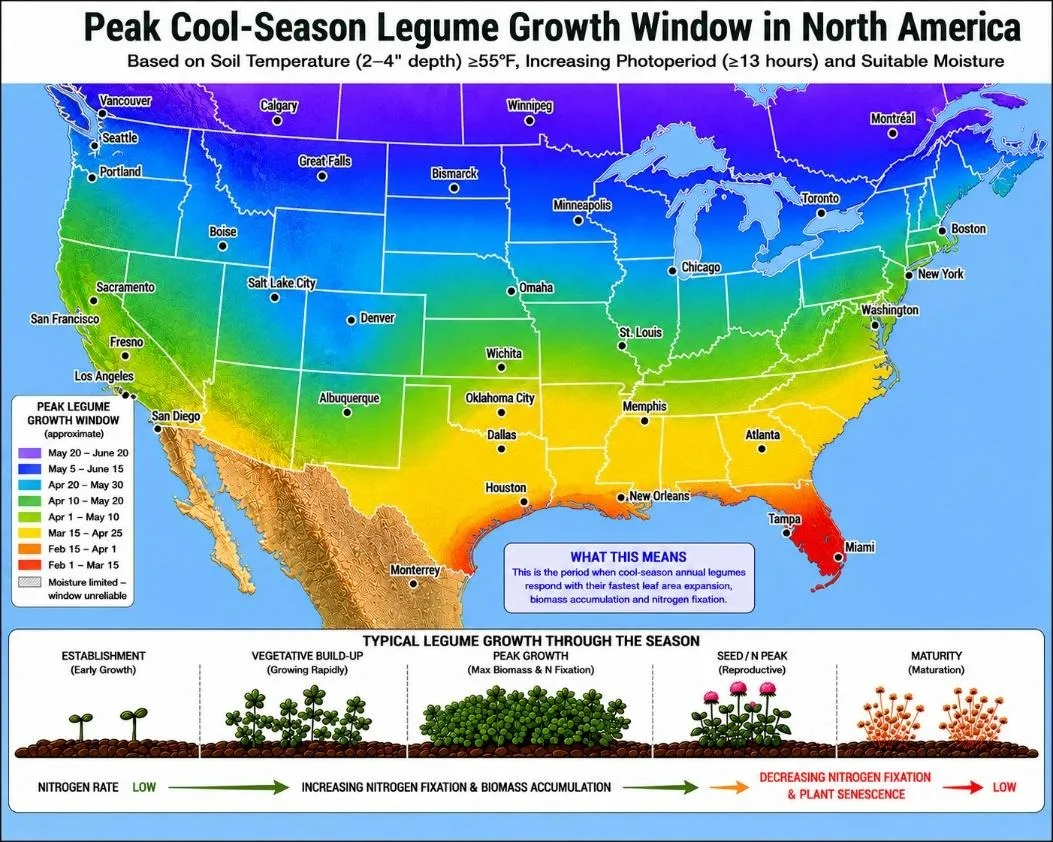
It is also worth noting that the nitrogen data above represents optimal fixation — full-season growth through initial bloom. Early termination to accommodate a planting window reduces the nitrogen yield from the clover proportionally. Timing termination to coincide with, or just after, first bloom captures the most nitrogen fixation without sacrificing too much corn planting flexibility.
One practice used to increase legume biomass and nitrogen production is "planting green." Under this approach, corn is planted directly into a living cover crop, which is terminated shortly before or after planting. Allowing the cover crop to continue growing during this period can increase biomass production and, in the case of legumes, nitrogen accumulation. Planting green successfully often requires careful planter setup and residue management. In high-residue systems, growers may utilize row cleaners, additional downforce, or alternative closing wheels to maintain consistent seed placement and emergence.
To learn more about how to use legume covers, read the article “Annual Legumes: More Than Just Free Nitrogen” featured on Cover Crop Strategies.