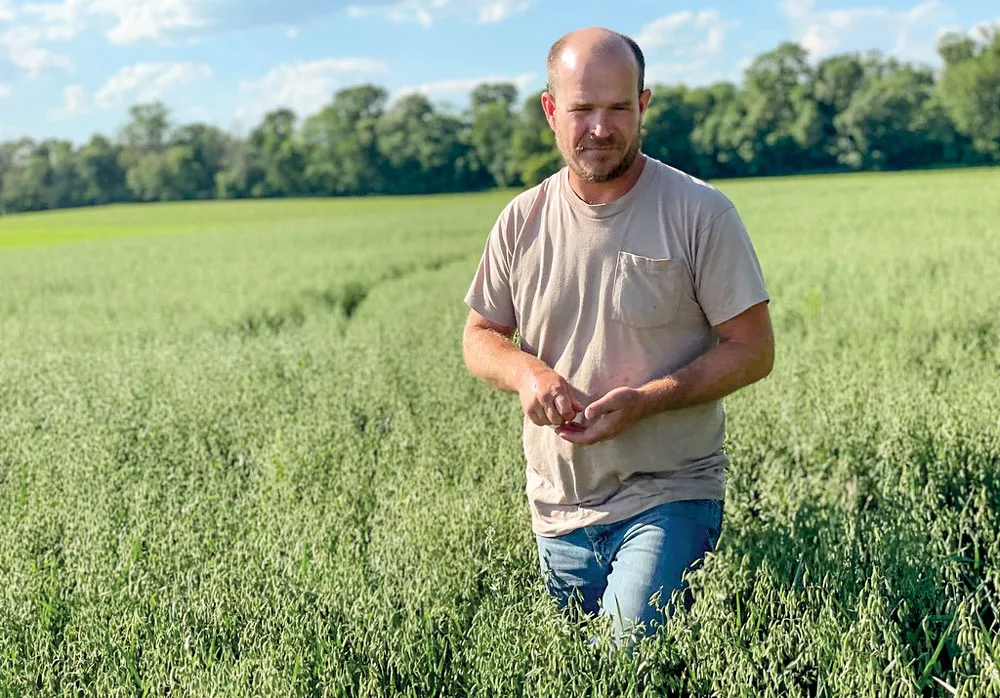
Martin Larsen (Byron, Minn.)
When advocating to other farmers to incorporate nitrate-reducing management strategies, it’s important that I’m able to provide first-hand knowledge. If I can be successful with a practice, I can convince them and help them become successful with the practice, too.
For me, adoption of some conservation practices took a little nudge from nature. I first started farming using my own money in 2010. In 2013, a May snowstorm resulted in half my acres being prevent-planted due to excessive moisture. It was my first experience with cover crops.

DEEP IMPACT. In the Karst geography, farming practices above can have a dramatic impact and relatively (geographically speaking) immediate impact on the water systems below. Martin Larsen
The following year I tried no-tilling some of my crops into the covers. It went well, so in 2015 I went full no-till and haven’t looked back. The only tillage my farms see is some rare vertical tillage on my very heavy clay soils or in compacted headlands.
In 2018 I trialed some food-grade oats on the farm. This was a familiar crop that I’d seen my grandfather and father grow in the past. I quickly found I enjoyed the crop and that it had potential. By 2020 I had ramped that rotation up to a full third of my acres. There are many benefits, but a significant factor was the impact oats and other small grains can have on nitrates.
In areas where corn and soybeans make up the whole of the rotation in a Karst system, nitrates in ground water are overwhelmingly found to be well over the drinking water standard of 10 parts per million (PPM). Studies show the easiest way to reduce nitrates is to have a cover crop, expand the crop rotation to include a small grain, and/or change how you farm, namely no-till.
By implementing these practices we’ve been able to lower nitrate concentrations in our tile lines and in the wells my family drinks out of by 30-40%. What’s more is these practices have helped create financial stability on the farm.
This content is part of the article "Oats, No-Till & Covers Deliver Benefits Above & Below" from the June 2026 issue of No-Till Farmer.