The following is part of a feature article from the No-Till Farmer May 2026 Conservation Tillage Guide. Read the full article at no-tillfarmer.com.
On Dry Ground
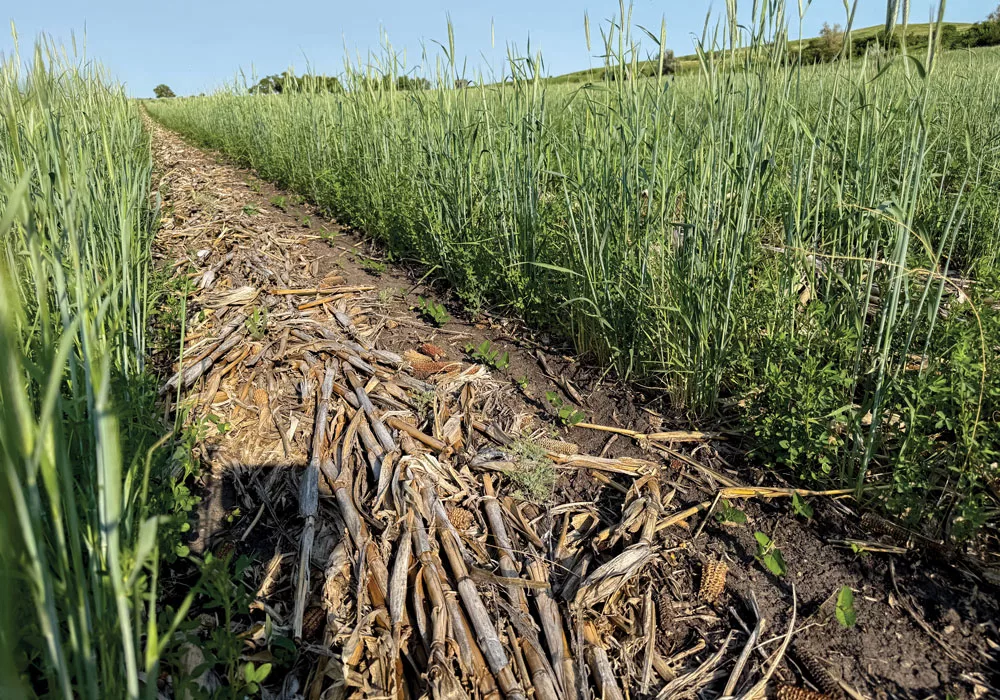
Cold, wet soil was my biggest challenge back in 2006. Even after 20 years of no-till and soil structure building, conditions at planting were often frustrating at best. I switched to bigger tires and even tracks on equipment. I started strip-tilling to deal with the mat of moisture when planting corn into wheat stubble. When possible, residue was left standing to prevent making a mat.
I’m happy to report that tremendous progress has been made in that department. At the time of the article, I was just starting to tile some of my ground and was dabbling in cover crops. Both have since proven essential to creating a system that works on multiple levels.
Saline seeps are a significant problem in this area. We live along an elevation change and have mineral-laden water. It soaks down from the upper elevations and exits where we are farming. The result is areas of fields that don’t produce. Those areas, which also usually have heavy clay soil, are where we focused tiling efforts.
Tiling really saved my no-till program. The cold, wet soils with the weather patterns we were having were really putting a strain on no-till. Once I tiled some of those troubled acres, I had much better luck with water management. I also started to experiment with cover crops.
The combination of cover crops and tiling helped remediate the saline areas. They went from not growing anything to being some of the most productive areas on the farm. That’s in part because they went for years receiving fertility but not producing any crop. Tiling helped move the water, and cover crop mixes got the soils functioning again.
It did take some trial and error, though. Initially I was growing cover crops that were good forages, as we had livestock at the time. It turns out that cover crops that are good forages aren’t necessarily species that are adapted to poorly drained, high salt, high pH, poor soils.
When I started adding brassicas and more cereals to the mix I started seeing progress in the saline areas and the soil was slowly remediated.
Warming Up
Success with cover crops pushed me in the direction of more plants, less tillage. I didn’t want to have to strip-till or run a harrow. This led me to experiment further with ways to get more roots in the ground.
I want a variety of roots and for there to be living roots for as much of the year as possible. The challenge, of course, is getting plants established and working with your crop rotation.
The easy place to start cover crops in my system was to seed them in July after winter wheat harvest. There was always some volunteer wheat, but it wasn’t consistent and it wasn’t diverse.
I found if I planted a diverse mix by August, they would grow enough forage for grazing later in the year and would help soak up moisture in spring. As opposed to the bright, reflective wheat stubble, the cover crop produced a dark, light-absorbing residue that helped warm the fields the next spring, allowing me to no-till into those acres earlier than before.
This is a proof of concept that led to bio strip-tilling. The Conservation Cropping Systems Project (CCSP) research farm at Foreman, N.D., that I work with had seen consistent yield bumps with strip-tilling in heavy residue.
I was intrigued, but our goal was to reduce tillage. The manager came up with planting covers in rows in the fall that you would plant directly into in the spring. I’ve been bio strip-tilling for 10 years now and it’s a pretty good practice if you can manage it.
Just like traditional tillage or strip-tillage, there’s a window of opportunity you have to hit. Fava bean has proven to be an excellent bio-till crop ahead of corn. I will plant strips of fava beans into cereal stubble. Ideally, the fava beans will grow 12-18 inches tall before a killing frost.
The beautiful thing about fava beans is when they die, they turn a dark chocolate brown, and the leaves fall off and lay at the base of the plant. The dark color actually results in higher soil temperature the next spring, just like traditional strip-till.
It can change the soil temperature at corn planting by 10 degrees. It also provides additional nitrogen (N) rich biomass that breaks down very quickly and is readily available to the corn plant.
Continue reading the full article "Forty Years of Less Tillage, More Plants" on No-Till Farmer.