Global crop protection company Syngenta plans to stop making paraquat, once a leading burndown herbicide in the early days of no-till farming, by the end of June.
Production will be phased out at Syngenta’s Huddersfield, U.K., site, the company’s only manufacturing facility for the active ingredient globally. A small scale, multi-product production unit at the site will also close.
The company says its decision involving paraquat, or gramoxone, is due to “significant” competition from generic producers around the world, which has eroded Syngenta’s competitiveness in the production of this herbicide.
Syngenta said its decision is in line with its “focus on innovation, and its commitment to bring new solutions that elevate the productivity and sustainability of agriculture,” said Mike Hollands, head of Syngenta global production and supply. “This decision is about focusing our resources where they deliver the greatest value for our business and our customers.”
Syngenta brought paraquat to the market more than 60 years ago and today is a generic herbicide registered for sale by more than 750 companies. The company sells paraquat in only a few markets globally and it accounts for less than 1% of Syngenta’s global sales, the company says.
In 2024, Grupo Duwest, leader in development and distribution of agricultural inputs in the Mesoamerican region, acquired from Syngenta assets related to paraquat for Mexico, Guatemala, Belize, Honduras, El Salvador, Nicaragua, Costa Rica, Panama, Dominican Republic, Colombia and Ecuador.
Syngenta says it will work with its partners, customers and employees in relevant markets to ensure a smooth transition.
The news follows EPA Administrator Lee Zeldin’s announcement in January that the agency planned to re-evaluate the safety of paraquat, which is the subject of several lawsuits alleging that it causes Parkinson’s disease.
Zeldin said his agency’s goals were aligned with that of the Make American Healthy Again movement, which has been highly critical of herbicides used in the country’s food system.
Zeldin said, “any pesticide on the market used to eliminate weeds, germs, diseases, or bugs must meet the HIGHEST standards of safety, grounded in the best available gold standard science."
"EPA is requiring paraquat manufacturers to thoroughly prove that current uses are safe in real world conditions. If they cannot meet that standard, decisive action will certainly follow.”
Agri-Pulse reported that in November, the agency asked manufacturers for additional data on the product after a new vapor pressure study showed, “there is greater uncertainty regarding the potential for paraquat to volatilize than previously considered.”
The EPA in 2024 rejected the association between paraquat exposure and Parkinson's, although nearly 6,500 pending cases are included in a multi-district case that alleges a connection, Agri-Pulse reported.
At the time, Syngenta said in a statement that the company, "rejects the claims of a causal link between paraquat and Parkinson's disease because it is not supported by scientific evidence.
“Despite decades of investigation and more than 1,200 epidemiological and laboratory studies of paraquat, no scientist or doctor has ever concluded in a peer-reviewed scientific analysis that paraquat causes Parkinson’s disease. Our view is endorsed in science-based reviews by regulatory authorities, such as in the U.S., Australia and Japan.
Syngenta again this month affirmed that paraquat is, “safe when used in line with registered label instructions.”
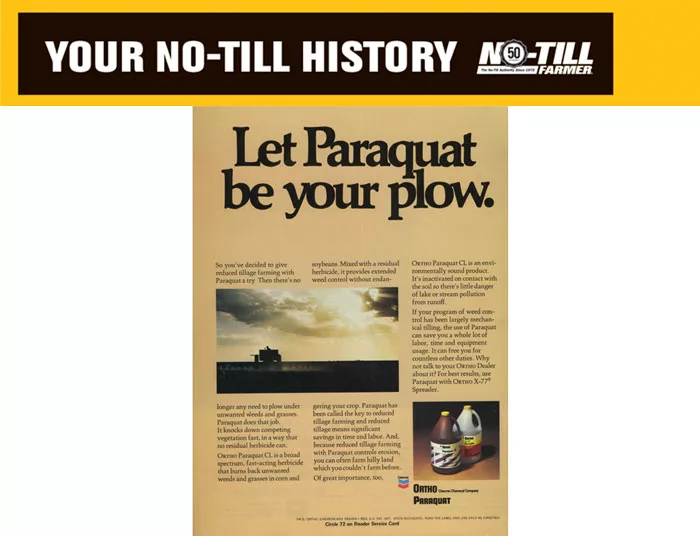
When No-Till Farmer was launched in 1972, paraquat was the No. 1 burndown herbicide on the market, although it lost much of its popularity to glyphosate when it emerged in the 1990s, according to a history of the herbicide’s early development published recently.
The product was Invented in the U.K. in 1955, and Imperial Chemical (ICI) licensed the formulation to Chevron Chemical Co. By the early 1960s, paraquat was used to control the weeds around U.S. orchard trees and beside oil tanks, buildings and railroad right of ways.
California-based Chevron Chemical discovered a new market after noticing large volumes of paraquat shipments into Kentucky, an odd region for an orchard-related product. A Chevron marketing manager attending a New York conference was told to add a day onto his trip to take a look before flying home. What he saw in western Kentucky caused him to delay his flight home by a few more days.
An ag retailer took him out to the farm of Harry and Larry Young in Herndon, Ky., (the first-ever commercial no-tillers in 1962). The brothers had hit on the idea of using paraquat as a burndown contact herbicide to control anything growing prior to no-tilling their corn and soybeans.
This chance encounter led to Chevron and ICI soon becoming major players in no-till. They started working toward a paraquat herbicide label for no-tilled corn along full-season and double-cropped soybeans.
Paraquat inhibited photosynthesis on a wide range of annual grasses and broadleaf weeds, and on the tips of perennial weeds. Further, it was fast-acting, rain-fast within minutes and was partially inactivated upon contact with the soil. These benefits, as cited in two mid-1960s research works on “plow-less agriculture,” led to paraquat’s key role in the development of no-till farming.
Due to problems with widespread glyphosate resistance in weeds, paraquat was getting a few new looks again from no-tillers.For additional reading, see: