
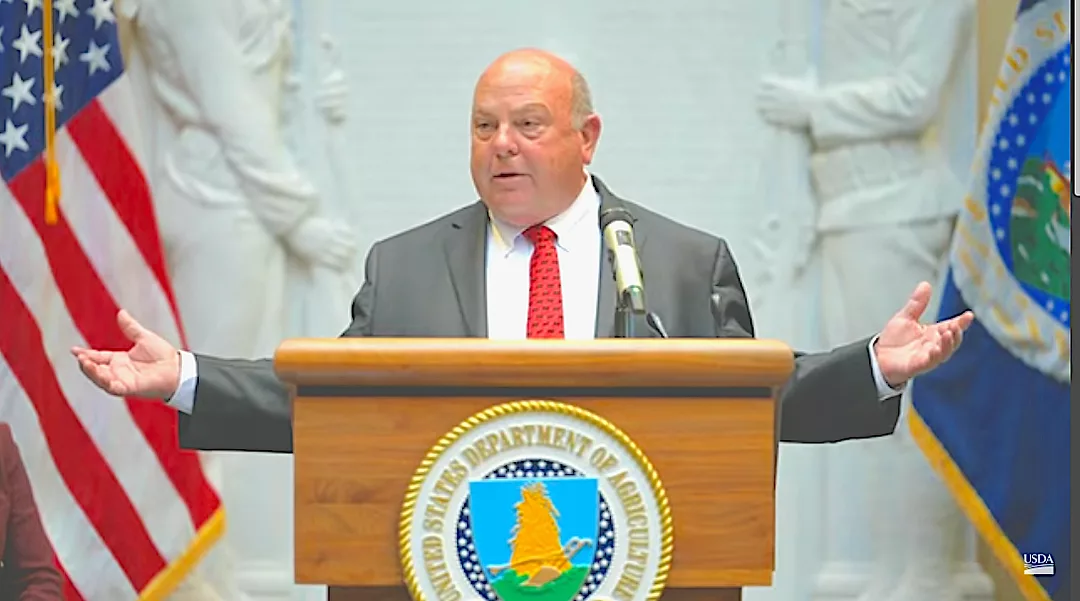
WASHINGTON — With the U.S. ag economy struggling mightily, stakeholders who gathered in Washington Tuesday to celebrate National Ag Day lamented major legislative reforms passed last year by lawmakers but acknowledged major challenges farmers are still facing.
A new USDA report released recently says less than 6 cents of every food dollar consumers spend reflects the value of raw agricultural commodities, with the rest tied to supply chain transformation and delivery to stores and restaurants.
Over the last 4 years, the cost of doing business for farmers and ranchers has skyrocketed, with fuel costs going up 33%, seed cost increasing by 19%, fertilizer up by 48%, labor 44% higher, and interest expenses increasing by 70% during that span.
American Farm Bureau Federation President Zippy Duvall said farmers raising food for U.S. families feeds the “economic engine” in rural America and provides a degree of national security, as many countries in the world cannot fully feed themselves.
“But right now, there’s a heavy cloud hanging over rural America,” Duvall added, striking a serious tone as he addressed farm leaders about shrinking crop prices and skyrocketing inputs. “We’re in a generational storm that’s been brewing for a long time.
“I say generational storm because some of those prices are at 1975 levels. What if your paycheck reflected a paycheck from 1975? That’s what farmers are facing today — falling income, and so many of our family farms that just can't keep going. This is the fifth consecutive year that farmers are going to see declining income, and it is very, very difficult. We must make changes now to bring certainty to farm country.”
Rollins highlighted efforts made in Washington to distribute billions in economic aid to farmers in a timely manner, streamline the USDA’s bloated bureaucracy and reach 18 new trade deals after seeing none approved during the Biden administration.
Reforms passed via the One Big Beautiful Bill eliminated the death tax, approved immediate 100% depreciation and small-business expensing and increased reference prices.
A new Farm Bill is now under consideration on Capitol Hill, although it faces an uncertain future, and Rollins said the U.S. trade deficit has been cut in half to about $25 billion since the change in administrations. H2A wage reform rules have also been passed that may save farmers up to $2 billion a year, she noted.
Rollins also announced Tuesday the launch of a national public awareness campaign to inform meat, poultry, and egg producers of the “Product of USA” voluntary labeling standard which went into effect on Jan. 1.
Under this standard, the “Product of USA” label is reserved exclusively for meat, poultry, and egg products from animals that were born, raised, harvested, and processed in the United States.
The claim is voluntary, but companies using it must meet this transparent and verifiable requirement. Officials said this ends the prior practice which allowed imported products to carry the claim after minimal processing, “and strengthens consumer confidence by aligning with what Americans expect and demand.”
Rollins agreed farm security is national security and there is still more work needed in Washington to help stabilize the farm economy.
“If we’re not able to preserve this way of life, ensure we are feeding ourselves, and stop reliance on foreign-owned companies and Chinese-owned farmland, then the America as we know it here on our 250th birthday will no longer exist in the way that our founders envision,” Rollins said.
Health and Human Services Secretary Robert F. Kennedy Jr. said he and Rollins are coordinating policy whenever possible, which he believes is unprecedented for the two massive agencies.
“Everything we do is laser focused as our president wants to ensure we have good, healthy food for the American people. And the only way to do that is by having prosperous farms in this country,” Kennedy said.
Kennedy noted when he and Rollins came into office they were handed 453 pages of new dietary guidelines that Biden administration had been working on, “that we were just supposed to promulgate at that point.
“They were incomprehensible. No dietician, no procurement officer, no school, no university, no prison system, nobody is going to read that. And worst of all, they were all written by food industry lobbyists and they reflected the same mercantile impulses that had driven Fruit Loops to the top of the food pyramid, which isn't even a food.
“One of the reasons this is critical for the American farmer is because profits from agriculture are going back to processed food companies, and that’s taking both wealth and power and prosperity away from the farmers. And we are ending that now and giving those profits back to local producers, cattlemen, ranchers and agricultural farmers all over the country.”