
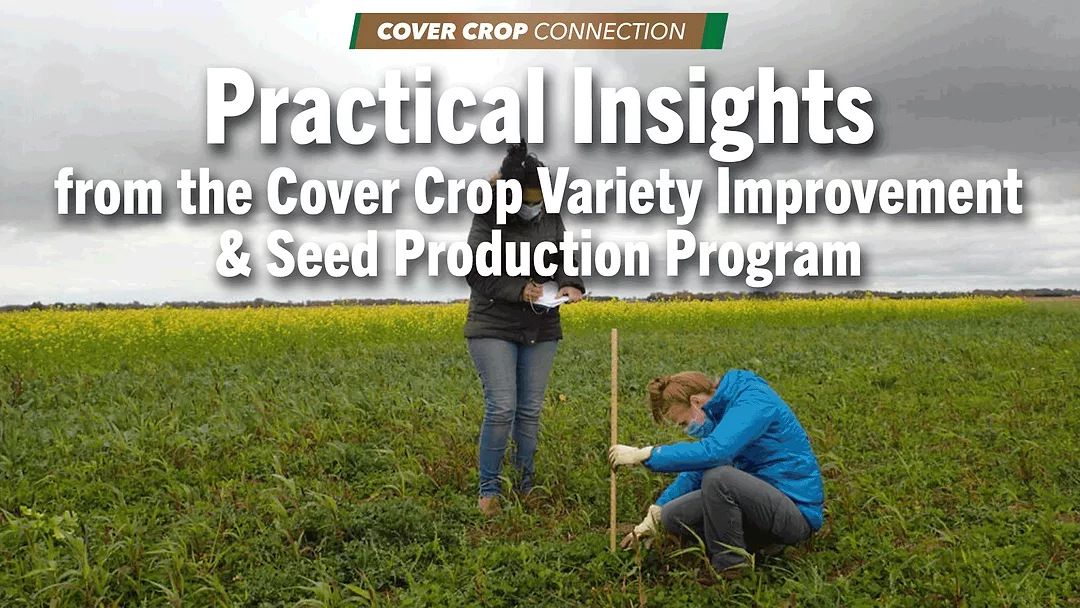
In this video, Etienne Sutton, agroecologist for University of Missouri's Center for Regenerative Agriculture shares a preview of what she will talk about during her upcoming presentation at the 2026 National Cover Crop Summit.
Mackane Vogel: “I'm here today with Etienne Sutton, she is one of our presenters this year at the National Cover Crop Summit. Etienne, why don't you just tell us a little bit about your presentation and give everybody kind of a preview about what they might learn?”
Etienne Sutton: “Sure. So I'll be sharing some of the work that we've been doing as part of our cover crop variety improvement and seed production program. It's based out of the University of Missouri Center for Regenerative Agriculture. But includes collaborators all across the country, ranging from university extension and researchers to the seed industry, as well as a really exciting on-farm component where we're working actively with farmers to test different species and varieties in their fields.”
Mackane Vogel: “Yeah. And I guess what's kind of been, I don't know, one of the biggest surprises or one of the biggest takeaways for you kind of going through the data over the last little bit here?”
Etienne Sutton: “Yeah. So what we've been learning so far from the data is that there are some really strong regional adaptation trends. So when you're thinking about what cover crop species to plant, there are all of these different varieties within a given species. Some of those varieties may be better suited to, for example, the Southeastern US, some are better suited to the Midwest. So those are some of the things I'll be covering in my presentation. And hopefully will be useful to folks making cover crop decisions.”
Mackane Vogel: “Absolutely, yeah. Well, I don't want to give too much away, but it's a great presentation. So hopefully, guys, you're all signed up already. If you're not, be sure to sign up for the fully free, fully online National Cover Crop Summit this year.”