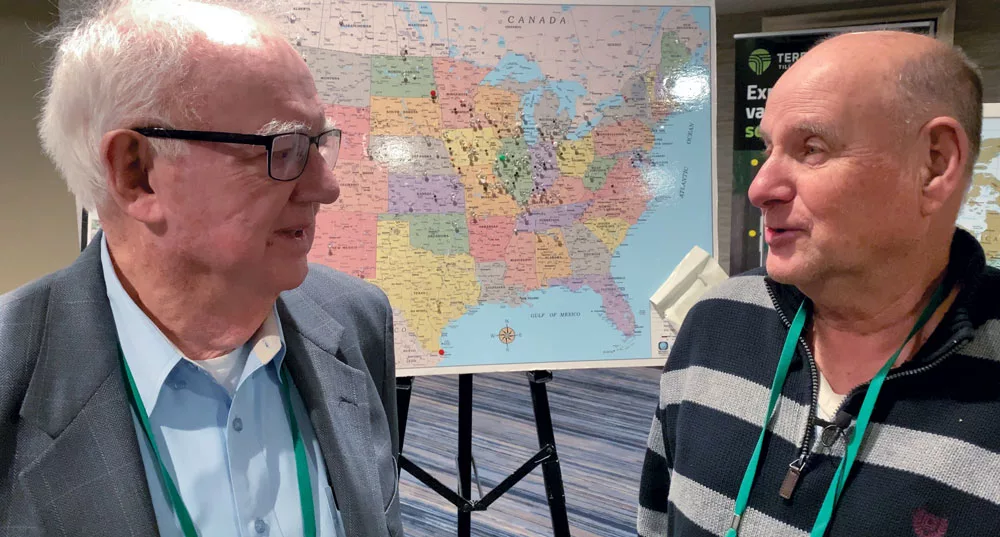
You never know who you’ll run into in the hallway at the National No-Tillage Conference. We crossed paths with Jeff Martin, a longtime strip-tiller from Mt. Pulaski, Ill., and talked about his relationships with landowners and some of his cover crop strategies.
Educating Landowners
Martin currently works with 24 landowners across his 9,000 acres, most of which are rented and strip-tilled or no-tilled.
“Most of the acreage that we picked up in the last 7 years has been from our current landowners, so they’re happy with what we’re doing and the return they’re getting,” says Martin, who used to serve as president of the Chicago Farmers organization. “Communication and education are keys to success. Explain what you’re doing and why you’re doing it. One of the big reasons I went to the Chicago Farmers was to help educate people. There are a lot of people in that area who own farmland across the country and in central Illinois.”
Strip-till, no-till and cover crops are big selling points for Martin. He says many landowners, especially from the younger generation, are interested in soil health and taking care of the farm.
“We talk to our landowners about a dozen times per year on average. Some of the landowners within a 40-mile radius of us, we talk to once a week,” Martin says. “That’s key to helping them understand the benefits of what we’re doing.
“We belong to the Farm Business Farm Management (FBFM) program. They have a graph at the end of the year showing where everyone is, and we might not be the top yield on the graph, but a lot of times we’re the top net profit.”
Diverse Covers
Martin has been experimenting with cover crops for a little over a decade now. The more diversity, the better, he’s learned.
“We started out with just radishes, but now we use a mix of oats, clover, African forage cabbage and a few other species ahead of corn because diversity in the soil is key,” Martin says. “On cornstalks, we’ll use cereal rye, and we’ll throw in radishes or turnips if it’s early enough.”
His biggest challenge is getting cover crops established on soybean stubble early enough to grow before they freeze. Most of his species ahead of corn will winterkill.
Nutrient Availability
Martin says the combination of cover crops and strip-till has been a winner, boosting his soil health and unlocking valuable nutrients from residue.
“We make fall strips, but we haven’t used P and K in 10 years,” Martin says. “Our soil biology is working to make those nutrients available. That’s the key, making those huge amounts of P and K in the soil last us for years. With soil health, we’re making those nutrients more available to the plants.”
Martin is also getting more bang for his buck with a foliar nitrogen product he’s been using for 3 years.
“A third of our nitrogen is going on with the foliar in amino acid form,” Martin says. “It’s more efficient. Four gallons of this product that we’re applying is equivalent to 80 pounds of sidedress (28%) or anhydrous applications. We’ve been able to cut nitrogen down and get the same yields.”
Note: This article originally appeared in the Spring 2026 issue of Strip-Till Farmer.