By Hank McGowan as interviewed by Martha Mintz
Takeaways
- Building C is like pushing a snowball off a hill, it just keeps growing.
- Relay cropping saves two herbicide applications with cleaner results.
- Cattle make covers pay when calves are $4-plus and corn is sub $4.
Carbon is the foundation upon which I’m building a farm I believe will be increasingly resilient, low-input, high-production, and financially and environmentally beneficial.
I want a carbon (C) to nitrogen (N) ratio of 15:1 in my soils, and I’m getting there. When C is high it enables the rest of the systems on our farm to function as they should. The soil will capture and retain more water, soil biology will thrive, nutrients will be released from the soil, crops will need fewer inputs, pests will be less of a concern, and the list goes on.
It sounds simple enough but figuring out how to increase C has taken a while and is only one piece of the resilient farming puzzle. It is a big piece, but not the only one. I’ve come to firmly believe that large applications of humic acid are helping me achieve in a sprint what most people see as a marathon process.
The amount of humic acid I’m applying and how I’m managing my crops after the applications go against traditional recommendations. In the last two years I’ve seen positive results, and I expect the benefits to continue to build in the future as my soil and farming system adjust.
The other pieces of my farm system include no-till, cover crops, relay-cropping, livestock, intensive soil and plant testing, and strategically reducing inputs including herbicides, pesticides, and fertilizers.
Tillage Trials
My father, Jim, and I have farmed together since 1995. He turned 90 last month. Together we’ve worked our way through a lot of farming experiments, some more successful than others. In the case of no-till, it was a success, a disappointment, and a success again.
The land we farm is a bit hilly and rough compared to the farming community surrounding us. No-till made a lot of sense in that we could reduce erosion, build soil structure, and eliminate the time and equipment requirements to make tillage passes.
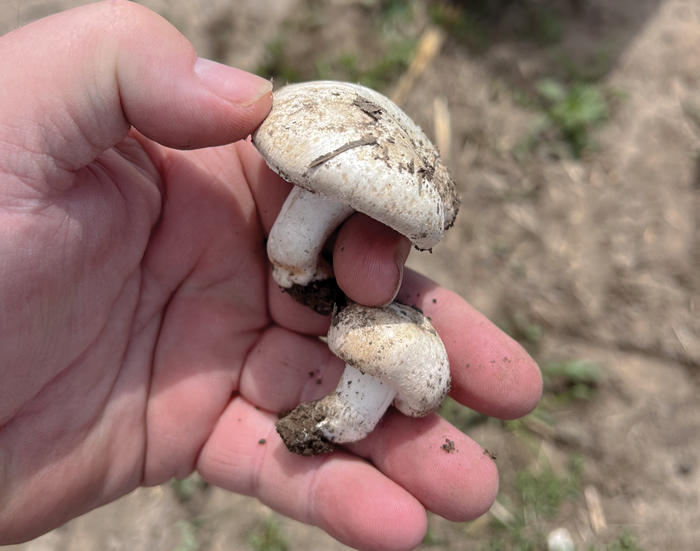
BUILDING BIOLOGY. Carbon is food for soil life including fungi and bacteria. Healthy populations of these organisms — both good and bad — help provide balance in the system. There may be “bad” bacteria and fungi, but they’re better kept in check by the rest of the soil life. Source: Hank McGowan
Over time, however, weeds became an issue. As a result, we started going back and forth between ridge-tilling and no-tilling depending on the crop and conditions. Our fields were gravity irrigated at the time, which increased our erosion challenge. The irrigation system paired with slope, meant even with no-till or soils eroded. Ridge-till was better for weeds, but worse for erosion. Frustrated, we went back to discing for a while, but it just didn’t make sense in our highly erodible fields. We were losing so much topsoil.
In 2020, we secured funds to try cover crops through EQIP and the USDA Regional Conservation Partnership Program (RCPP). With the cost-share on seed, we figured if dad and I each committed 250 acres for three years we could pencil out the purchase of a used no-till drill.
We knew cover crops would help hold the ground, and we wanted additional grazing for our livestock. We run from 200-400 cattle including cow/calf and stockers.
The herd was mostly penned up for calving. We were losing calves in the mud, always fighting health issues, and putting out expensive feed. It was necessary as we don’t want to turn out on grass until June 9 to maintain pasture health. Cover crops seemed like a great solution.
Check The Specs...
Name: Hank McGowan
Location: McCool Junction, Neb.
Acres: 2,000
Years No-Tilling: 5
Crops: Corn, soybeans and wheat
Primary Soil Type: Variable soils sandy-silt/loam
Precipitation: 24-28 inches
Irrigation: Pivot
Livestock: Cow/Calf and Stocker
Dad and I went back and forth on the plan but decided to seed cereal rye in the fall. He wasn’t convinced. In spring, we put 45 pairs out on a ¼-section. The rye was only 4 inches tall and barely out of dormancy. I was convinced there wasn’t enough for them to eat, so I put out a dairy-quality alfalfa round bale in a feeder.
In the span of a month, I watched the calves gain weight faster than I’ve ever seen before. When I pulled the herd May 9, there was still ¾ of the bale left in the feeder. The rye was 4-foot tall and headed out. You couldn’t even see the calves.
We planted directly into the standing cereal rye. It looked rough for 30 days, but the corn came up and got tall and beautiful. Cereal rye can have an allelopathic impact on corn, so we don’t plant it ahead of corn. We’ve moved more to wheat. It doesn’t have near the grazing value, but it opens other opportunities. This year we relay cropped soybeans with wheat.
Running Relay
I think there’s a lot of potential in relay cropping in soil building and keeping a living root in the soil, but it also has helped us save about $80 in herbicide applications.
We drill wheat in fall after corn harvest. That’s a little late here, but it came up in April and did well. I did bump the seeding rate to 2 bushels per acre which is about a ½-bushelI more than normal. I opted for late Group 3 to Group 4 soybeans so they would stay in a vegetative state longer and stay a little shorter so they wouldn’t interfere with wheat harvest. I also chose taller wheat varieties.
“With heavy applications of humic acid you can significantly reduce or eliminate P and K fairly quickly…”
The soybeans were planted the second or third week of April. We had a cold, dry spring, so we didn’t get as much growth on the wheat as we wanted. I used a FlexxiFinger attachment on the combine to push the beans down so they wouldn’t get clipped. It worked well enough, but wasn’t a homerun in our conditions. The stands were impacted on the end rows where we turned around, but in the rest of the field it looks like we got a decent crop.
Part of why we struggled with no-till is that we have a major problem with henbit. Everywhere we’ve planted cover crops, especially cereal rye, we’ve pretty much eliminated the weed and most early season weeds. The only one we still struggle with is palmer amaranth.
When using a cover crop, you can focus on just burning down the cover crop instead of having to put together a chemical concoction to kill the variety of problems.
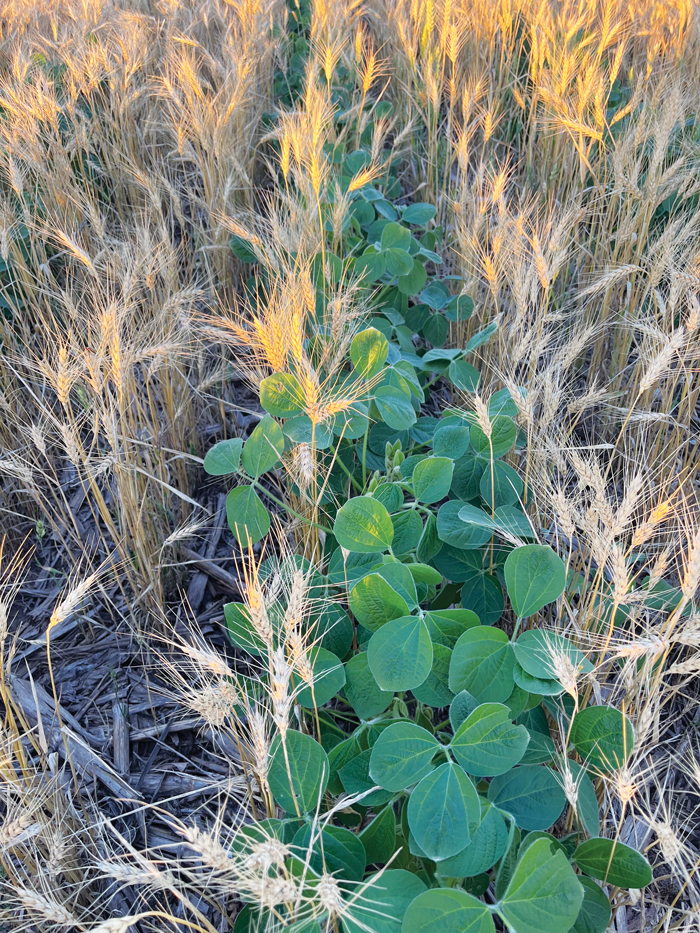
DOUBLING UP. Using cover crops and relay cropping soybeans with wheat have allowed for the elimination of two herbicide passes. It also produces two crops, with the soybeans providing some N to the wheat crop. Source: Hank McGowan
With the relay crop, I eliminated two herbicide passes in soybeans. I used to do a pre-emergence application and two post. Now, I plant herbicide-tolerant soybeans and just make one pass after wheat harvest to get any volunteer wheat and weeds coming up.
The soybeans also start to fix N, benefiting the wheat crop. I’m only foliar feeding the wheat 11-12 lbs. of N. Getting a crop with minimal N while eliminating herbicide applications is an immediate win.
I like relay cropping because it keeps a living root in the soil, provides grazing and a cash crop, and savings in weed control. I think there’s great potential to build soil and C with relay cropping.
Cover crops may not be a perfect fit for everyone, but when you have cattle, it’s a slam dunk because it can be grazed — especially this year with sub-$4 corn and $4-plus calves.
In the five years we’ve used cover crops with no-till, we’ve seen soil organic matter (SOM) increase 1.5% in some places. It’s improvement, but we haven’t seen that translate into release of nutrients tied up in the soil and it’s not moving the needle as fast as I’d like.
Humic Acid
One thing I’m adamant about is that every farmer and livestock producer should be getting humic acid on their soil. I think humic acid has a bit of a bad rap as it’s being applied at too low of rates and not living up to promises of instantaneous results. I think there are very significant benefits to be gained with the right strategy and patience.
Stepping outside the traditional clay colloid soil test is what opened my eyes to the nutrients that are in my soil and made me determined to access them. I started using the Haney soil test and the Total Nutrient Digest (TND) analysis.
The TND analysis shows what nutrients are in my soils whether they’re plant available or not. I found I have 3,500-5,000 lbs. of N sitting in the top 6 inches of my soil. There were also shockingly high numbers of other nutrients including phosphorus (P), potassium (K), Copper (Cu) and more.
“Carbon is only one piece of the resilient farming puzzle. It is a big piece, but not the only one…”
Most of those nutrients weren’t plant-available. Building soil organic matter (SOM) and soil life through no-till and cover crops can help increase C and start accessing those nutrients, but it’s a slow process. Humic acid provides a fast track. I’m 54 years old. I don’t have time to build the soil slowly.
Humic acid contains high levels of C and oxygen (O2). Carbon is the only mineral we can apply to crops with the ability to absorb water. Humic acid also acts as a buffer, moving soil to the ideal pH of 7 no matter if it’s acidic or alkaline. Its properties are also able to facilitate freeing of N and other minerals from being locked to clay colloids in the soil.
Many common recommendations are to apply 5-8 pounds of humic acid per acre, and to apply every year. We tried it that way but didn’t see much improvement. If you want to move numbers in the soil it takes volume. I’m applying at least 100 pounds per acre per year for three years with a long-term goal of applying 450 pounds total per acre.
Humic acid provides a large amount of organic C. The nice thing about C is if you don’t till, you don’t have to keep putting it out in a big volume. I shouldn’t have to continue applying the humic acid after I’ve loaded my soils.
Humic acid is a waste product from coal mining. It doesn’t burn, but it’s loaded with organic matter, C, O2, and some biologicals. It’s worthless for the mine, but a beneficial agricultural product. I use Black Earth, which I believe is the highest quality. They offer three grades of product at various price points. The more expensive grades are treated to help them activate and work faster. I use the highest grade for my first application. At the time, it cost $0.75 per pound.
Some people immediately make drastic cuts to NPK after applying humic acids. That’s a mistake because the process if fast, but it’s not instant. One benefit I did realize the first year was water retention.
Last year I had an irrigation pivot break down on one of the fields where I had applied 100 pounds of humic acid. That quarter got 2 inches of water while the rest of the farm got 8-10 inches during a bad drought. That field was one of my better fields of corn that year. It wasn’t the best yield ever, but it made 200 bushels with only 2 inches of water. The C from the humic acid helped keep more water in the soil and pull that crop through.

Hank McGowan Source: Hank McGowan
I soil test every year. The soil test prior to applying humic acid indicated I had 70 lbs. of N available. I applied 120 lbs. of N and produced a 200-bushel crop. At 0.8 lbs. of N per bushel, that should have made 237-bushel corn without the drought. There should have been some N left over, but soil testing the next year showed 126 lbs. of available N in three of the four places I tested. That’s significantly more than what we would have expected.
I didn’t apply any P or K, and those numbers also went up. They doubled or more. In my experience, with heavy applications of humic acid you can fairly quickly significantly reduce or eliminate P and K. When it comes to N, I will back off gradually after giving the soil system time to develop. My soil tests are showing improvement. My C:N ratios are up to 13:1 in some places. I’m not quite there, but I’m getting there.
The most N I put on my corn this year was 157 lbs. It’s just as green as the guys that are applying 250-plus pounds. I’ve also noticed that there aren’t any yellow spots that usually show up in August on the clay field. I’ve noticed that you see a faster response in poor soils than in good soils.
Many will say you can’t change the CEC of a soil. I beg to differ. Humic acid denatures the charges in the soil, enhancing the ability of the minerals to donate and receive electrons. It also feeds the fungus and bacteria that keep developing the soil. Building C is like pushing a snowball off a hill. Once it gets started the system just keeps growing and growing.
Beyond water retention, we’ve also noticed how mellow the soil is after using humic acid. Our planter as automatic down pressure. Just two years ago we had issues getting enough down pressure for consistent planting. Just 15 months later, we have zero issues. The ground is noticeably softer.
The guys that install my water sensors says he loves my fields because the sensors push right into the soil.
Soils that are functioning with a rich and diverse population of soil life produce plants that are healthy and more resistant to insects and disease. I haven’t used fungicide in six years. I think this is a direct result of the increase in C in the soil.
This article originally appeared in the October 2025 issue of No-Till Farmer.