In the epicenter of the 1930s Dust Bowl, no-tiller Nick Vos has spent 15 years of trial and error figuring out how to use cover crops to prevent another Black Sunday, while also raising profitable cash crops in a desert environment.
Vos, who lives in Hugoton, Kan., farms 986 acres in southwest Kansas and the Oklahoma panhandle. Three pivots cover about 350 acres, and the rest of the operation is dryland. The U.S. rainfall map reports 12-16 inches of rainfall annually for the area, but Vos says precipitation is not very consistent.
“Last year we had 12 inches in one night,” Vos says. “The year before, we had 22 inches in six weeks, and the 2 years before that, we had 5 ½ and 6 inches. It’s a pretty extreme area of farming.”
Vos says he can raise a crop if he gets 12 inches of precipitation through the rainy season, but that hardly ever happens. Evaporation also hurts his chances at raising a good crop. The area has an annual evaporation rate of 90-100 inches per year.
“At 12-16 inches of rainfall with 90-100 inches of evaporation, covering the soil and lowering the temperature of the soil is a big thing,” Vos says. “That's one of the reasons why we're not big fallow fans.”
Instead of fallowing, Vos and a few other farmers in his area use cover crops to capture moisture when it’s available.
“Moisture is king for everyone, and the myth is still that cover crops use moisture,” Vos says. “They do, but there’s more to it than just that. Cover crops use the moisture when the moisture is there.”
More Rotations
Vos’s operation has more than 15 commodities: corn, sorghum, wheat, barley, triticale, rye, soybeans, cow peas, forages, alfalfa, cover crops for grazing and non-grazing, camelina, pinto beans, commercial and stud dorper sheep flocks, and stud Kalahari Red goats.
“What makes our journey different is we are first generation, which means we don’t have a whole lot of room for mistakes,” Vos says. “Half our farm is non-irrigated acres, which is very unforgiving in this area. It could be wet with 2-3 inches of precipitation, and then it could turn to 105 degrees F with 40-mile-per-hour winds. Within 2 days, all that rain is basically gone.”
Vos limits the cost of production on his dryland acres to $100 per acre at most because of actual production history (APH) and transitional yield (T-yield). He takes a systems approach, using chemical, physical and biological tools to build resilience and stay profitable. To get the most out of his cover crops, Vos considers the impact rainfall — or lack thereof — will have on his carbon-to-nitrogen (C:N) ratios.
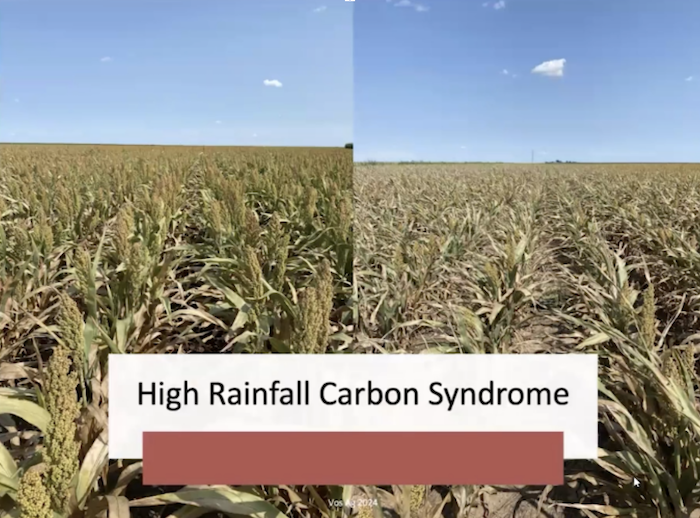
This photo shows a side-by-side comparison of 22 pounds of a basic cover crop mix of 2 brassicas, 2 legumes and 2 grasses (R) to 44 pounds of the same cover crop mix (L) in a field in Texas. The difference in the seeding rates of the mix was due to operator error. On the left, the consequence of the heavier residue showed up in the cash crop the next year. The milo that followed the 22-pound mix made yield, while the milo following 44 pounds did not. To Nick Vos, a no-tiller from Hugoton, Kan., the error illustrates the importance of managing carbon-to-nitrogen ratios in dry environments. “We ran out of moisture and nitrogen because we had too much carbon to digest,” Vos says. “This is what I call the high rainfall carbon syndrome. The cover crop was very detrimental to the cash crop.”
“The most important soil health principle for us in the desert is C:N ratios, which affect our cycling, N availability and reserve moisture,” Vos says. “If we don’t manage it, it will hurt us in the cash crops.”
He cites a statistic that root exudation builds organic matter 5 times faster than residue. Roots are also 90% water, he says, so the roots plus their rhizosheaths add moisture to his dry soil.
“Carbon can kill you in a dry environment,” Vos says. “If you grow too much carbon and you don't have the moisture to decompose it, you’re going to have a wreck on the cash crop the next year. You’ll still have a lot of residue, and you're going to run out of N and moisture.”
Vos says he doesn’t have an ideal C:N ratio, as it’s a guess as to how much growth he’ll get from the cover crops based on rainfall. In years with more moisture, dorpers and goats are a tool for Vos to control the C:N ratio. Grazing them on the cover crops helps balance carbon in the drier areas and terminates the mix without chemicals.
“Carbon can kill you in a dry environment...”
“Be timely in managing the carbon factor so you don't grow too much carbon if there's a drought predicted for the next year,” Vos says. “Also, plan your C:N ratios. If you're going to soybeans, you can handle more carbon because you're going to have a high N crop following that. If you're going to go to corn, you want a lower carbon crop because you don't want to have too much carbon going back to carbon.”
Making Mixes
Vos recommends first starting with a basic cover crop mix that includes a grass, a legume and a brassica to prime the system for increased diversity of species. In Nebraska, he uses sorghum and millet for most of his grasses and sunn hemp and cowpeas for the legume. Radishes are a favorite for brassicas added to the mix, but he also uses turnips and hybrid rape. He typically uses a 10-15 pound per acre seed mix that’s 50% grass and 50% legumes, with about 2 pounds of each species of cover crop.
“Last year, I raised 4,400 pounds per acre of a cover mix, and it was perfect,” Vos says.
Vos drilled that mix 2-3 inches deep in July 2024 after getting rain. The mix frosted out in November and the radish froze out in January. A cover crop analysis report showed the mix produced 105 pounds of N, 16 pounds of phosphorus (P), 229 pounds of potassium (K), 57 pounds of calcium, 18 pounds of magnesium and 39 pounds of sulfur per acre, plus smaller amounts of zinc, iron, manganese, copper, boron, molybdenum and aluminum.
“Plan your carbon-to-nitrogen ratios…”
He also conducted a Haney soil test at the same time, which showed 36 pounds of N and 16 pounds of P as available. With that much N and P going back into the soil, Vos no-tilled a summer cash crop of Milo into the covers.
“Mother Nature doesn’t want to be naked, so she’s going to grow something if you leave it naked,” Vos says. “Anytime we have moisture, we try to feed microbes. You don’t have to put 20 pounds of seed mix out there. Even 2-3 pounds — a few plants per square foot — will do what’s needed to feed the microbes.”
Grazing Cover Crops
Johanna, Vos’s wife, owns and manages the dorper flock, and she grazes the sheep on some of the cover-cropped fields, especially those that are multi-species mixes and grain sorghum.
“We use the dorpers for a lot of wheat management, a lot of fertility management and also to control the C:N ratio on the cover crops,” Vos says.
The sorghum functions as a winter cover crop, and the animals convert carbon from the plant into N through their manure. Johanna usually runs 400 head of lambs over 14 days on 5 acres. Each lamb produces about 4 pounds of manure per day, resulting in about 62 pounds of N, 22 pounds of P and 54 pounds of K by the end of the grazing cycle. Vos says he doesn’t need any fertility for his fields to get by with these numbers.
“The final key in the soil health puzzle is introducing hoof prints and biology with the animals,” Vos says. “There’s a huge root surface increase when mycorrhizal hyphae expand and get nutrients for you.”
The fallow grass aka “normal grass” fields are also used for high-density grazing 1-2 times per year. Vos says the field has 7 species of grass after the grazing, but he’s waiting for some of the better species to come back as the soil improves.
Building on the fallow grass fields are green bridge grass fields, which have a cereal rye cover crop drilled into the fallow. Vos adds the rye when there is enough moisture. The rye is a green grazing residue on pastures, acts as fire suppression and stimulates soil biology.
“There’s a lot of evaporation on fallow,” Vos says. “Anywhere from 70-85% of what moisture you receive in a fallow year is lost through evaporation. What we’re trying to do with cover crops is exchange sunlight for sugar and get trans-evaporation instead of evaporation. We want to use that moisture to grow carbon and roots.”
Balancing the Scale
To balance the C:N scale, Vos encourages no-tillers to avoid over applications and fine-tuning their systems to solve problems instead of dumping on products in an attempt to solve problems. Overapplication in one area leads to shortages in another, Vos says.
“Soil pH self-adjusts when the building blocks of photosynthesis are in proper balance,” Vos says. “Plants form symbiotic relationships that help them access nutrients more effectively. They might alter their physiology to prioritize the use of available nutrients for growth and reproduction. And then over time, plants can genetically adapt to lower pH. If you let them be, they will definitely become tougher.”
Managing inputs also improves ROI. Every farm is different and needs different applications. At the same time, don’t be afraid to try new ideas that could result in a great return on investment.
“Find your sweet spot on your own farm, and don’t be afraid to try things that might bring return on investment,” Vos says. “Put yourself outside your comfort zone on some limited acres, and you’ll be amazed at how much you can learn.”
When Is Tillage Considered No-Till?
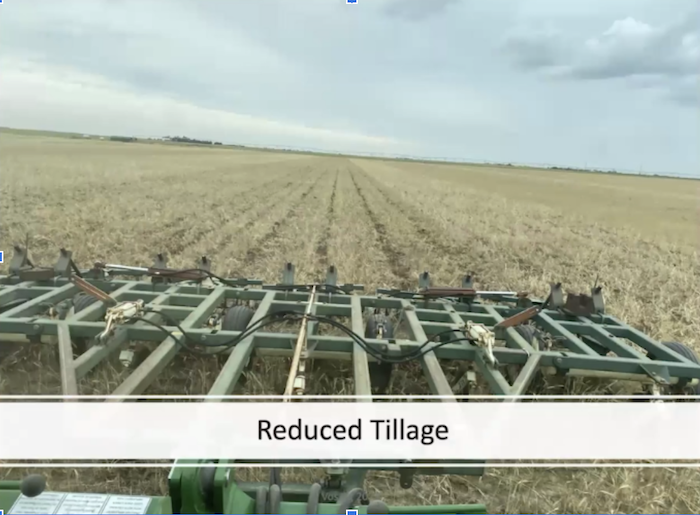
The severe dust storms of the 1930s are a warning to farmers in the Great Plains about the consequences of tillage. Today, some are finding success with sweep plows, also called undercutters, a form of minimal tillage that’s considered no-till on the plains.
Nick Vos, a no-tiller and cover cropper from Hugoton, Kan., says a lot of no-tillers use a sweep plow on their wheat fields ahead of the drill. A single pass per year or one pass in a 2-3 year rotation of wheat, fallow, milo are typical. Wheat tends to grow better after a single tillage pass, Vos says. The sweep plow also helps manage herbicide-resistant weeds in times of drought by cutting them at the roots, while leaving residue in place. He typically runs it 2 inches deep because he’ll come back and drill the wheat at 2 ½ to 3 inches deep.
“I don't have that bulk density problem where the seed sprouts and then has horizontal roots like in vertical tillage,” Vos says. “This has been a really good system for us where we can bring in a tillage pass in the toolbox without making it detrimental. Our infiltration actually is really good behind this.”