Costs continue to rise across the board and that was reflected in farmers’ cover crop programs.
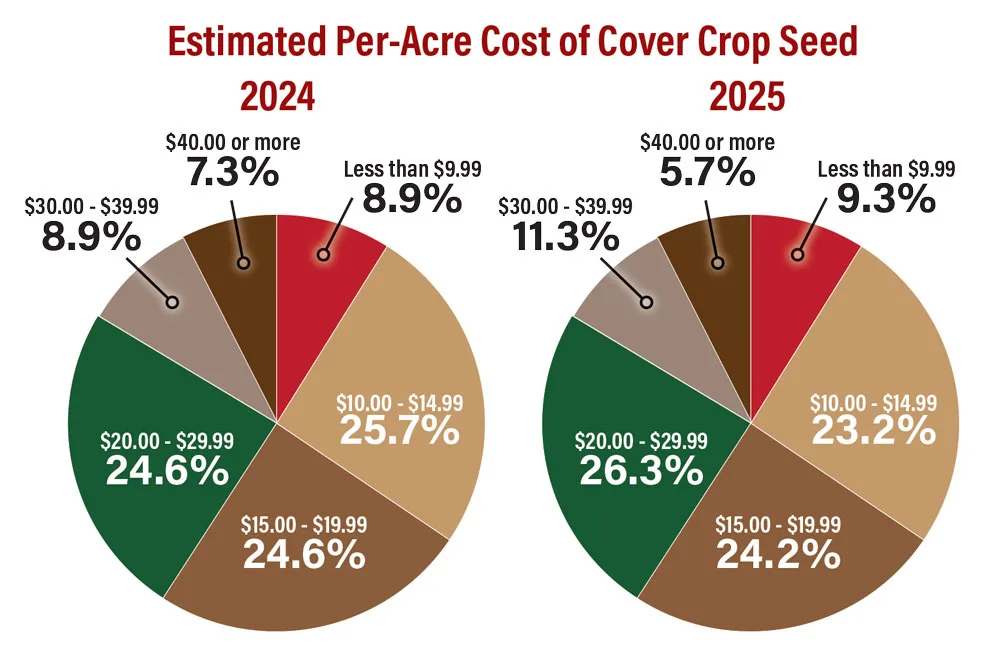
The amount spent on cover crop seed per acre ticked upwards year-over-year. In 2024, the majority of survey participants (25.7%) spent somewhere between $10 and $14.99 on seed per acre. In 2025, the majority (26.3%) spent $20-$29.99 per acre, while those who were in the $10-$14.99 range fell to 23.2%. Just under a quarter averaged in the $15-$19.99 range, while those averaging $30-$39.99 per acre ticked up 2.4 points to 11.3%.
Farmers don’t expect costs to come down soon: 45.1% anticipate an increase of 1-5% in cover crop seed for 2026. However, they’re budgeting to spend even more than that. Growers estimated spending an average $7,835.70 on seed in 2025, but plan to spend an average $8,803.57 for 2026 — a near 12% increase. While that likely reflects rising seed prices, it could also indicate that some farmers plan to expand their cover cropping acreage.
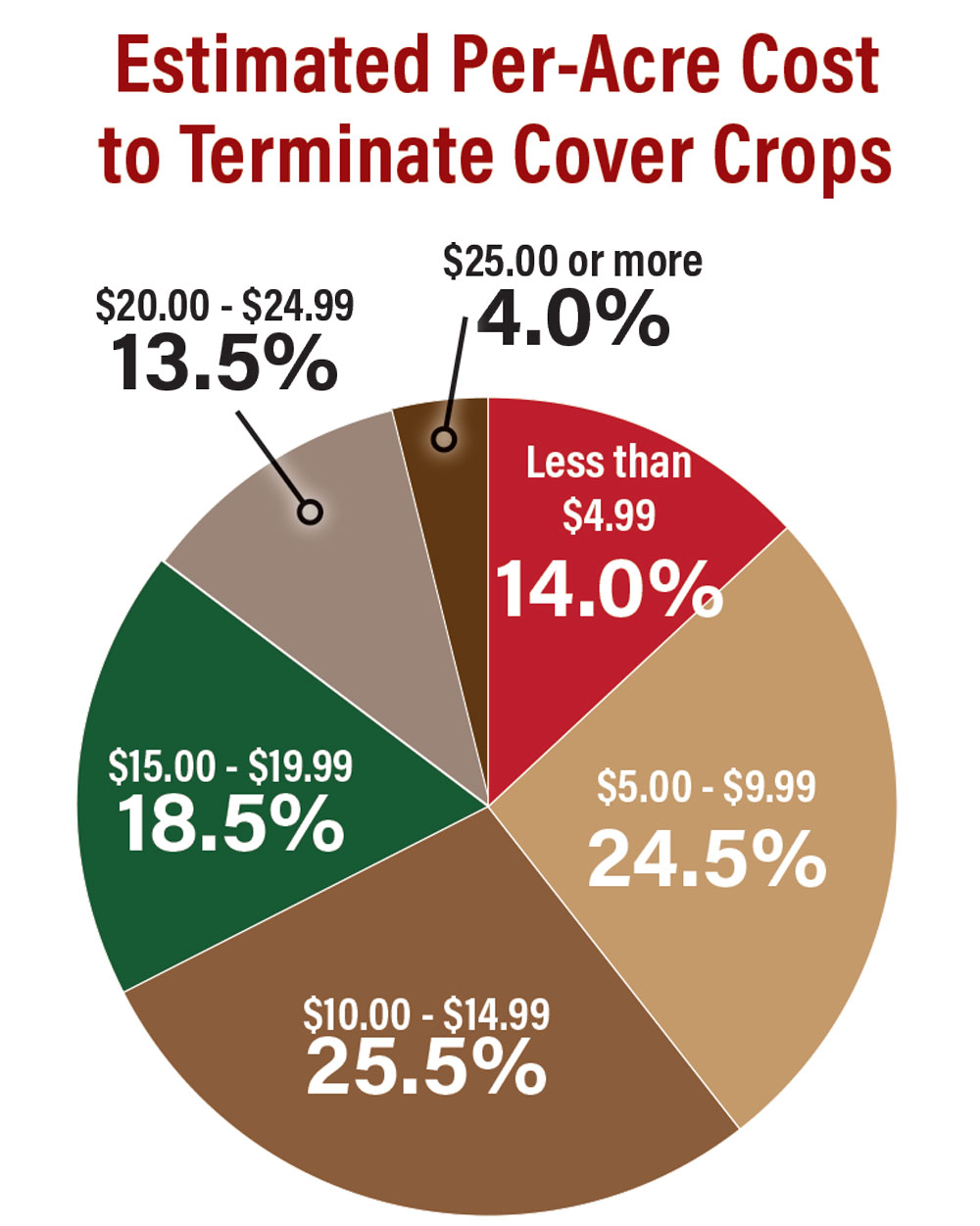
We see a similar trend among termination costs. While most farmers (64%) still spent less than $15 per acre terminating their cover crops, that was down 3.5 points from 2024.
Two-Thirds Received Incentive Payments
Although prices are on the rise, most farmers aren’t carrying the costs of cover cropping alone: 65.8% received some form of incentive payments, up from 63.5% in 2024.
Of those who received money for the practice, most (59.2%) were funded by a federal government program like the Environmental Quality Incentives Program (EQIP) or the USDA’s Conservation Stewardship Program (CSP), up 2.5 points from 2024. Just over a third received payments from the state level (up 5.9 points), while 23.2% were supported by local programs like their Soil and Water Conservation District (SWCD), which was down 2.2 points. Payments from companies and foundations made up 28% of financial incentives, up 2.6 points, while 11.2% of growers received payments elsewhere, down 12 points.
Pesticide Savings Fall, Nitrogen Credits Rise
Increased cover crop expenses may be why farmers saw less per-acre savings in herbicide and pesticide costs from their cover crop programs. The majority (40%) saw less than $5 per acre in savings, similar to 2024, and almost a quarter saw an average savings of $5-$9.99 per acre, up 2.5 points from 2024. But those who realized savings in the $10-$19.99 range fell 6.6 points to 20.5%. Just over 15% reaped at least $20 per acre in pesticide savings, up 3.4 points from 2024.
One area where growers are seeing a financial benefit from cover crops is with nitrogen (N) credits. While most (43.2%) estimated an N credit of 19 pounds per acre or less, that percentage is down 4.1 points from 2024, and those realizing N amounts between 20 and 79 pounds per acre were up. Nearly 28% estimated an average credit of 20-39 pounds per acre, up 2.5 points, and 6.8% believe they reaped 60-79 pounds of N per acre, up 2.5 points. Those in the 40- to 59-pound range were up by just two tenths of a point to 16.7%.
Cover Crops Meet Grower Expectations
Cover crops also pay off in helping farmers reach their soil health goals.
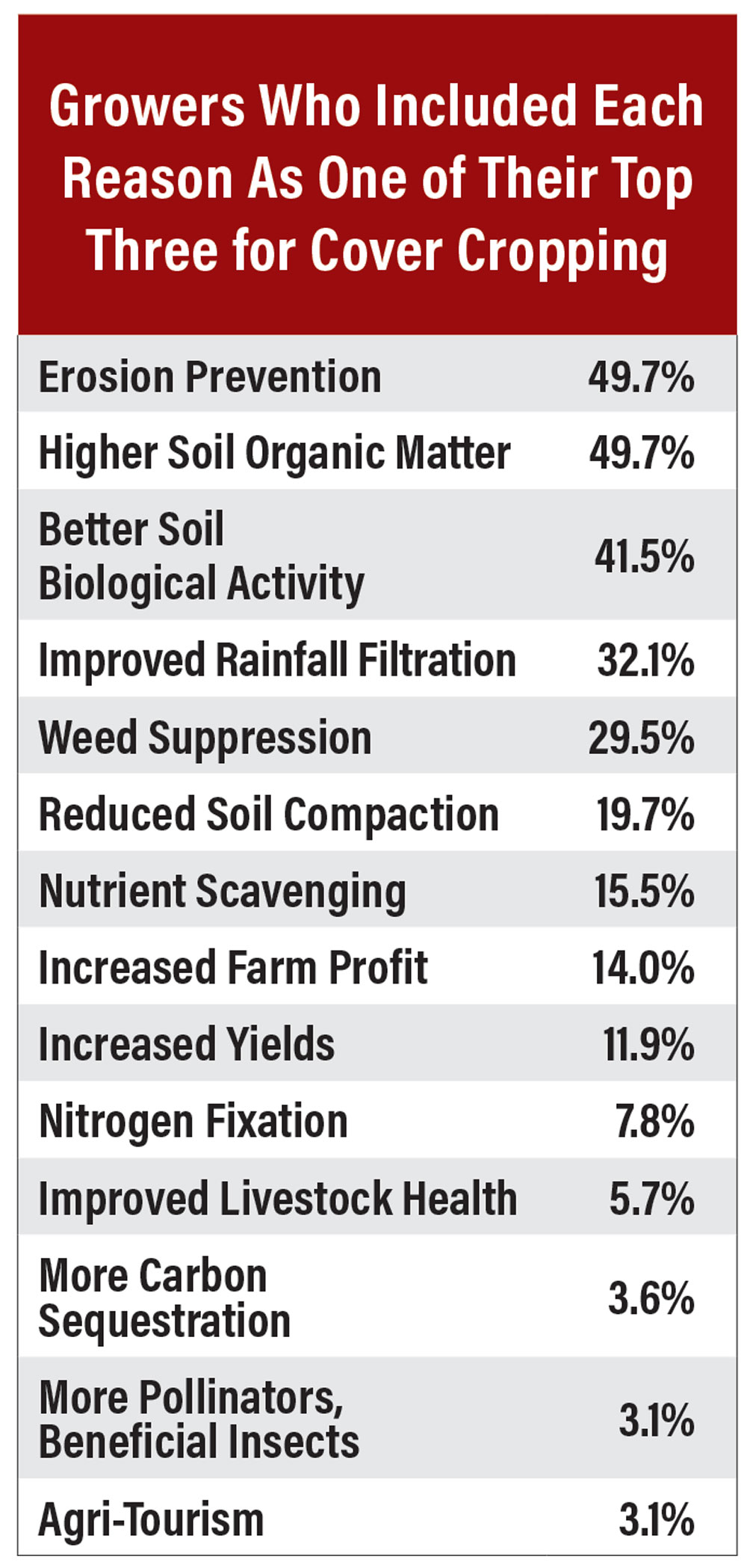
Every year we ask survey participants to rank their top three reasons for the practice and rate cover crops’ effectiveness for various possible benefits, such as higher crop yields and reduced soil compaction. Preventing erosion was once again a top motivator, with half of survey participants including it as one of their top three reasons to raise cover crops, and 29% ranked it as their most important objective. It also proved to be the No. 1 goal achieved: Over 98% of farmers see some benefit in this regard, with 64.4% indicating they experience the maximum benefit in preventing erosion with cover crops.
Increasing soil organic matter tied with erosion prevention as being included on growers’ top three reasons to cover crop, with 17.6% indicating it was their primary motivator. Nearly 93% of respondents said cover crops provide a benefit in boosting soil organic matter content, with one-third finding they offer a maximum benefit.
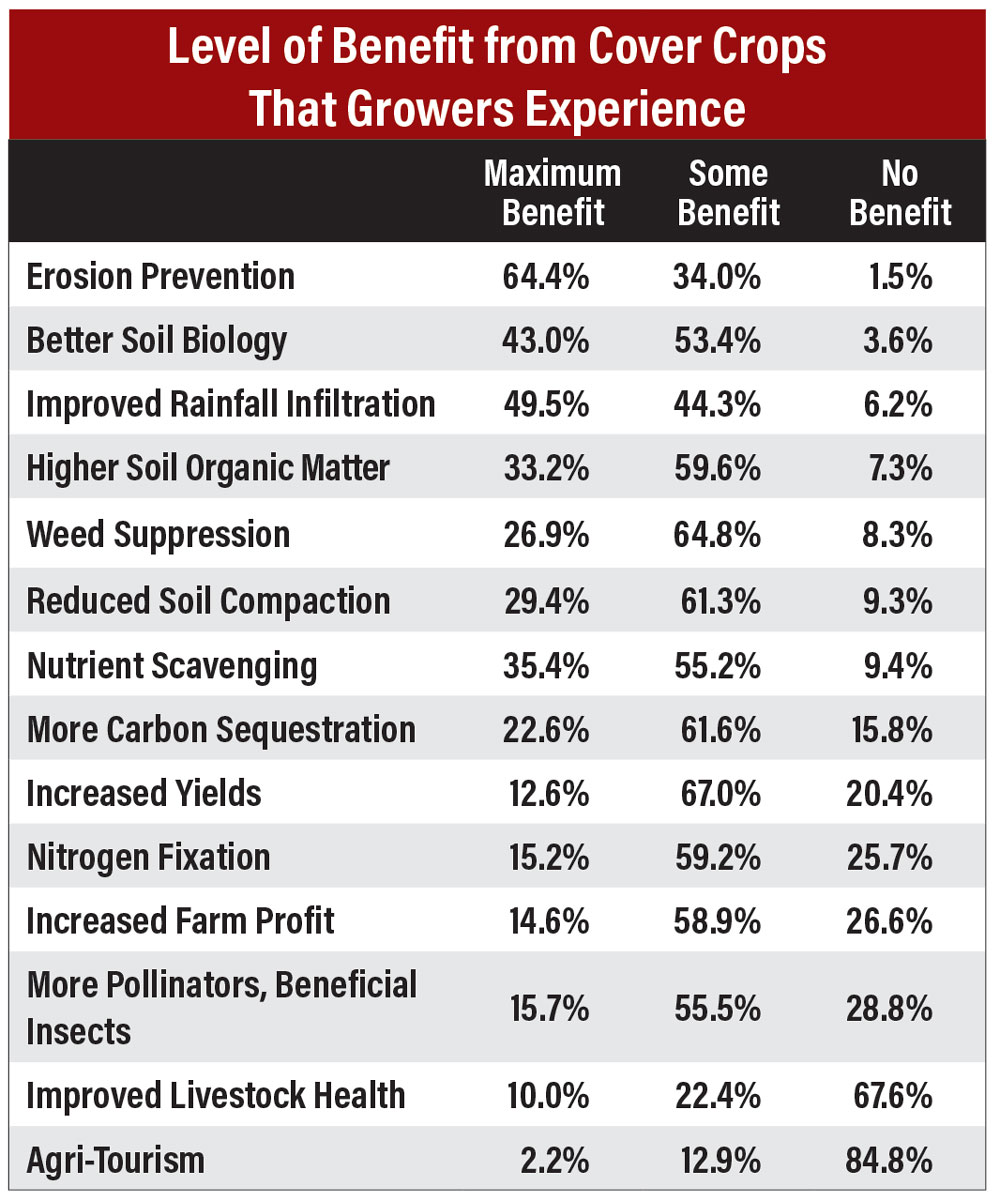
Better soil biological activity came in third as a reason to cover crop, with 41.5% of growers including it in their top three and 15% selecting it as their No. 1 objective. It also ranked second overall in terms of cover crop benefits, with 53.4% seeing some benefit and 43% receiving the maximum benefit.
Improved rainfall infiltration was the third highest ranked benefit, with nearly half of growers indicating that cover crops provide the maximum benefit while 44.3% said they provide some. Just under a third of respondents listed it as one of their top three reasons to use cover crops.