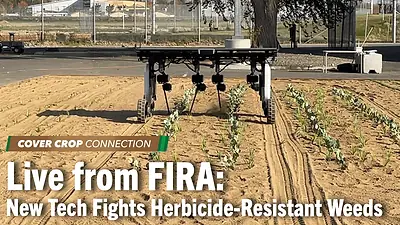
I traveled to FIRA USA last week in Sacramento, Calif., to see some of the latest technology in agriculture on display. The conference is known for showcasing autonomous ag solutions such as weeders, sprayers, planters and more.This was my 2nd year in a row at the event, having traveled to the Salinas Valley last year. From all I gathered at both events, one thing became clear to me. While agriculture is vastly different depending on what region of the country you are in, the goals remain the same.
Being based in the Milwaukee, Wis., area, a vast majority of my editorial farm visits take place in Indiana, Iowa, Wisconsin or Illinois. It’s been fascinating learning about the intricacies of the corn belt over the last 2 years that I’ve worked here. But when I get a chance to travel to other regions of the country, it is equally interesting to explore the unique challenges that farmers face based on those regions.This past summer I got the chance to go on several farm visits near my hometown of Baltimore, Md. I visited Jay Baxter in Delaware and Steve Groff in Pennsylvania and learned more about the Chesapeake Bay and the unique set of issues that it presents for farmers in that proximity.So during my two trips to California for FIRA USA these last two years, I’ve taken a quick glance through the window of viticulture and orchards and even tomatoes and other crops that are more common for that part of the country.And while the equipment changes and the management practices are surely different from a corn or soybean farmer, there really is one central similarity that all farmers share.No matter the crop or the region, every farmer is constantly looking for ways to improve their bottom line, cut back on harmful chemicals, improve their weed or pest management strategies, increase yields — every farmer strives for a more efficient operation.And that is what FIRA USA focuses on. Dozens of companies, new and old, bring their ag implements to the show to display the latest technology they’re working on. And all of these companies recognize that they will only get a farmer to pull out their wallet if they can prove that their product is something that will help meet this central goal of all farmers.So while it can be easy as an ag journalist with a heavy corn and soybean audience to see something related to vineyards or orchards and say, “Oh that doesn’t pertain to me or my audience,” What I have found is that it’s really not for me to decide.So at this year’s FIRA USA conference, and at all events I go on to cover in the future, my goal is to capture what is there and re-tell that story to the best of my ability so that any farmer who reads my articles can decide for themselves if there is something to be taken away and utilized on their operation.And on that note, stay tuned for lots more coverage from what I saw not only at FIRA USA this year, but for all that is yet to come at future field days, farm visits and ag conferences. I am here to tell the story for the farmers who can't make it to these events, but are looking to learn something from them.