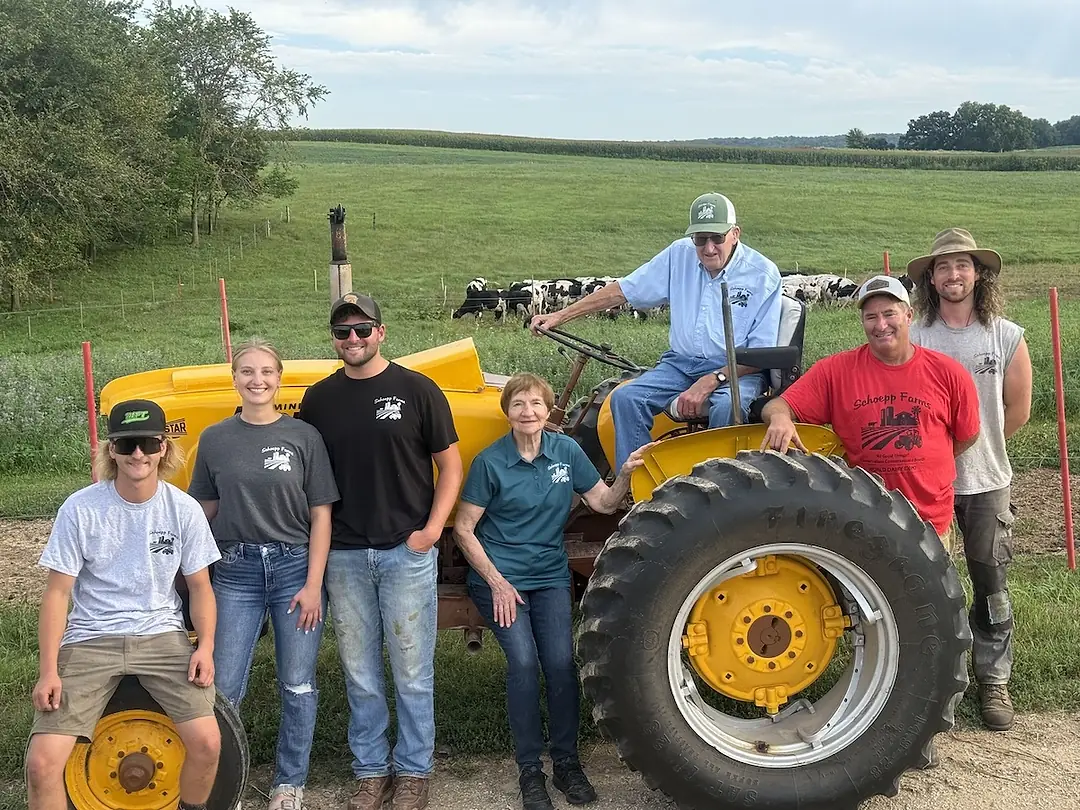
The Schoepp family of Lodi has been selected as the 2026 Wisconsin Leopold Conservation Award® recipient.
The $10,000 award honors farmers and forestland owners who go above and beyond in their management of soil health, water quality and wildlife habitat on working land.
The Schoepps were revealed as the award recipient at the November 12 meeting of the Wisconsin Board of Agriculture, Trade and Consumer Protection in Madison. He will be formally presented with the award at the Wisconsin Farm Bureau Federation’s Annual Meeting on December 6.
Sand County Foundation and national sponsor American Farmland Trust present Leopold Conservation Awards to private landowners in 28 states. In Wisconsin the award is presented with Wisconsin Farm Bureau Federation and Dairy Farmers of Wisconsin.
Given in honor of renowned conservationist Aldo Leopold, the award recognizes landowners who inspire others to consider conservation opportunities on their land. In his influential 1949 book, A Sand County Almanac, Leopold advocated for “a land ethic,” an ethical relationship between people and the land they own and manage.
Earlier this year, Wisconsin landowners were encouraged to apply, or be nominated, for the award. Nominations were evaluated by an independent panel of agricultural and conservation leaders from Wisconsin.
About The Schoepp Family
Cattle grazing a hilltop overlooking Lake Wisconsin might seem like a scene on an old postcard. However, it’s what real-world resilience looks like on the Schoepp farm.
Dave and Nancy Schoepp, and their son Ron, have long been early adopters of conservation. Their long-term approach to keep soil in place and out of the lake has made their farm both ecologically and economically resilient.
Since the 1960s, Dave avoided tilling near waterways, but the family’s conservation journey began by adopting no-till practices to reduce erosion and protect water quality in 1991. Just five years later, they hosted a no-till field day with the University of Wisconsin’s Arlington Research Station to showcase reduced erosion and improved soil structure.
Ron’s desire to share what he’s learned about conservation has only grown in the last three decades. He’s made it his mission to open his family’s farm to other farmers, students, researchers, and international visitors, where he freely shares his successes, failures, and lessons learned from growing cover crops and rotationally grazing cattle. Fellow graziers praise Ron’s dedication to pasture management, and his willingness to mentor others.
In addition to growing corn, soybeans, wheat, and hay, the Schoepps have custom-raised heifers and dry cows for a neighboring dairy farm since 1999. Across 110 acres of the farm, cattle intensively graze small paddocks for a short time before the land is given two months of recovery time. The Schoepps also raise a small herd of their own grass-fed beef cattle.
In 1996, the Schoepps began growing strategically timed cover crops to provide living roots and protective plant coverage over the soil much of the year. A decade later, Ron began experimenting with grazing cattle on cover crops. Allowing cattle to harvest forage and recycle nutrients naturally further reduced the farm’s fertilizer needs and strengthened the biological systems that sustain crop production. Minimizing the need for costly commercial fertilizer also reduced the potential for nutrient losses to groundwater and nearby Lake Wisconsin.
With each growing season, the Schoepps saw how each conservation practice built upon the last. The combination of continuous no-till, cover crops, diverse crop rotations, and the integration of livestock onto cropland with rotational grazing, all worked in tandem to create healthier soils with increased water infiltration, while maintaining productivity and profitability.
Each investment in conservation helped create a farm better prepared for changing weather patterns, volatile input and commodity prices, and evolving environmental challenges. Ron manages about 500 acres of rolling terrain on the edge of the ecologically important Driftless Area, in Columbia and Sauk counties.
Recognizing that heavy equipment can compromise soil health, the Schoepps voluntarily use tractors under 100 horsepower to minimize soil compaction. These thoughtful equipment choices, combined with regenerative management, ensure that rainfall infiltrates healthy soils rather than carrying sediment into surrounding waterways.
In 2024, Ron began participating in the inaugural Advanced Soil Health Training cohort hosted by American Farmland Trust and Purdue University. This invitation was only extended to farmers recognized as leaders in advancing soil health.
Motivating others to consider new ways to harness conservation practices while feeding the world is one of the things that drives Ron. Another is improving water quality, something that is not an abstract concept for a farmer who can see Lake Wisconsin from his barnyard.
Accolades
“The Schoepp family shows what can happen when generations of stewardship meet a willingness to try new ideas,” said Chad Vincent, CEO of Dairy Farmers of Wisconsin. “Their commitment to healthier soils and cleaner water, along with their generosity in sharing what they’ve learned, extends their impact far beyond their own farm. We’re proud to recognize their leadership and the example they set for Wisconsin dairy and agriculture.”
“Wisconsin farmers are advancing conservation by sharing knowledge, building partnerships and learning from each other. The Schoepp family exemplifies how a commitment to conservation can inspire progress across the agricultural community. Wisconsin Farm Bureau is proud to congratulate Ron Schoepp on receiving the Leopold Conservation Award and to recognize his leadership in demonstrating how collaboration can move conservation forward across Wisconsin agriculture,” said Wisconsin Farm Bureau President Brad Olson.
“These award recipients are examples of how Aldo Leopold’s land ethic is alive and well today,” said Kevin McAleese, Sand County Foundation President and CEO. “Their dedication to conservation is both an inspiration to their peers as well as a reminder to all how important thoughtful agriculture is to clean water, healthy soil, and wildlife habitat.”
“As the national sponsor for Sand County Foundation’s Leopold Conservation Award, American Farmland Trust celebrates the hard work and dedication of the award recipients,” said John Piotti, AFT President and CEO. “At AFT we believe that exemplary conservation involves the land itself, the practices employed on the land, and the people who steward it. This award recognizes the integral role of all three.”
Among the many outstanding Wisconsin landowners nominated for the award were finalists: Andy Bensend of Dallas in Barron County, Brattset Family Farm of Jefferson in Jefferson County, Endres Berryridge Farms of Waunakee in Dane County, and Jesse and Kylie Sebero of Porterfield in Marinette County.
Sand County Foundation’s Wisconsin Leopold Conservation Award is made possible thanks to the generous contributions from American Farmland Trust, Dairy Farmers of Wisconsin, Wisconsin Farm Bureau Federation, Culver’s, The Mid-West Farm Report, Compeer Financial, Rural Mutual Insurance Company, USDA Natural Resources Conservation Service, Wisconsin Corn Growers Association, Wisconsin Corn Promotion Board, Wisconsin Land and Water Conservation Association, and Wisconsin Potato & Vegetable Growers Association.