The grants are designed to help partners implement and evaluate innovative approaches that have demonstrated conservation benefits on farmland. These conservation practices are sorely needed on Alabama farms for several reasons, said Rishi Prasad, assistant professor and Alabama Extension specialist in the Department of Crop, Soil and Environmental Sciences and leader of the research project. Read more in this article from Southeast AgNet.
According to a recent survey, Indiana farmers planted 950,000 acres of cover crops in 2019. Cover crops are known for their environmental benefits and, with the exception of corn and soybeans, are planted on more acres than any other commodity crop in Indiana.
Some farmers claim that you need to “open up and fluff up the soil with tillage” so it can take in moisture and that no-till just makes the ground hard making it difficult for water to get through. Tradition may make you think that is the case. Read more in this article from the Dodge City Daily Globe (Dodge City, KS).
The soil health benefits of having a perennial forage in the crop rotation are better than any cover crop, because its living roots are in the soil for much longer. Hay prices have been strong over the last couple of years, and there is always a market for high-quality hay. Read more in this article from the Ontario Ministry of Agriculture, Food & Rural Affairs.
Florida vegetable farmers who grow cover crops as a green manure between their cash crops anecdotally tout the health benefits, but a two-year study by University of Florida has provided the research to back it up. In a Southern Sustainable Agriculture Research and Education (SSARE) On-Farm Research Grant, University of Florida soil health expert Jehangir (Jango) Bhadha shadowed the cover crop practices of eight farmers across the state to measure the benefits of using cover crops (mainly cow pea and sunn hemp) as a soil amendment and nutrient source for subsequent cash crops.
Mitchell Hora walks to a field on his family’s southeast Iowa farm, where 5-inch-high soybeans grow in alternating rows with 4-foot-tall cereal rye. The 25-year-old admits that combining the two crops would make most farmers freak out. Read more in this article from The Hawk Eye (Burlington, IA).
When faced with a crop failure due to severe weather, or conditions prevent planting in the first place, seeding cover crops on these acres can help control weeds and protect soil from erosion as well as provide other soil health benefits. Trials from the University of Minnesota reveals which covers grow the most biomass the quickest.
Due to the increased demand for efficiency, farmers have had to pull more resources from the soil to make sure their production practices are as efficient as possible. The extra demand for resources from the soil has led to a decrease in overall soil health. Read more in this article from the Herald Journal News (Logan, UT).
Soil microbes are living, working barometers of soil health. They are responsible for turning atmospheric nitrogen into forms plants can use, and for releasing nitrogen back into the air. Read more in this article from the Wisconsin State Farmer.
The National No-Tillage Conference returns January 12-15, 2027!Build and refine your no-till system with dozens of new ideas and connections at the 35th Annual National No-Tillage Conference in Indianapolis, Jan. 12-15, 2027. Experience an energizing 4-day agenda featuring inspiring general session speakers, expert-led No-Till Classrooms and collaborative No-Till Roundtables. Plus, Certified Crop Adviser credits will be offered.
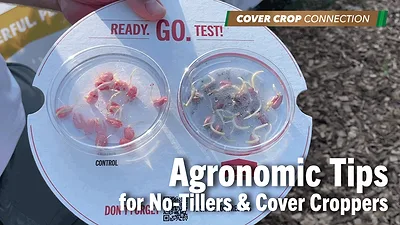
This week we are looking at a clip from Cody Hornaday, a technical agronomist with Koch Agronomic Services, as he explains a few tips that no-tillers and cover croppers should keep in mind for unlocking phosphorus in their soils.
Family Owned since 1964 – Remlinger Manufacturing was founded by Wilbur Remlinger in 1964 and the family tradition continues today with Wilbur’s grandson being the current CEO/President. Although the business has expanded and diversified, family remains a core value to the company and is evident in the company culture.
Made in USA – Remlinger Manufacturing is proudly located in Kalida, Ohio. We have dealers located across the US and Canada to conveniently serve our customers.
Quality Driven – With over 60 years of producing farm equipment, we continue our tradition of manufacturing high quality attachments and products to serve farmers around the globe.
Byron Seeds LLC is a team of individuals who have a passion for high energy forages, cover crops, and proper farming techniques. Byron personnel seek to understand our clients’ goals so that we may provide the best environment for our clients’ success through research, education, support, and...
Our years of experience and network of dealers make us the ideal choice for your mowing, no-till and horse drawn equipment needs. Use our Dealer Locator to contact your nearest I&J dealer today.