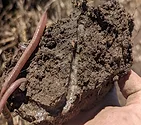
Brian Dougherty says growers combatting compaction in their fields should realize they have bigger problems than merely compressed soil, and compaction is a symptom of poor soil function.
After harvest is a great time to conduct soil sampling. In this video, Fabian Fernandez, Soil Fertility Specialist with University of Minnesota Extension, demonstrates how to correctly take a soil sample from your field.
Research soil scientist Hal Collins with the USDA ARS explains how plants use photosynthesis to sequester carbon and why growers will need to store more carbon in the soil as organic matter.
September is a great time to take a soil sample. The soil sample can be submitted to the University Extension Service for analysis. Read more in this article from the Pontotoc Progress (Pontotoc, MS).
Using cover crops is a way to protect the soil and mitigate soil loss, says Pennsylvania cover crop expert Steve Groff, and that includes in vegetable production. Groff also explains how vegetable production can be done with no-till, how bare soil can lead to soil-borne disease in vegetable crops, how soil health and plant health are linked, and more.
Pennsylvania cover crop expert Steve Groff says that in the past 5-10 years, soil health testing has grown in popularity, but they aren’t a silver bullet for detecting all soil health problems. In this podcast, learn about the different types of soil tests available, what they can measure and why each one is important.
Looking to learn more about building the soil? This podcast from the Northeast Sustainable Agriculture & Research Education program (SARE) breaks down the basics of soil.
Timing, cover crop seeding rates and application methods are the keys to maximizing manure management for cover crops, according to Pennsylvania cover crop expert Steve Groff. Groff recommends that growers plant covers before applying manure and try to do both as early in the season as possible to get the most days with warm enough weather to help the cover crop stand get established. Applying manure to covers can be an efficient way to restore nitrogen in the soil.
Pennsylvania cover crop expert Steve Groff shares key concepts for working with heavy clay soils, discusses why diversity of species is critical for this type of soil, and how cover crops and can be used in heavy clay soils for water management.
Because heavy clay soils tend to hold moisture, they can produce outstanding yields, so understanding how to manage some of the biggest challenges this soil type can offer is of the utmost importance.
The National No-Tillage Conference returns January 12-15, 2027!Build and refine your no-till system with dozens of new ideas and connections at the 35th Annual National No-Tillage Conference in Indianapolis, Jan. 12-15, 2027. Experience an energizing 4-day agenda featuring inspiring general session speakers, expert-led No-Till Classrooms and collaborative No-Till Roundtables. Plus, Certified Crop Adviser credits will be offered.
Last month I had the chance to visit with Douglas Poole on his farm in Waterville, Wash., where he is proving that no-till, cover crops and a regenerative farming system can not only work, but thrive in his part of the country.