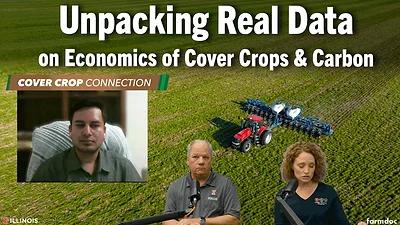

Well, right now I'm standing in the green cover cover crop plots. And while we're about to talk with Keith Burns, get a little tour of what's going on behind me, first, I want to talk with Ryan Heininger and Rob Myers about the newly released National Cover Crop Survey Report and some of the most interesting data that's come out from that so far.
Rob Meyers: "31% of farmers are doing some type of cover crop grazing, and that's an increase from what we've seen in the past. Slightly more in the fall, but also some in the winter and spring and then a bit in the summer. But notably, many of them are saying that virtual fencing is really going to help. So we had a series of questions about virtual fencing. You can see more on that on the lack of fencing on page 53, some following pages on virtual fencing. So of the farmers that are already doing cover crop grazing, 85% said virtual fencing would lead them to increase cover crop grazing more themselves or just in general. So I think as we look over the next few years, that's going to be a big change in cover crop use is more grazing with more virtual fencing because if you haven't followed that story just a year ago was the beginning of when you could buy virtual fencing in the Midwest."
"Before that you couldn't buy it. Out west, a couple of years it's been there, but there are now several companies selling virtual fencing. And although we still recommend a perimeter fence near a roadway, it really makes cover crop grazing much, much more easy and a very economical practice for producers."
Keith Berns: "Cover crops can be an amazing tool for cattle. And the cover crop survey said about one in three, those users will graze their cover crops. I think for our customers, it's probably two and three. I would guess that 60 to 65% of everything that we sell is going to get grazed or at least has the intention of being grazed. This is one of those mixes. This is something we call it a stockpile mix. We can plant this in late June or early July after wheat harvest. And the intent on this is we're not grazing this until November, December, January. So we don't want to graze this early. This is going to be saved, this is going to be stockpiled and we're going to graze it into the winter months. So we specifically choose things that aren't going to fall over. We specifically choose things that are going to hold their forage value."
"We're going to specifically choose things that still have the best nutritional quality. We can grow it during the heat of the summer. We can graze it during the cold of the winter. And so it gives producers another tool to be able to extend their grazing into a season where they normally might have to be buying hay or buying protein supplements, all of which costs money. But this is a relatively inexpensive way to get some of that protein, get some of that energy out there. And then you can graze this along with corn stalks or you can graze it in conjunction with other things. And like what Rob said, if you have collars on those cattle, you will get probably twice the forage utilization out of any of these mixes we're going to talk about. You literally can double the value of it with collars on your cattle versus just turning them into the whole field all at once. It's going to be a game changing technology."
Lots of good cover crop info on display as always.