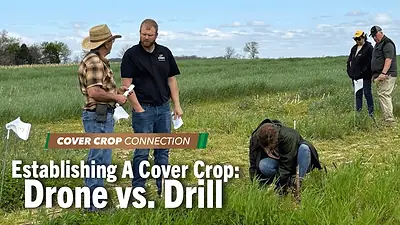
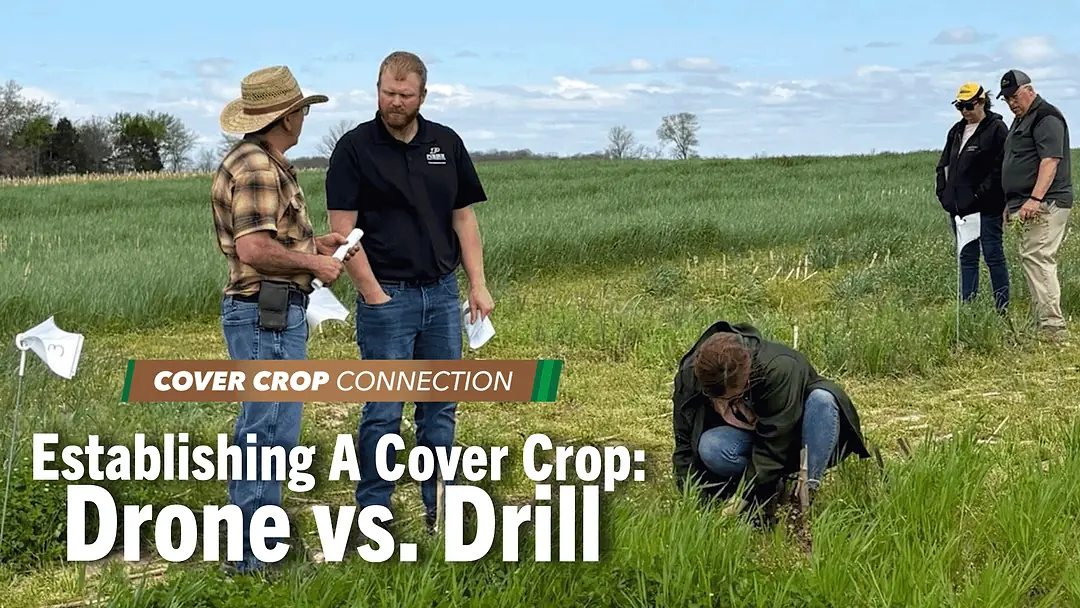
This week we go over to the Midwest Cover Crop Council and the Univ. of Missouri Center for Regenerative Agriculture for a Cover Crop Check-In. Let’s see what Anna Morrow has to tell us about cover crop establishment and the differences between using a drone versus a drill.
Scott Gabbard: Well, good morning. Scott Gabbard and I'm here with Anna Morrow with the Midwest Cover Crops Council. And Anna, talk about some of the work we're doing today.
Anna Morrow: Yeah. Today we drone seeded a cover crop demo for a national cover crop variety trial, and we just wanted to get an earlier seeding date than we could with a drill.
Scott Gabbard: And so what are some, maybe not the varieties, but what are the different type of cover crops are we actually flying on today and then drilling later?
Anna Morrow: Yeah, we did cereal rye, canola, crimson clover, winter pea, radish, and hairy vetch.
Scott Gabbard: And we talked about this being a national study. Who are some of the other participants and where does this research originate?
Anna Morrow: Yeah, this is work that came out of the cover crop breeding network and they've taken some varieties that have done well and they're kind of scaling those up across the country. We're looking at several varieties of each of those species across a national scale to see if some varieties are suited to different regions or different production practices to suit different goals for farmers.
Scott Gabbard:Sure. So just kind of see what will grow here.
Anna Morrow: Right. And also we're looking for winter survival, biomass in the spring, and there are some other really specific traits that we've looked at like soft seededness in hairy vetch and low toxicity and just some other things like that.
To see what cover crop varieties worked well in your state, read the 2025-2026 National Cover Crop Variety Project Report, which can be found at the Univ. of Missouri center for regenerative agriculture website.