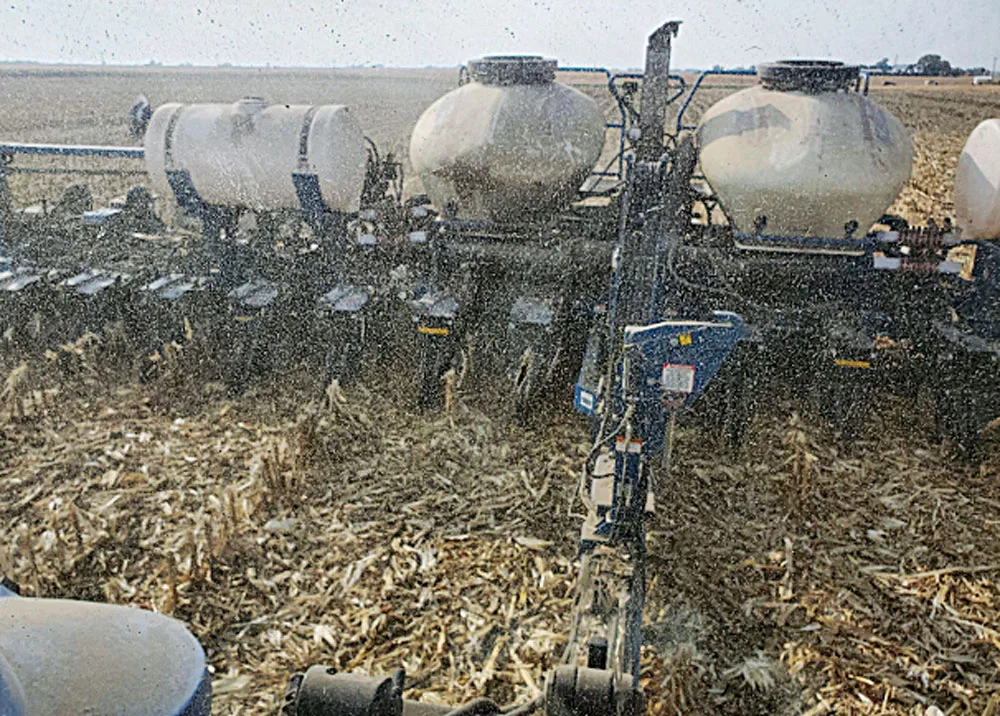
“I use a 15-inch Kinze planter. I can go in the field right after harvest and I can make sure I get the cover crop seed into moisture. When we have dry conditions, I can still get a good stand. I am thinking about a drone to get some seed out before harvest, but not all the cover crop seed.”
– Garay Asay, Osco, Ill.
“I use an old Hiniker Air Seeder. I didn’t pay much for it but I really like it, it’s easy to transport and can cover acres in a hurry. I also use Autosteer.”
– Nate Yoder, Cynthiana, Ky.
“We have a 15-foot John Deere 750 no-till drill and tractor equipped with guidance, autosteer and mapping capabilities. With the help of a Minnesota soil health grant, we were able to add a scale to our drill to better dial in rates of some of the multi species blends that are harder to dial in based on drill charts. The drill has small seed attachment and is used for under seeding small grains and cover crops. We plant around 200 acres annually so for our size this unit works well and assures good emergence. We also found the purchase of a battery operated grease gun to be a good investment.”
– Bob Christie, St. Charles, Minn.
“We plant our cover crops like we do a cash crop, with a drill. Drilling the cover crops allows us to get seeds placed though residue and into the soil (and into moisture, assuming moisture is available), so we don’t depend on rain. This gets the cover crop germinated and emerged as fast as possible, at a time of year where every day makes a big difference in growth.
I have worked with many growers who surface broadcast their cover crops (with ground or aerial equipment), and while it can work well in a year with frequent rains, the stands are usually much more inconsistent.
We also fertilize our cover crops (again like a cash crop). This same fertilizer is then utilized by the following corn or soybean crop.”
– Phil Needham, Calhoun, Ky.
“We have used everything you can think of over the decades. To get seed out there ahead of the frost most of it now gets applied with a large drone.”
– Rod Sommerfield, Mazeppa, Minn.
“I use a John Deere 1560 no-till drill to seed wheat, soybeans and all my cover crops. It can plant through heavy corn residue without plugging or running into other problems. It cuts the corn stalks and puts a lot of the stalks on the ground so they decompose. I have rebuilt it with all Needham Ag drill parts, which are superior to the original John Deere. I also have equipped my tractor with autosteer to be able to do a better job planting, as many times, in heavy residue you can not see the marker.”
– Jake Kaderly, Monticello, Wis.
“I use my Kinze for covers ranging from mixes to straight seeded rye. I have it in the shed so I figure I might as well use it. It does a decent job of sizing and breaking up corn stalk residue.”
– Bradley Robson, Viroqua, Wis.
“We use a Horsch 60-foot, 10-inch spacing air seeder. It is an amazing machine, just like our Horsch corn planter. It is simply amazing what it can do. In the eastern belt, where we have dry falls, or flooding in the fall/winter, we feel it is important to plant the covers and get good seed to soil contact. We use pre-mixed multi-species programs so we can just put the bag into the seed tender and quickly refill the seeder. We can plant 600 acres a day pretty easily, especially when timing is so critical to success.”
– Ken Rulon, Arcadia, Ind.
“In October we seed cereals (usually Rye) into corn stalks going to soybeans with a pull type fertilizer buggy at 50 pounds per acre. That usually works fine into the first few weeks of November. We rent the spreader from our local Co-op ($2/acre) and have guidance on our tractor so we can print maps for the government. It’ll run 10 mph and spread a 50 or 60 foot width. Filling the buggy with a seed tender makes it a quick and simple operation.
In August we seed legumes into standing soybeans with a drone. Usually we buy premixed blends in 50 pound bags so they can go in the hopper of the drone. We have had mixed results on this one and some years are better than others. Vetch and larger seed clovers do okay but the small seeds probably need to be seeded at a higher rate to get a full assortment in dryer years.”
– Jason Erfling, Hermann, Mo.