
One cover crop species stands out from the rest when using covers to mitigate nitrate leaching, according to Nicole Tautges, research director at the Michael Fields Agricultural Institute in East Troy, Wis.
Over the last four years, Tautges and a group of collaborating farmers and researchers conducted a study assessing the benefits of adding cover crops to a 3-year cropping rotation that includes a small grain. One of their goals was to analyze how the covers affected nitrate leaching and protected water quality.
“We have a cohort of Wisconsin farmers who we know well who are really committed to cover cropping because they say it’s the right thing to do for their soils and to protect water quality,” Tautges says. “We want to protect drinking water for our rural residents, and we’re also hoping to discover agronomic benefits from these cover crops as well.”
In 2025, Tautges and 10 participating farms across Wisconsin started a replicated strip trial using diverse cover crop mixes and frost-seeded red clover. The on-farm trials were set up as strips at least 30 feet wide for full-scale equipment and 100-250 feet long for the split rate. Each cover crop strip had a control strip next to it without covers for a replicate trial setup.
Growers were asked to choose mixes that were at least 70% legume to help “kickstart” the nitrogen (N) component of the system. All mixes were planted in August following the small grain harvest, grew for 3 months and then winterkilled ahead of corn planting the following year. The weather was average in 2025, according to Tautges. The growing season was wet but dried out in the fall. There was no drought for the entire season.
In the red clover system, the farmer drilled a small grain in the late fall that then sprouted and overwintered as green shoots. In February or March, the farmer broadcasted red clover seed. Through the frost heaving of the soil through the freeze-thaw cycle, the red clover seed came in contact with the soil, germinated and started growing under the small grain canopy. The small grain was harvested in July, leaving the red clover to grow for the rest of the year.
Sorting Species
Around the time of the first frost, Tautges took biomass samples from the cover crops, dried them and weighed the biomass from each species individually. This allowed her to calculate the percent of each species in the biomass sample and understand what was happening in the field. After that, she took soil profile samples at 1 foot and 2 feet deep, kept them separate and ran them for nitrate.
“We had species results, so I wanted to look at what characteristics of the cover crop mix might be helping to mitigate nitrate leaching,” Tautges says.
The expectation was that more biomass would lead to more nitrate uptake and less nitrate leaching, based on the literature and common belief that more biomass is better. However, Tautges says the data from this study didn’t illustrate that type of relationship (see Figure 1). As cover crop biomass increased, soil nitrate did, too.
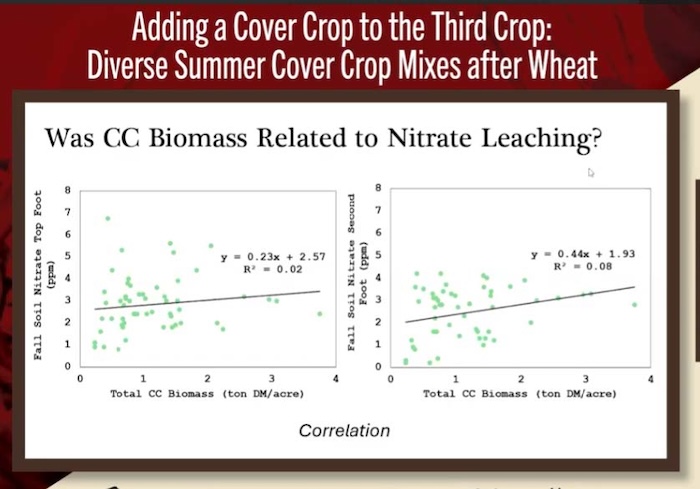
Figure 1. These charts show the effect of biomass from a diverse cover crop mix on soil nitrate leaching at 1 foot (L) and 2 feet (R) deep. “These graphs tend to look like they’re sloping upward, which would tell us that as cover crop biomass increased, soil nitrate increased, but it’s not a significant slope, so statistically, this is flat,” says Nicole Tautges, research director at the Michael Fields Agricultural Institute in East Troy, Wis.
“Statistically, this is flat, so we’re just not seeing an effect,” Tautges says. “In some cases, when there was more nitrate available in the soil, it may have been helping the cover crop produce more biomass. That makes sense because N helps plants grow more just to distill down the N.”
Looking at the effect of individual species, Tautges says more brassicas and volunteer cereal in the mixes did not show a statistically significant beneficial effect in the soil samples from both depths. However, strips with red clover showed a significant decrease in fall residual soil nitrate as the amount of red clover in the mix increased (Figure 2).
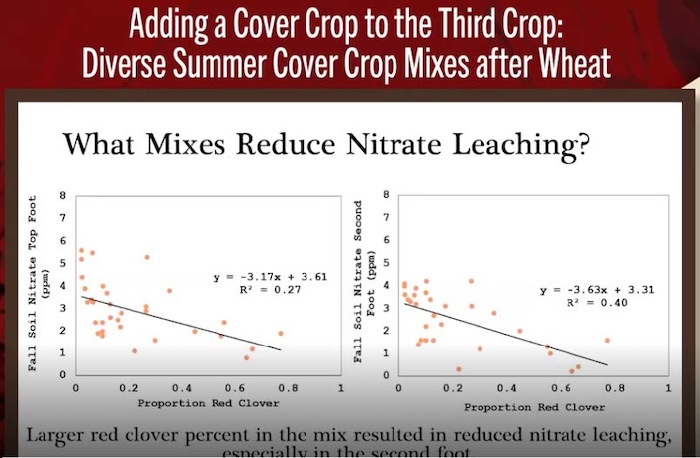
Figure 2. These charts show the effect of red clover biomass on soil nitrate leaching at 1 foot (L) and 2 feet (R) deep. The proportion of red clover in the cover crop mix is shown on the X axis.
“As we have more red clover represented in our mix, it decreases the nitrate left in the soil profile,” Tautges says. “The red clover seems to be doing a great job scavenging soil nitrate in the top 1 foot, and that was true to perhaps an even greater extent in the second foot of soil.”
Tautges says mixes with red clover and other legumes didn’t affect the top 1 foot of the soil, but they started to show a beneficial effect for soil nitrate scavenging in the second foot, although not enough to be statistically significant.
“What this tells us is not all legume species are doing the same things in our soils,” Tautges says. “An annual legume like pea is going to look, behave and grow very differently than a perennial legume like red clover.”
She says differing soil microbial dynamics around the roots of an annual vs. perennial plant may be causing the difference.
Control Comparison
The final analysis was a head-to-head comparison of the cover crop and no cover crop treatments on nitrate leaching. Tautges says the cover crops meaningfully reduced nitrate leaching at 3 of the 9 nine sites in the trial.
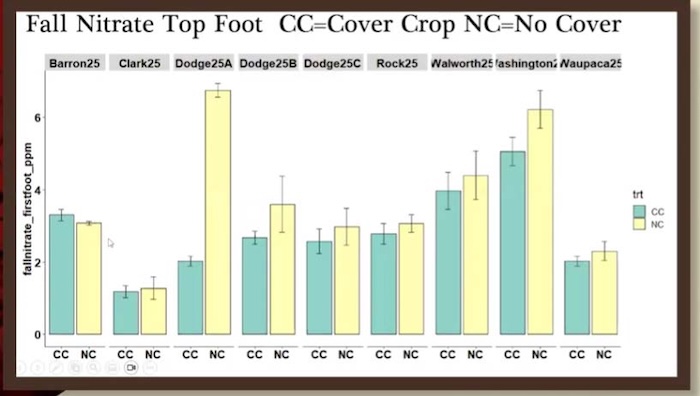
Figure 3. The yellow bars in this graph represent nitrate leaching in the no cover crop systems in the top 1 foot of the soil profile. The teal bars show nitrate leaching in the strips with cover crops.
In the top 1 foot of the soil profile (Figure 3), the Dodge County 25A site experienced the biggest benefit from its cover crop mix, which was 70% volunteer cereal, 10% brassicas, 10% vetch and 10% red clover. The cover crops at this site only had ⅓ of the nitrate leaching compared to the no-cover treatment. Tautges says the rest of the sites had similar results, except for the Washington County farm.
“In Washington County, we’re also seeing a benefit,” Tautges says. “This is where the farmer effectively controlled the no cover crop strips so that the soil was actually bare. Some no-cover strips in the trial had volunteer cereal taking up soil nitrate in theory.”
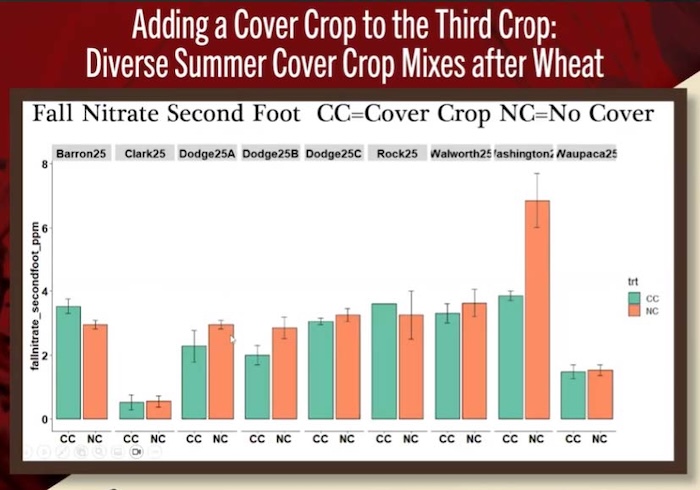
Figure 4. The orange bars in this graph represent nitrate leaching in the no cover crop systems in the top 1 foot of the soil profile. The teal bars show nitrate leaching in the strips with cover crops.
The second foot of soil showed a similar dynamic (Figure 4). Tautges says this is interesting because many farmers think most roots are near the surface, but her research continually shows that cover crops have a greater impact on the soil at 2 feet deep.
“I couldn't explain to you in a soil science way exactly why that is,” Tautges says. “Maybe there's less overall biological activity at 2 feet deep than in the top foot, so any extra introduction of roots as extra biological activity in that second foot layer is really making a difference. If you are looking for effects of your cover crops in soil, make sure you sample into that second foot and keep it separated because I guarantee you, you'll start to see a difference.”