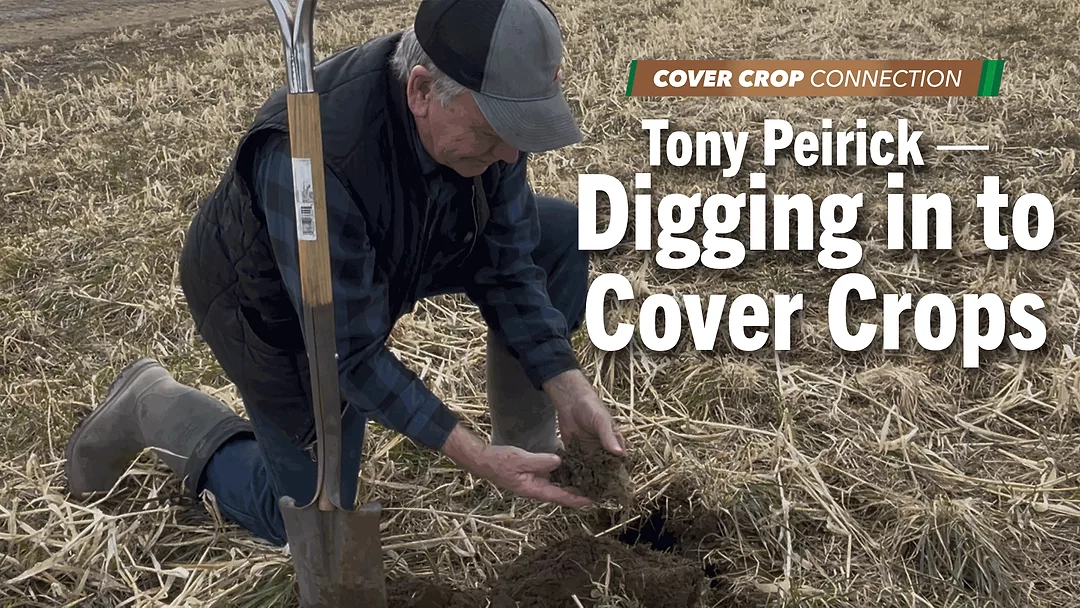
This year’s No-Till Farmer Conservation Ag Operator Fellow is Watertown, Wis. no-tiller Tony Peirick. Tony has been using cover crops and practicing no-till on his farm for decades. Let’s watch as Tony grabs a shovel from his truck and digs into a field of cover crops to check out the soil structure.
“Start seeing it. Yeah, that's what you want. Here's your soil texture. Yeah, there really isn't. Well, if the cover's out there, you keep it living. A few years ago, our group did a weekly check on living on cover crops and rye. And our crop consultant did it, had to break the frost every week and he checked the root depth. It's growing every day of the year in the winter. It doesn't stop growing. The roots were deeper and deeper and deeper every week you did it, but you can just see the root structure. How does this look compared to maybe ... I don't know how long you've had this field, but- Oh, it's been for over 10 years or more. So has it changed a lot? Oh yeah. All the soils is just ... We used to remember on that ... We used to not own that farm until the 80s, that 80 over there came right away.
“Then we used to plow it back in the ... Oh, that'd be early 90s already. We took it over in 84. And it could have been the late 80s, but it was so hard. We rotory hold it two to three times to get the corn out of the ground. Well, we weren't educated. I was like 10 years old, I was running a disc and disk it three times and have a real nice soft soil. And we didn't know any better. You wanted to sink in that deep. Oh, that's going to absorb all the water. And then turn to nothing concrete. And that over there was just like ... There's no color compared to what this is now that ... But that's what you want, that soil aggregation.”
Be sure to check out the first installment of the four-part print series on Tony Peirick, which is featured in the May edition of the No-Till Farmer Conservation Tillage Guide and can also be found at no-tillfarmer.com.