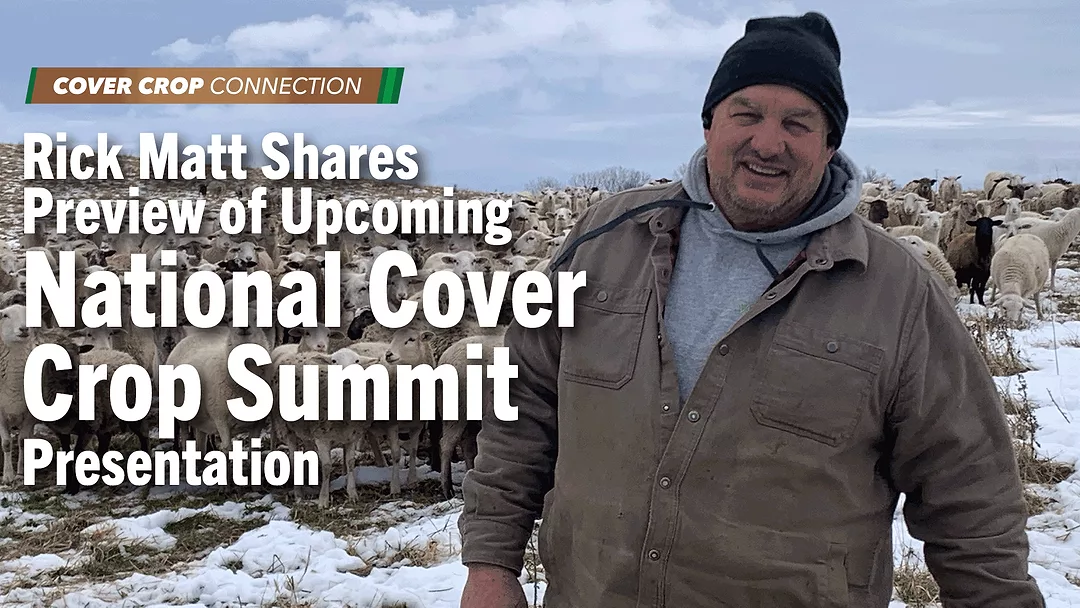
Iowa no-tiller Rick Matt will be presenting at this year's National Cover Crop Summit. In this video, he gives a short preview of what audience members can learn from his session titled "Covers & Critters: Integrating Livestock on Summer Annuals."
Mackane Vogel: I'm joined with Rick Matt, one of our growers who's going to be on the Cover Crop Summit program. Rick, why don't you just tell everybody a little bit of a preview about what you're going to be talking about at the summit this year?
Rick Matt: I guess I'm just sharing my experience with adding covers and then various forms of livestock and growing summer annuals as our little niche and how that fits in with that. Try to touch on a little microbes deal, but usually when it gets too technical, my brain goes blah, blah, blah. So hopefully, it's pretty layman's terms.
Mackane Vogel: Yeah. And to build off of that, what you just said, I guess there's a wide range of people using cover crops that might consider themselves either a beginner or intermediate or maybe more advanced. Where would you put your presentation in terms of what those three different groups can learn and take away from this?
Rick Matt: I would think all kinds could take something away from it from a little bit of touching on row crop and interplanting in between that. Yeah, I am a little heavy on the livestock because that's my main enterprise here, but it's fun to play with the row crops and multi-species with that.
Mackane Vogel: I was just at our National No-Tillage Conference in St. Louis and talked to a lot of different farmers from different backgrounds and regions out there. But one thing I heard over and over again is folks saying, "Man, I've been doing cover crops and no-till for a long time, but grazing and the livestock part of it is something that a lot of folks want to add to their system, but just haven't quite figured out the logistics." I guess what's your advice to beginners trying to get into that part of it?
Rick Matt: Take it slow on growing it, especially with cattle right now. It's pretty risky to jump into that and add it, but when it corrects, I think it'd be a really good time to bring it in, but start on a small level, see what works. Sheep's a little easier just for manhandling them and moving them around. It's just a little easier. To me, the benefits we've seen is just starting to diversify your crop rotation has started to enhance your crop growth. And to me, that's a big plus if you could even start doing that ahead of the livestock.
Mackane Vogel: Yeah. And lastly, I'm curious too, what would you say is unique about the region that you farm in, the weather patterns there? What makes that a unique place to farm and how do you handle that?
Rick Matt: Well, it is unique because it's the Driftless Area. When it does rain, we have to be really careful because you could slide all the way to the bottom of the hill and you won't get out until it dries up. We get about 34 inches of rain a year, but with the clay level we have, you just have to be a little more careful. Some people say it's beautiful where we live, but I always say you can't eat the scenery. So we're making it work. I brag that I get to farm both sides of the hill versus flat ground, they just get one side. It's not quite that exaggerated, but yeah, it's rough ground, it's fun to look at, but I don't get to drive everywhere I want to year round.
Mackane Vogel: Yeah, absolutely. Well, we're looking forward to your presentation and those of you listening, feel free to go to covercropstrategies.com and you can find out more about the Cover Crop Summit there and sign up for free.
Rick Matt: All right. Well, thank you again, Mackane, and letting me be part of this. I'm looking forward to checking it out.
To view his full presentation, plus several other videos from various cover crop experts, sign up for FREE at covercropstrategies.com.