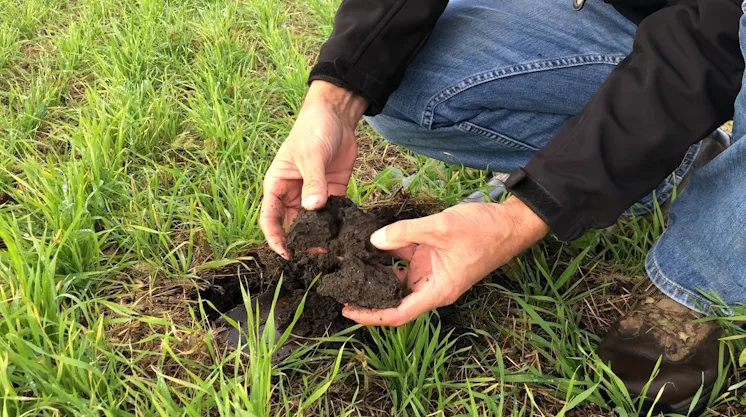
WASHINGTON — The USDA said Wednesday it’s pledging $700 million toward launching a pilot program meant to encourage more farmers to adopt regenerative practices that improve soil health, protect waterways and produce healthier food and fiber.
USDA Secretary Brooke Rollins, U.S. Health and Human Services Secretary Robert F. Kennedy Jr. and Centers for Medicare & Medicaid Services Administrator Dr. Mehmet Oz announced a $700 million Regenerative Pilot Program.
Rollins says the move builds off the Make Our Children Healthy Again Strategy released in September, and DHHS is also investing in research on the connection between regenerative agriculture and public health, as well as developing public health messaging explaining this connection.
Rollins said in a statement that protecting and improving soil health “is critical not only for the future viability of farmland, but to the future success of American farmers.
“To continue to be the most productive and efficient growers in the world, we must protect our topsoil from unnecessary erosion and improve soil health and land stewardship.”
The program’s goal is to support farmers transitioning to regenerative agriculture and reduces barriers to entry for conservation programs.
The announcement did not define what regenerative farming practices would be encouraged, and No-Till Farmer has contacted the USDA to get clarification.
Kennedy has previously voiced support for regenerative farming, including no-till, precision farming and alternatives to using glyphosate due to health concerns. His department stopped short of calling for a ban on the popular weed killer, however.
Since the creation of the Soil Conservation Service — now the NRCS — in response to the Dust Bowl in the 1930s, the USDA said that between 1948 and 2021, total U.S. farm production increased 190% while total farm inputs—such as land, labor, and water—decreased 2% in the same period.
But Rollins said current conservation programs at the USDA have become “overly burdensome and farmers are bogged down with red tape” when they try to adopt regenerative agriculture practices.
Even with the improved soil health since the creation of NRCS, Rollins says USDA data shows farmers recently reported 25% of acres had water-driven erosion concerns and 16% of acres had wind-driven erosion concerns.
The pilot programs will be administered by the NRCS and include an outcome-based conservation model that will allow them to plan and implement whole-farm regenerative practices through a single application.
In the coming year the pilot programs will focus on whole-farm planning that addresses “every soil, water and natural vitality under a single conservation framework.”
The USDA says it’s is dedicating $400 million through the Environmental Quality Incentives Program (EQIP) and $300 million through the Conservation Stewardship Program (CSP) to fund this first year of regenerative agriculture projects.
Farmers will be able to bundle multiple regenerative practices into one application to streamline the process and increase flexibility for operations. The program is designed for both beginning and advanced farmers.
In addition, the NRCS will be forming an advisory council designed to keep the program
“grounded in practical, producer-led solutions,” including advising the NRCS chief, reviewing implementation progress, and guiding data and reporting improvements.
The USDA says the program will also create opportunities to create new public-private partnerships that will allow the USDA to match private funding, “in turn stretching taxpayer dollars further, and bringing new capacity to producers interested in adopting regenerative practices,” the agency said.
Companies interested in partnering with USDA NRCS in the Regenerative Pilot Program can email regenerative@usda.gov for more information.
Farmers and ranchers interested in regenerative agriculture are encouraged to apply through their local NRCS Service Center by their state’s ranking dates for consideration in FY2026 funding.
Applications for both EQIP and CSP can now be submitted under the new single regenerative application process.