The value of healthy soils was showcased at an event at the Brandt Family Farm this week.
The Brandt Family Farm grows corn, soybeans, wheat, and a variety of other cereal grains sold through the on-farm cover crop business, Walnut Creek Seeds. For more than 50 years, the Brandt family has been committed to soil conservation and building healthy soil.
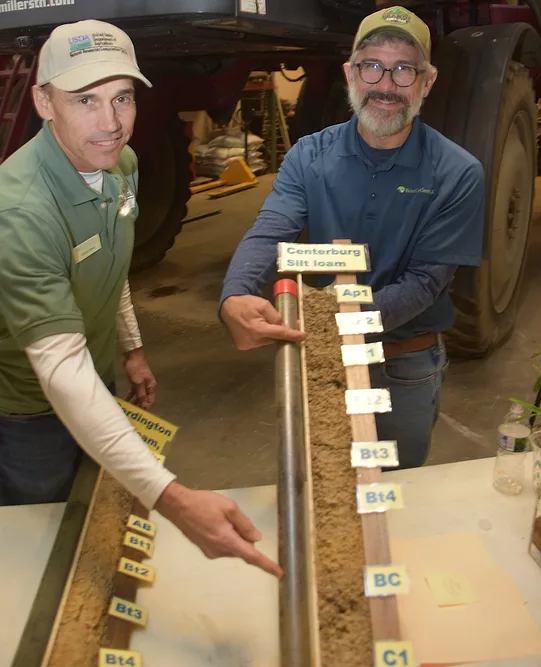
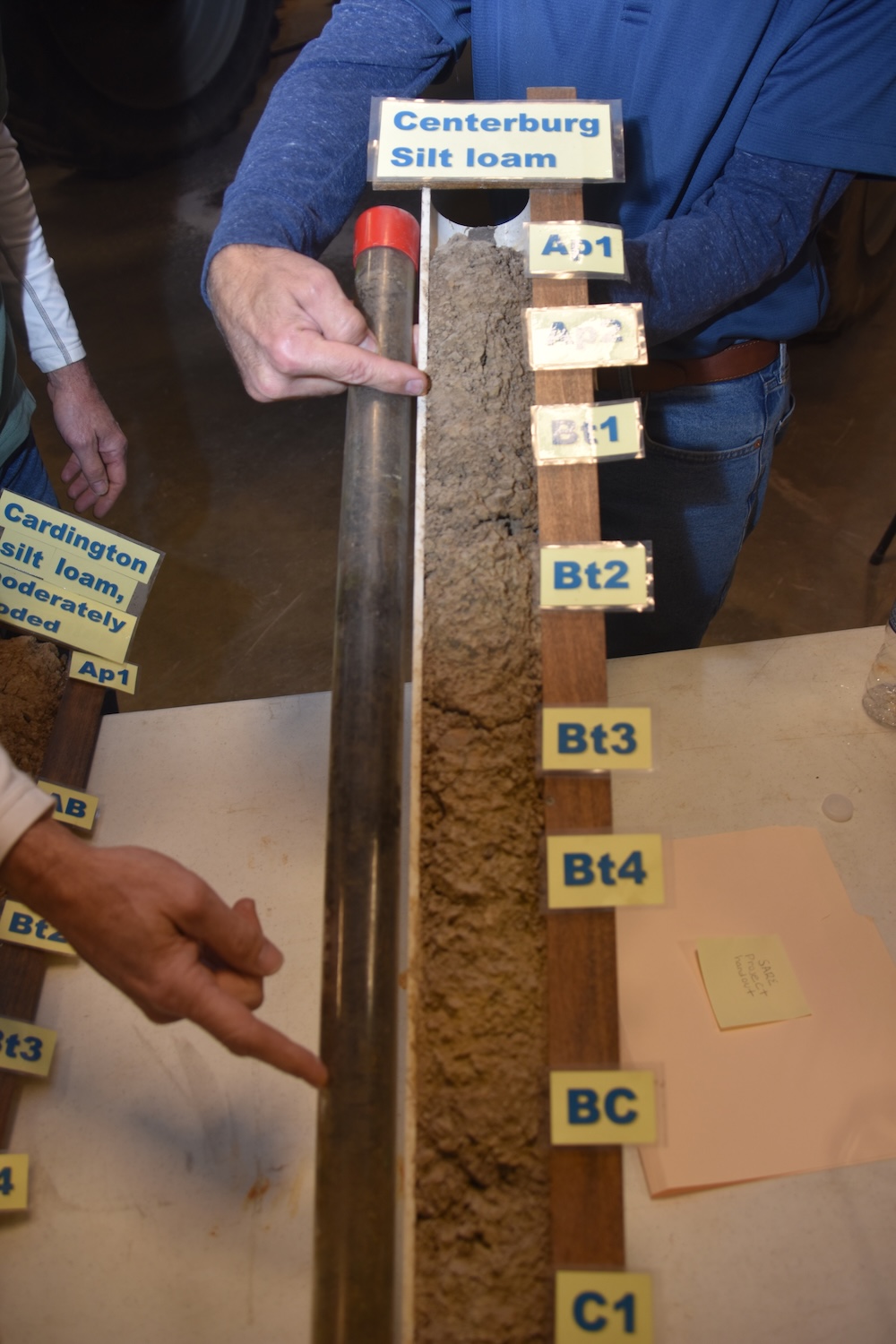
Soil cores, 3 feet deep, taken back in 2011 showed that topsoil (A horizon) was about 4 inches deep. A similar soil core taken 10 years later showed that high organic matter levels (black soil) reached more than 2 feet deep.
More About David and Jay Brandt
- What I Learned from David Brandt
- 2025 CTIC Hall of Fame Inductee: David Brandt
- Farmers, Local Leadership at Heart of Plans to Continue Dave Brandt’s Learning Center
Continuous no-till and cover crops “added” value far faster than “Nature” could add topsoil from below even if erosion was zero, experts said at the event.
Jay Brandt, son of No-Till Legend and No-Till Innovator David Brandt, conducted a slake test, which illustrated how healthy no-till soil with good structure holds together when saturated, contrasted to tilled ground which quickly broke apart.
Jay also demonstrated runoff and infiltration with small pans of soil 4 inches deep taken from 3 field situations: bare tilled soil, no-till, and no-till with a green cover crop. Source: Randall Reeder
With simulated rainfall, the pan with a cover crop had minimal runoff and some infiltration through the profile. The pan with bare tilled soil had a lot of runoff and no infiltration. The audience gasped when that pan was flipped over, revealing bone dry soil under the muddy surface.
Ohio State University and USDA-ARS have been measuring runoff and water quality from a Brandt field and one across the road that is tilled every year. Mary Henry, research technician at the OSU Department of Food, Agricultural and Biological Engineering, shared data from a full year, 2021:
- Brandt’s no-till with cover crops reduced total surface water discharge 50% and tile drainage 15%.
- For water quality, the Brandt field had half as much nitrate loss and the dissolved reactive phosphorus (DRP), was reduced 25%. The data showed no-till and cover cropped soil held more than 2 inches of water (increasing resistance to drought and decreasing downstream flooding) and the reduced DRP would lessen harmful algae growth if the water flowed to a lake.
Cover Crop Value
Keith Dennis, who no-tills in a neighboring county has been a protégé of Dave Brandt more than 14 years. After many years with no applications of phosphorus (P) and potassium (K), he noticed that cover crop growth was stunted.
So he experimented with applying nitrogen (N) fertilizer (20 gallons an acre of 20-0-0-4) to the cover crop. Tissue tests taken May 5 showed the cover crop biomass had 257 pounds of N per acre, 70 units of P per acre and 401pounds of K an acre. The N, P and K were pulled from the soil profile.
The cost of the cover crop and applied N was far less than the nutrient values provided the following corn crop, Dennis said.
This event, sponsored by the Ohio Ecological Food and Farming Association (OEFFA), is one of several similar programs during Ohio Soil Health Week. This week in November has been officially designated by the Ohio Legislature and honors David Brandt by including his birthday, Nov. 16.