
By Kathrine Torday Gulden
New research reveals that the secret to building healthier, more resilient soils in Norway’s challenging climate lies beneath our feet — in the roots produced by cover crops.
Cover crops, plants grown to protect and enrich the soil, are known to boost soil health and help store carbon. However, the exact mechanisms behind these benefits — especially under Nordic climate conditions — have been unclear until now.
Root growth drives stable soil carbon
Researchers led by NIBIO’s Dr Thiago Inagaki found that root growth is a major driver in forming mineral-associated organic matter (MAOM), a stable form of soil carbon that is less likely to decompose and can persist for years.
“This form of carbon is less likely to break down, meaning it can persist in the soil for years, helping to fight climate change,” says Dr Inagaki.
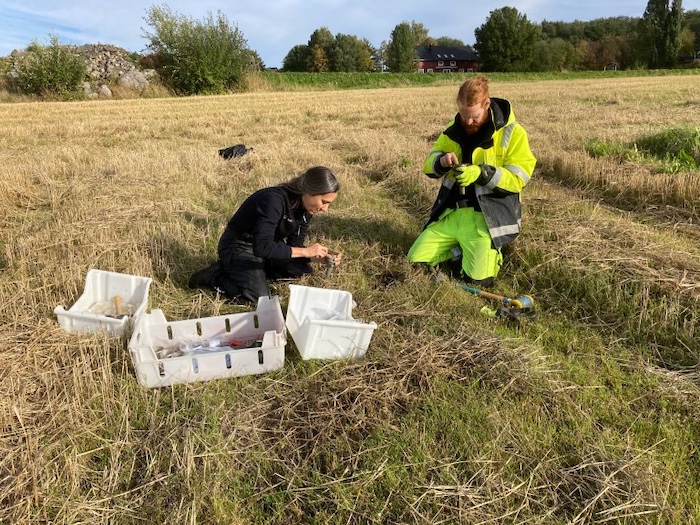
Dr Alice Budai and Dr Frederik Bøe sampling soils at Tuv. Source: Ievina Sturite
The study site at Tuv Gård, Steinkjer, included five years of replicated cover crop systems grown alongside barley. Results showed systems with greater root biomass — notably mixes including ryegrass and clover — stored significantly more MAOM than others.
“Our results show that systems with more root biomass, like those with ryegrass and clover, stored significantly more mineral-associated organic matter than others,” says Dr Inagaki.
While diverse mixtures with species such as chicory and bird’s-foot trefoil improved soil structure and microbial abundance, those benefits did not immediately translate to higher carbon storage — suggesting some effects emerge over longer timescales.
Roots, microbes and nutrient cycling
An upcoming study by Dr Frederik Bøe explores how root growth interacts with microbial abundance to promote nutrient cycling, especially phosphorus — indicating root-focused practices can also improve nutrient retention.
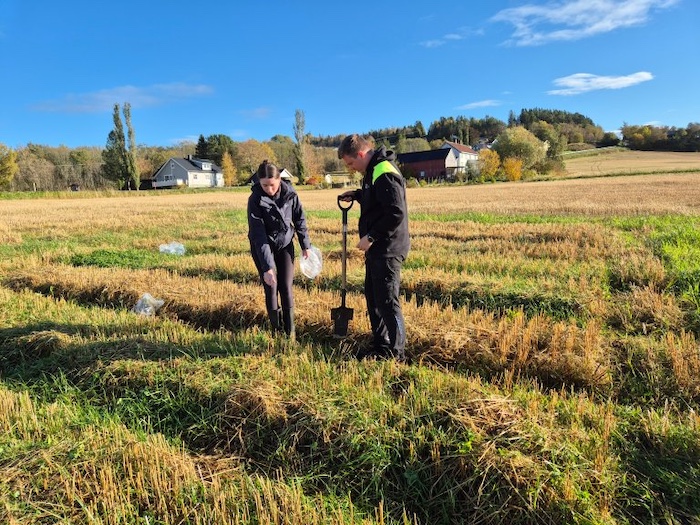
Meike S. Bärmann and Stian Dalbakk conducting field work at Tuv for the AgroMixNorth Project. Source: Ievina Sturite
No yield penalty
The research also found that adding cover crops — even diverse mixtures — did not reduce barley yields, addressing a common farmer concern that covers might compete with main crops.
The team additionally tested biochar; while it did not significantly boost soil quality or yields in these trials, it showed no negative effects and remains promising for carbon storage and potential carbon credit markets.
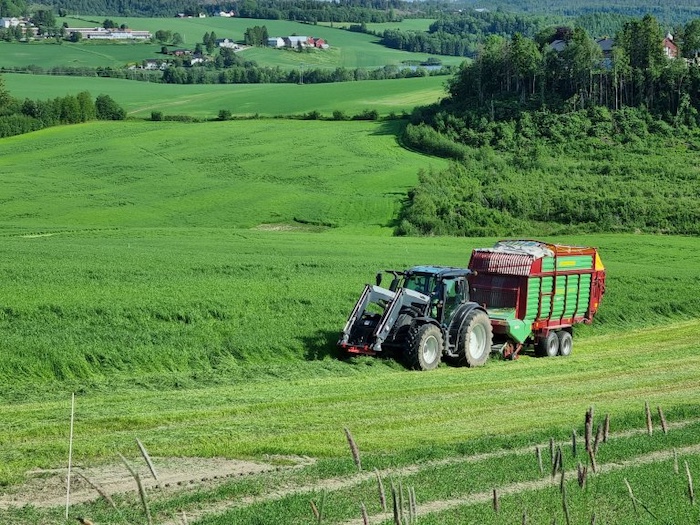
Tuv experimental farm in Steinkjer. Source: Jørgen Lervik
Next steps
NIBIO’s AgroMixNorth project will continue investigations into nitrogen dynamics, photosynthesis activity, and plant development across the season. Master’s student Meike S. Bärmann (Goethe University) is conducting plant development and soil fertility evaluations under Dr Inagaki’s guidance.
“This next phase will help unravel how cover crops and root systems optimize nutrient cycling and soil health in Nordic agriculture,” says Dr Inagaki. “Hopefully our findings can help reframe soil management in Nordic agriculture.”