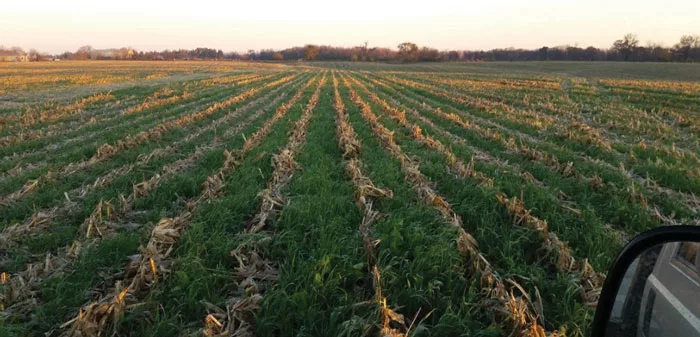
Rob Ewoldt’s cover crop journey began in 1996. He planted cereal rye at first, “strictly for selfish reasons, to make cheap feed for cows,” he says. A drought year in 2005 changed his perspective.
“That’s when we had our ‘ah-ha’ moment,” Ewoldt says. “We planted beans into cereal rye. We grew 36 bushels per acre on the cereal rye ground. Where we had bare corn stalks, we only grew 12 bushels per acre. That told me there was something going on with cover crops we needed to explore a little bit more.”
Knee-High Cereal Rye
Cereal rye got “wooly and thick” on Ewoldt this past year after planting corn late due to cool and wet conditions. The rye was knee-high when he terminated later than normal.
“I was nervous when we were planting that corn,” he says. “I’ve never planted into anything that thick before. I walk out there now, and you can barely find any of it on top of the ground. I could not believe how many earthworms we found. I’m like, ‘this is what we’ve been working for.’”
Cover crops like cereal rye have been a staple on his farm for over 25 years. Ewoldt grows covers on about one-third of his 2,000-acre operation, he estimates.
Ewoldt has experimented with several species, including oats, clover, triticale, radish and winter wheat. Certain covers have worked better than others. Getting tillage radish established before frost was a struggle. There was also a rough experience with perennial ryegrass a few years ago.
“We thought the small seeds would be easy to fly on with a helicopter,” he says. “It was a complete disaster. The seeds were too light, they didn’t fly very far and it was very hard to kill in the spring.”
Ewoldt’s favorite covers are cereal rye and winter wheat. Rye has the edge for the top spot because “it’s idiot proof,” he says.
“Rye can grow anywhere. You can apply it a lot of different ways. You can drop it from an airplane, or you can spread it out with a fertilizer buggy.
“Winter wheat is my second favorite because it gives us a lot of bang for our buck. We can get it established early and it grows fast. I also like the tillering aspect of it.”
Ewoldt plants cereal rye on corn-on-corn ground before the fall application of manure. He terminates it, using Roundup, 3-4 days after planting the corn. For beans, he terminates right before planting.
Cover crops are helping boost yields, increase organic matter and hold N in place from fall-applied hog manure, Ewoldt says. Soil scientists from the Iowa Department of Animal Land Stewardship (IDALS) gave two thumbs up during a recent visit.
“The soil scientists came out last year and looked at our soil structure,” Ewoldt says. “They’re the professionals and they were impressed with what they saw. They didn’t know exactly where we were in the beginning, but when they looked at our soil, it’s a lot better, especially the clay ground.”
Read the full article from Strip-Till Farmer: Improving Soil & Water Quality with Strip-Till & Cover Crops