
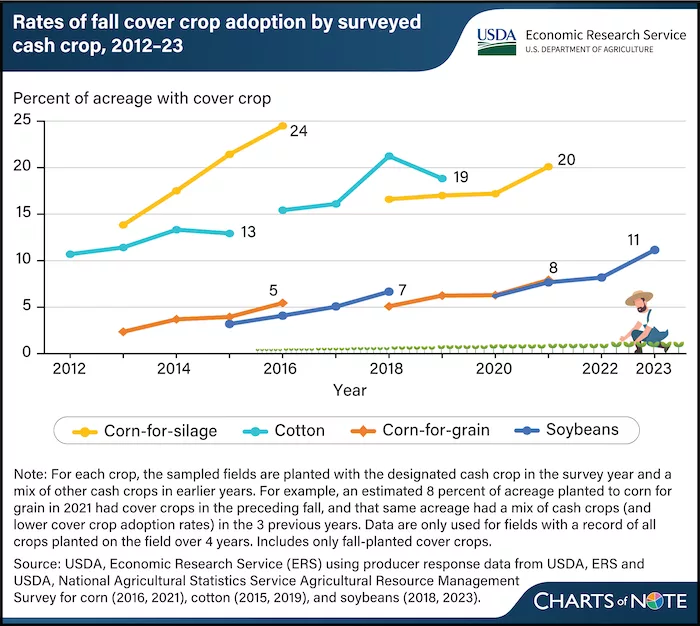
Cover crops provide seasonal living cover in between a farmer’s primary commodity crops and are often planted in the fall to provide winter cover for soil that might otherwise be bare. Over the past decade, use of fall cover crops has grown for the major cash crops of corn, soybeans, and cotton. According to farmer responses to the Agricultural Resource Management Survey, in the fall preceding the survey year, producers planted cover crops on 8 percent of all corn-for-grain (2021) acres planted, 11 percent of all soybean (2023) acres planted, and 19 percent of all cotton (2019) acres planted. Producers can use cover crops to comply with local or State regulations on acreage where manure is being applied, to address soil health and erosion concerns on fields in continuous corn silage, or as grazed or harvested forage (e.g., on dairy operations). Cover crop adoption was also relatively high on cotton fields, where cover crops can help prevent erosion and increase soil moisture and organic matter. This chart appears in the USDA, Economic Research Service bulletin Economic Outcomes of Soil Health and Conservation Practices on U.S. Cropland, published in 2025.