Kura clover offers potential for bolstering plant-microbe synergy.
Corn crops have a voracious appetite for nitrogen. Purdue University scientists are investigating whether mulching Kura clover, a perennial legume, can provide sufficient nitrogen for corn, thus reducing the need for synthetic fertilizers while enhancing soil organic carbon storage.
This innovative system could potentially boost the much-needed supply of soil nitrogen in Midwest corn production. Indiana alone produced more than a billion bushels of corn in 2023, at a value of more than $5 billion, according to the U.S. Department of Agriculture’s National Agricultural Statistics Service.
“A substantial percentage of the nitrogen we apply to our annual production systems is lost into our waterways or into the atmosphere,” said Purdue’s Yichao Rui, assistant professor in the Department of Agronomy. “Whether it’s from the soil system or from external application, corn needs a lot of nitrogen to be productive.”
Rui heads the new project, funded by the USDA’s National Institute of Food and Agriculture (NIFA), to test the little-studied effects of Kura clover on corn production.
In an ecologically robust system, corn would rotate with other crops. But corn’s economic potential calls for a more profitable alternative. Integrating Kura clover into a continuous corn production system offers a possible path toward both high corn productivity and environmental sustainability.
Winter cover-cropping is gaining popularity in the Midwest. A growing number of farmers plant cover crops such as cereal rye after harvesting their corn or soybeans to cover the soil during the winter fallow season. But during the growing season, cornfields typically lack such cover crops.
Kura clover, a unique perennial legume that survives all year round, can harness underutilized temporal and spatial niches of the monoculture corn system. As a legume, Kura clover also fixes inert nitrogen gas from the air, converting it into plant-useable forms available to corn.
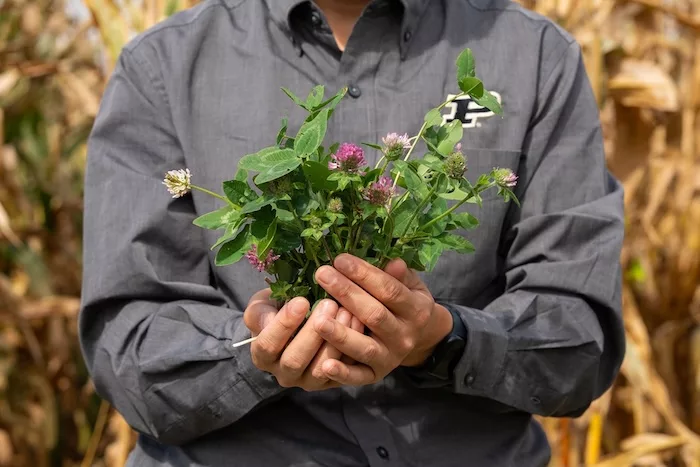
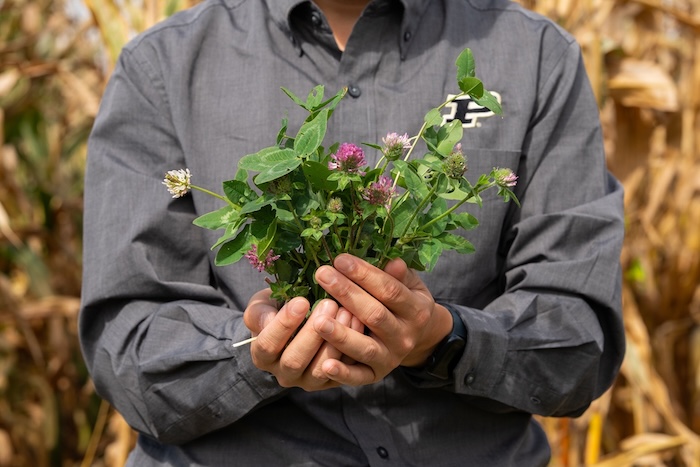
Yichao Rui, assistant professor of agronomy at Purdue, holds a sample of Kura clover.

“This added ecological complexity, combined with biological nitrogen fixation, presents a unique opportunity to enhance soil carbon accumulation by fostering stronger plant-microbe interactions,” Rui said.
Rui’s collaborators on the project are Sylvie Brouder, the Wickersham Chair of Excellence in Agricultural Research and professor of agronomy; Jeffrey Volenec, professor of agronomy; and Pratishtha Poudel, assistant professor of agronomy. The researchers conduct their experiments at the Water Quality Field Station (WQFS) located at Purdue’s Agronomy Center for Research and Education.
The new NIFA study adds a soil health dimension to a variety of ongoing tests at the field station. These include greenhouse gas and water quality studies involving corn, both with and without Kura clover for comparison. Also underway: trials related to grasses used in bioenergy production and restored prairie systems.
Purdue launched the field station in 1992 with USDA funding. Since then, it has been used to track the movement of pesticides, nutrients, and hormones and antibiotics from manure into lakes, streams and rivers. The field station’s subsurface drainage system and special instrumentation facilitates these critical research activities.
“The environmental performance of the Kura clover system has yet to be fully understood,” Volenec said. Preliminary data suggests that planting corn into this sod of clover improves the system’s water quality. Greenhouse gas emissions, which the WQFS also monitors, are another focal point since they contribute to climate change.
The dynamics and outcomes of soil carbon are a novel focus for researchers studying Kura clover. Soils globally store about 1,550 gigatons of soil carbon to a depth of 1 meter. “That’s more carbon in the soil than carbon in global vegetation and the atmosphere put together,” Rui said. Carbon in the soil means more soil organic matter, better soil health and more nutrients to support crop production.
Somewhere between one-third and one-half of Midwestern soil carbon has been lost to the atmosphere since intensive farming began in the 1850s, Rui said. Before then, prairie plants covered the ground year-round, performing photosynthesis, fixing carbon from the air and forming dense root systems firmly linked to soil microbes.
Modern corn crop root systems are shallow and less robust because they have access to abundant water and synthetic nitrogen at the surface. This also loosens the link between corn roots and soil microbes, reducing the latter’s ability to pump carbon into the soil where it becomes a stable source of organic matter. Kura clover may reverse the process while also reducing erosion and retaining moisture.
Like alfalfa and wheat, Kura clover originated in the Caucasus Mountains that run between Europe and Asia. “This is a spreading clover,” Brouder said. It dies back in the summer heat, then regrows in the fall to serve as a winter cover crop. “You don’t have to plant the cover crop. It’s just there, and then in the spring, you whack it back and plant your corn.”
Kura clover produces aggressively growing underground runners that aid the plant’s ability to adapt and thrive, even as it withers above ground. “But the leaf tissue that you’ve killed will fall on the soil and decompose, and that nitrogen will be available to the corn crop,” Brouder said.
It sounds simple in theory. But putting the system into practice comes with some complex logistical and management issues. Kura clover seed is difficult to obtain. “Like a weed, it competes with the corn for water, nutrients and light if not managed properly,” Volenec said. Farmers would need to learn new procedures. And even the clover’s response to varying herbicide regimes comprises a study in itself at the field station.
“That’s all going to have to be figured out before anybody tries this at scale,” Brouder said.
The National No-Tillage Conference returns January 12-15, 2027!Build and refine your no-till system with dozens of new ideas and connections at the 35th Annual National No-Tillage Conference in Indianapolis, Jan. 12-15, 2027. Experience an energizing 4-day agenda featuring inspiring general session speakers, expert-led No-Till Classrooms and collaborative No-Till Roundtables. Plus, Certified Crop Adviser credits will be offered.
As the weather heats up and farmers everywhere get busier, the editorial team and I are getting plans squared away to hit the road and travel to several farms and field days in the coming months. In case you missed the content last time around, here’s a clip from a conversation I had last year with Elizabethtown, Pa., no-tiller Jim Hershey.
Family Owned since 1964 – Remlinger Manufacturing was founded by Wilbur Remlinger in 1964 and the family tradition continues today with Wilbur’s grandson being the current CEO/President. Although the business has expanded and diversified, family remains a core value to the company and is evident in the company culture.
Made in USA – Remlinger Manufacturing is proudly located in Kalida, Ohio. We have dealers located across the US and Canada to conveniently serve our customers.
Quality Driven – With over 60 years of producing farm equipment, we continue our tradition of manufacturing high quality attachments and products to serve farmers around the globe.
Byron Seeds LLC is a team of individuals who have a passion for high energy forages, cover crops, and proper farming techniques. Byron personnel seek to understand our clients’ goals so that we may provide the best environment for our clients’ success through research, education, support, and...
Our years of experience and network of dealers make us the ideal choice for your mowing, no-till and horse drawn equipment needs. Use our Dealer Locator to contact your nearest I&J dealer today.