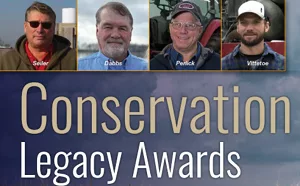
The American Soybean Association congratulates the regional winners of the 2023 Conservation Legacy Award.
Terry & Lori Dabbs, Stuttgart, Arkansas (South Region)
Tom Perlick, Washburn, Wisconsin (Upper Midwest Region)
Michael Vittetoe, Washington, Iowa (Midwest Region)
Les Seiler, Fayette, Ohio (Northeast Region)
The award winners will be recognized at the annual ASA Awards Celebration event during Commodity Classic on March 10, 2023. During the celebration, one of the regional winners will be announced as the national winner.The Conservation Legacy Award is a national program designed to recognize the outstanding environmental and conservation achievements of soybean farmers, which help produce more sustainable U.S. soybeans.
A national selection committee, composed of soybean farmers, conservationists, agronomists and natural resource professionals, evaluated nominations based on each farmer’s environmental and economic program. The program is sponsored by ASA, BASF, Bayer, Nutrien, the United Soybean Board/Soy Checkoff and Valent USA.
Michael Vittetoe, Washington, Iowa (Midwest Region) To say conservation is in Michael Vittetoe’s blood would be an understatement. A veteran of no-till farming and cover crops, the Washington, Iowa, soybean and corn farmer joined the family operation in 2014 after working off the farm as an engineer for five years.“We have long strived to be good stewards of the land by taking action to reduce soil erosion and improve water quality,” Vittetoe says.In fact, Vittetoe’s grandfather was an early adopter of reduced tillage in the area, moving away from the use of the moldboard plow. Waterways, terraces and filter strips also have been an integral part of the operation for decades.“Going way back, conservation has been a part of our operation—essentially since its inception,” Vittetoe explains. “My dad was big on no-till back in the ‘80s when it was first starting to be a thing. The farm has been essentially no-till ever since.”The family’s rich history in soil preservation is matched by its efforts to protect water quality through cover crops, waterways, terraces and filter strips. Read more.Les Seiler, Fayette, Ohio (Northeast Region) Seiler Farms is part of the Western Lake Erie Basin, where Les says farming practices need to be improved to help mitigate losses. He adds the Maumee River itself is one of the biggest contributors to the algal bloom issues of Lake Erie. Seiler is a long-time no-till farmer and cover crop user.
“We have so much soil erosion because we have a lot of poor soil health, and we can’t infiltrate water on the land anymore,” Seiler says. “We’ve seen the need to do something different besides the conventional farming practices of moldboard plowing and a lot of tillage.”He recalls the Toledo water crisis of 2014, in which several people had no access to water for two days because of algal blooms on Lake Erie. He realized during that event he didn’t want to be a contributing factor to people being without water.“I don’t think there should be anybody anywhere in the world who wonders where their next glass of water is coming from, or if water is going to be an issue,” Seiler says. “I hope someday that somebody says, ‘Well, I hope that guy made a difference.’ I don’t want to be the one who didn’t realize the importance of that.” Read more.Tom Perlick, Washburn, Wisconsin (Upper Midwest Region) Tom Perlick’s conservation journey is all about changing attitudes. From coming back to the family farm after his father’s death to charting his own course in unexplored management techniques, the now-veteran farmer is a pioneer in the northwest Wisconsin conservation frontier.Learning what cover crops could bring to his operation has been amazing, Perlick says, as the number of earthworms alone on his farm has grown exponentially.“Soil health is what I think it’s really brought to us,” he explains. “We’re learning so much more about how the mycorrhizal fungi, different bacteria and living organisms that are in the soil make our soil more productive and healthier. We minimize erosion to the maximum amount that we can.”During his tenure, Perlick has far exceeded no-till and cover crops in implementing successful conservation practices. From wetlands restoration to forestry management, pollinator plots and critical area seeding to manure pit remediation, nitrogen rate studies, grassed waterways and beyond, Perlick’s conservation legacy is all about changing attitudes. When others said he couldn’t succeed, he proved them wrong. Read more.Terry & Lori Dabbs, Stuttgart, Arkansas (South Region) For Stuttgart, Arkansas, farmers Terry and Lori Dabbs, their farming legacy solely focuses on water conservation. “Water is the most important thing to our farm,” Terry says.Both the Dabbs’ LTD Farms and Lori’s family operation, Hargrove Farms, Inc., focus on growing corn, soybeans and rice in a minimum-till setting.Lori says many of their stewardship practices are specific to the area because water quantity is a big concern, with irrigation efficiencies and water conservation primary points of focus.“One of our greatest challenges in our area is the availability and the competition for surface water,” Lori explains. “The water conservation efforts on our farm really began before my grandparents ever purchased the farm.” Read more.
The National No-Tillage Conference returns January 12-15, 2027!Build and refine your no-till system with dozens of new ideas and connections at the 35th Annual National No-Tillage Conference in Indianapolis, Jan. 12-15, 2027. Experience an energizing 4-day agenda featuring inspiring general session speakers, expert-led No-Till Classrooms and collaborative No-Till Roundtables. Plus, Certified Crop Adviser credits will be offered.
This week we are looking at a clip from Cody Hornaday, a technical agronomist with Koch Agronomic Services, as he explains a few tips that no-tillers and cover croppers should keep in mind for unlocking phosphorus in their soils.
Family Owned since 1964 – Remlinger Manufacturing was founded by Wilbur Remlinger in 1964 and the family tradition continues today with Wilbur’s grandson being the current CEO/President. Although the business has expanded and diversified, family remains a core value to the company and is evident in the company culture.
Made in USA – Remlinger Manufacturing is proudly located in Kalida, Ohio. We have dealers located across the US and Canada to conveniently serve our customers.
Quality Driven – With over 60 years of producing farm equipment, we continue our tradition of manufacturing high quality attachments and products to serve farmers around the globe.
Byron Seeds LLC is a team of individuals who have a passion for high energy forages, cover crops, and proper farming techniques. Byron personnel seek to understand our clients’ goals so that we may provide the best environment for our clients’ success through research, education, support, and...
Our years of experience and network of dealers make us the ideal choice for your mowing, no-till and horse drawn equipment needs. Use our Dealer Locator to contact your nearest I&J dealer today.