It’s easy to get stuck in a rut with farming, but that’s a major reason Tom Cotter did the opposite of that and turned to no-tilling and interseeding cover crops to rejuvenate his farm.
The system he’s developed over time let him increase yields, generate more income from the same amount of land and improve the quality and health of his soils, livestock and crops in a geography that generates some challenges to no-till success.
Learning Curve
Cotter is a fourth-generation farmer whose family had been tilling their 1,100-acre farm near Austin, Minn., since the 1870s. About 19 years ago, Cotter and his father Michael first tried a cover crop of dwarf Essex rape seed on harvested pea ground for weed suppression and drainage. They saw immediate results on their heavy, clay loam soils.
“We used it for the weed suppression first but realized really fast that there was an advantage to tiling also,” Cotter told attendees at the National No-Tillage Conference earlier this year. “When we’d tile the field we’d have to hook three tractors up to get through mud and wet spots.
“With the cover crop out there it’s like driving on a football field. Then we realized that our farm drainage as a whole was working better because of the cover crops. I still install drain tile in some key spots, but the cover crops are helping that water infiltrate faster.”
The following year, the field where the cover crop had been also gave them their best field-corn yields. That encouraged them to continue experimenting.
“I played with cover crops, made mistakes and it took me about 14 years to really learn how to do it successfully,” says Cotter. “When we started we were still doing tillage and had about 12 inches of nice growth we thought we’d incorporate as green manure. But we let it sit for a week and suddenly it was up to 30 inches and there was too much to put in the ground.”
“My ground was addicted to tillage, chemicals and fertilizers so I felt I needed to earn the right to no-till my sweet corn…”— Tom Cotter
More recently he delayed seeding soybeans to get more cover crop re-growth for better weed suppression. Then it got hot and dry.
“The cattle had grazed the covers off, and the ground got so hard I had to add down pressure to seed. The beans were stunted from the start. I should have planted the beans and waited to spray and kill the cover crop off later,” says Cotter. “I waited too long.”
Cotter no-tills around 765 acres of field corn and soybeans, 150 acres of sweet corn and 185 acres of peas. Once sweet corn is harvested in late July or early August he seeds a multi-species cover crop.
“I like diversity in those fields because I’ve got some high, low and wet ground,” says Cotter. “When I have cover crops out there the one plant that doesn’t do good in one area generally does really good somewhere else. I have great growth.”
Cotter drills soybeans into a single-species cover crop, generally cereal rye or triticale, around May 15 after grazing the previous fall-planted cover crop. He just started interseeding cover crops into the soybeans around Sept. 12, just as the plants are about to drop their leaves, instead of waiting until after soybean harvest.
“When I’m harvesting I’m already on top of a nice, green mat of grass and then I can graze it afterwards,” says Cotter.
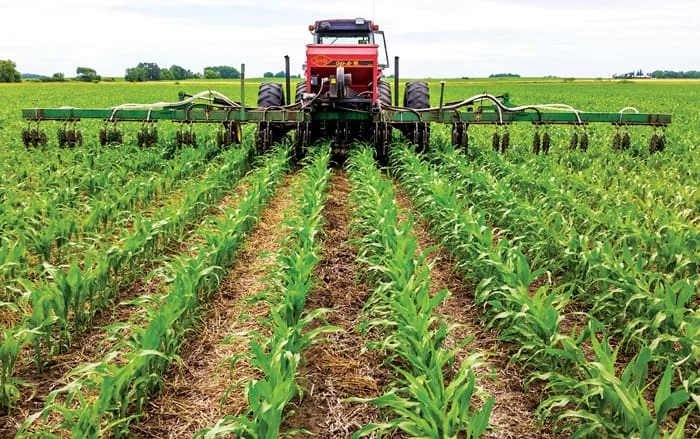
For corn, Cotter strip-tills the existing cover-cropped fields toward the end of April after grazing it first and plants corn around May 1. If he has the option to graze the field after, he comes in and interseeds a cover crop mix at the V6 stage around June 15. “I harvest the corn around Oct. 15 and I can graze right after that,” he says.
This year Cotter no-tilled his sweet corn for the first time and liked the results.
“My ground was addicted to tillage, chemicals and fertilizers so I felt I needed to earn the right to no-till my sweet corn,” Cotter recalls. “I had to get the soil healthy so I really pushed the cover crops hard. The last couple of years my sweet-corn crops have been amazing, and it all comes down to my cover crops.”
Cotter uses a variety of cover crop mixes — up to 17 different species. He always ensures there are at least three grasses, such as Bounty annual ryegrass, cereal rye or triticale, three brassicas, such as purple-top turnip, tillage radish, kale, dwarf Essex rape seed or African cabbage, and two or three legumes, such as Austrian pea, cow pea, vetch or red clover and a broadleaf, such as buckwheat as a pollinator.
The mix will depend on seeding date and what his goals are. “It depends on whether I want to graze it with my grass-fed calves or if I’m going to put my cows out there,” he says. “Every field has different goals.”
For example, Bayou kale provides good wind protection for cattle grazing out in the winter, buckwheat increases beneficial mycorrhizal fungi — which helps plant roots draw water and nutrients from the soil — and purple-top turnips release nitrogen (N) slowly over time as they break down, Cotter says. His covers are versatile as they can be grazed, baled, chopped or cut for hay.
Cattle are Essential
Cotter says livestock is another essential component of his farm system. He has a 50-head cow/calf operation and having cover crops in the rotation extends grazing later into the fall and early winter, as well as early spring.
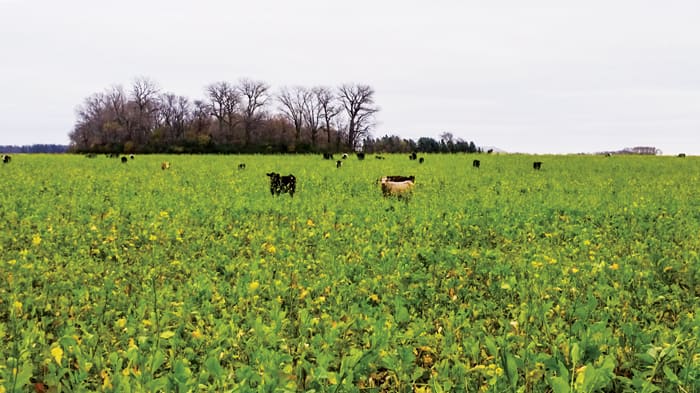
Cash Cows. Tom Cotter likes to finish his grass-fed calves on a diverse cover crop mix because they’ll put on weight much better with a smorgasbord of brassicas and grasses. He’s noticed cattle are healthier on covers and need fewer supplements. He recently had a 240-pound mineral tub out in a field for 2 months and the cattle only a third of it.
“I always shoot for grazing the cover crops April 1, which is around my calving time, because I don’t want to be calving in the sheds and manure, I want them out on that grass where it’s cleaner and healthier,” says Cotter. “I like to finish my grass-fed calves on a big multi-species cover crop because they’ll put on weight much better when they have a big smorgasbord of brassicas and grasses and all that.”
Although Cotter doesn’t measure average daily gain, he’s noticed cattle are healthier and need less supplements after feeding on covers. “I recently had a 240-pound mineral tub out in the field for 2 months and the cattle ate about a third of it,” he says. “The cover crops are providing lots of different nutrients.”
Cotter believes his farm system functions better if livestock are involved because the animals provide more income using the same crop acres, they increase soil biological activity by tramping residue into the ground, and they bring nutrients to the land with manure.
“I don’t feel you can get to a high plateau if you don’t put cover crops, no-till and livestock grazing together,” he says.
Taking Another Step
After seeing so many positive benefits to soil health with cover crop cocktails following his canning crops, Cotter wanted to capture those same benefits in his cash crops.
“If you’re just a corn-and-soybean guy you’re pretty much locked into winter rye here for a cover crop. But interseeding gives you the capability to get different species out there,” he says. “What I want is more diverse microbial colonies, and when you have that it creates a smorgasbord for the cattle grazing it and for the livestock underground, too.”
About 4 years ago Cotter started interseeding multi-species cover crops into standing corn at the V4-V6 stage. Rather than purchase seeding equipment, Cotter built his own machine using an old Gandy Orbit-Air seeder and two 8-row rotary hoes to make a 16-row, 40-foot toolbar.
“The whole thing cost me less than $4,000,” says Cotter. It’s cheap, easy and versatile.”
Tips for Interseeding
Cotter is still experimenting with different cover mixes and seeding methods but says there are some critical steps producers need to follow if they want to be successful:
- Be aware of herbicide carryover, which not only affects cash crops but also livestock grazing. Research the products being used, says Cotter, adding that the University of Missouri, University of Wisconsin and Penn State University have a lot of good information available.
- He advises interseeding covers as early as possible to ensure good establishment. Cotter aims to seed the covers between V4 and V6 in corn and uses shorter corn varieties that won’t shade out the covers before they have a chance to grow. For soybeans he interseeds around Sept. 15 just as the plants are about to drop their leaves. He prefers east-to-west rows that allow more sunlight for faster crop establishment.
- Flexibility is vitally important to successful interseeding, Cotter notes, and that includes being flexible with timing and methods of seeding, chemical applications and plant species.
He can plant covers many different ways. “Early on I can spread it on top of the ground, but the later it gets the more I have to plant that seed into the soil,” says Cotter.
Besides his no-till drill, Cotter has used a pendulum spreader and floater truck to broadcast seed, and he can transfer his Gandy air box to a vertical-tillage tool he uses to seed covers and put them in contact with the soil while still protecting valuable residue.
“I can plant a cover crop early into V4 or V6 corn on June 15 and if I want to graze it I have to work with my chemicals,” says Cotter. “On my pre-emergence herbicide I did 60%- or 70% of Harness and some Roundup to kill the cereal rye and that was it. That’s all I had to spray. I didn’t have to come back and make another pass.”
He’s thinking of changing up his herbicide program for next year. Generally when he sprays Roundup with pre-emergence herbicides the weed control is so good that he has to wait to do the post-emergence spray, which interferes with interseeding timing, he says.
“This year, I’ll probably skip the pre-emergence and just come in with Status, which likes to be sprayed early. Then I’ll be able to come in and interseed earlier.”