
Farmer enthusiasm around 45Z, low-carbon corn, and its economic potential may have peaked this summer, with the FarmDoc article showing that cover crops could generate as much as $90 per acre in total 45Z value.
One of the more curious relationships between cover crops and carbon scores shows up geographically.
Where cover crops have more value
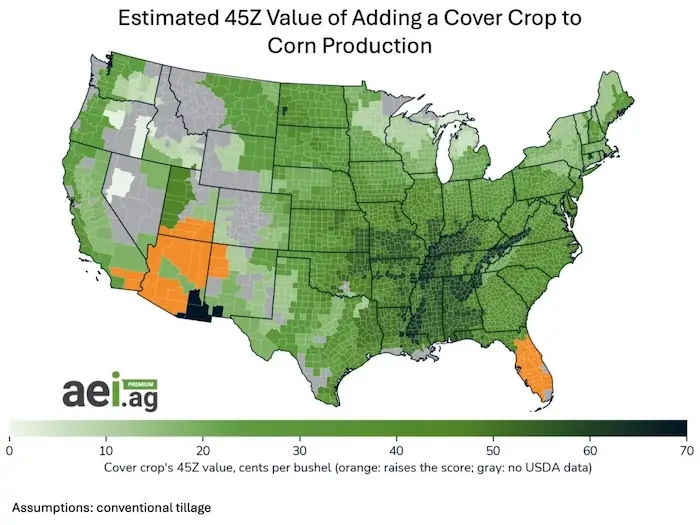
Figure 1 shows the geographic differences in total 45Z value a cover crop provides per bushel of corn. To be clear, this is the value for the entire system (not a specific farm-level value). Renewable fuel manufacturers would claim the 45Z tax credit and could pass some of that value along to farmers and grain handlers in the form of a low-CI premium. Farmers should not use the full value shown in Figure 1 when making plans or building on-farm scenarios.
The counties shaded dark green are where the per-bushel value of a cover crop is $0.60 to $0.70/bushel. That aside, the per-bushel value of a cover crop is highest in parts of Kentucky, Tennessee, Mississippi, and Alabama.
Counties in eastern Kansas, southern Missouri, and southern Illinois could also benefit from higher per-bushel cover crop values.
At the other extreme, a few regions have quite low per-bushel values. Northern Minnesota, northern Wisconsin, and northern Michigan, for example. Notably, in areas in the Southwest and much of Florida (shaded orange), adding a cover crop raises the corn carbon intensity score.
The important factor not included in Figure 1 is expected yield. For regions with high per-bushel value and big yields, the potential gross value per acre can be considerable.
Wrapping it up
As producers dig into the details around 45Z and achieving a low-carbon score, many moving – even interacting – factors are in play. For instance, adding cover crops is even more valuable in no-till systems. The biggest surprise, however, might be that the value of cover crops depends on where you farm. That geographic variation is considerable, even within a specific state.
For producers, this is a reminder to carefully review and test how low-carbon practices fit into operations. In short, the appeal of cover crops will vary greatly. For renewable fuel producers, it’s a reminder that the local supply of low-carbon corn could be highly variable and may require premium structures and educational programs to reflect those nuances.
The AEI team has been digging into various aspects of the 45Z program and potential implications for producers. Be sure to join the 11/5 webinar and explore the related articles.