Managing nitrogen remains a top priority for farmers as fertilizer prices have surged. Jackson Stansell, founder and CEO of Sentinel Ag in Ithaca, Neb., shares how new technology equips farmers with more precise nitrogen management tools.
Nitrogen can be challenging to manage due to its agronomic complexity. Additionally, prices and policy fluctuate, and a wide array of nitrogen products are available. Synthetic fertilizers provide a predictable supply of nitrogen in available forms and the nitrogen credits are more easily counted. Other practices such as biologicals, biostimulants, cover crops and manure also provide nitrogen, but they are more challenging to account for.
Traditional methods of nitrogen crediting include MRTN (Maximum Return To Nitrogen), Nitrogen Accounting and Modeling. These methods were built on synthetic fertilizer response trials.
“Cover crops, biologicals, manure and soil health are either not considered at a state level in terms of these recommendations or they're treated as fixed credits,” Stansell says.
By not precisely accounting for the nitrogen credits accumulated by non-fertilizer nitrogen sources, the farmer may inadvertently purchase more nitrogen than the crop will actually use. In the MRTN, recommendations are built with profit as the top priority, whereas the Nitrogen Accounting method is agronomically based and aims to reach a set yield. Modeling does integrate weather data, but struggles to account for non-fertilizer nitrogen sources.
“This is what farmers have started to identify as the opportunity with Sentinel accounting for the release from cover crops in a way that gives this farmer the advantage to take the full credit when it's available and really using the plant to tell whether more nitrogen is needed,” Stansell says.
The availability of these nitrogen credits occurs through mineralization, nitrification and fixation.
“Peak mineralization occurs near field capacity,” Stansell says. “That means we want moist soils, but not saturated soils when we're talking about really ideal conditions for mineralization.”
Mineralization continues to increase during the growing season as the soil temperature rises and soil microbial activity increases.
Nitrification occurs as bacteria in the soil convert ammonium to nitrate. It is key for converting nitrogen into a plant available form, and is driven by soil temperature, moisture and pH. In high hydraulic conductivity soils, the nitrate can quickly leach out of the root zone, making it no longer available to the crop.
“Fixation is another process by which nitrogen is made available to crops,” says Stansell. “In this process, microbes are basically pulling nitrogen gas out of the air, turning it into ammonia, ammonia into ammonium and then eventually into nitrate for plant usage. A lot of people think about this coming from legumes, root nodulation and the rhizobium but this process does occur with free living organisms in the soil, even in corn systems and non-leguminous cropping systems.”
Stansell says that in high biology soils, fixation is reported to contribute 20-40 pounds of nitrogen per acre per year. However, this contribution is typically not well-credited in the current models.
Understanding the constant change in nitrogen availability during a growing season led to Sentinel Ag’s approach. The company’s nitrogen management system focuses on in-season application.
“It's really hard to predict exactly how these non-fertilizer nitrogen sources are going to contribute to the crop,” Stansell says. “We really need to push that decision back as far as we can, and ideally push it back as far as an in-season application, potentially multiple.”
Doing this allows for better accounting of nitrogen credits gained during the growing season through mineralization and fixation, and credits lost through volatilization and denitrification.
“Using imagery, we are able to actually make a better measurement of at least how the presence or lack thereof of these non-fertilizer nitrogen sources is impacting sufficiency,” Stansell says. “With imagery, you're actually able to track your field over a full year, see how biomass is developing and even track nitrogen status in the cover crop itself so that you have some estimation of how the cover crop is faring.”
This imagery data compares “canary plots” to the rest of the field. Canary plots are small areas in the field that receive 30 pounds per acre less nitrogen than the rest of the field. When the imaging indicates the canary plots are approaching deficiency, that signals the rest of the field will reach similar levels in about a week if no action is taken.
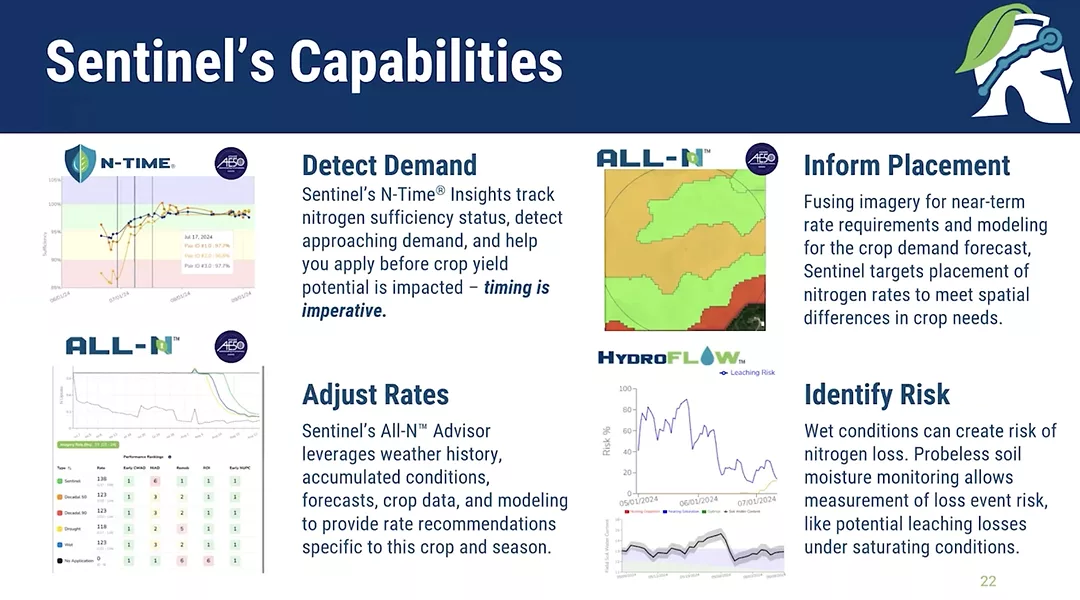
Sentinel Ag has three digital tools to help farmers maximize their nitrogen utilization.
N-Time: “Timing is really, really important when it comes to nitrogen,” Stansell says. “If you can detect that you're going to be approaching a demand a week or more before that demand actually occurs, you have time to get into the field and correct that demand before it impacts yield potential.” N-Time gives farmers the data to do exactly that.
All-N: This tool combines historical weather data, accumulated weather for the growing season and forecasts with crop and soil dynamics data to provide rate recommendations for the specific crop at that point in the current season. Recommendations even specify certain areas of a field that may need a different application than the rest of the field.
HydroFlow: This risk identification tool detects areas in a field under wet conditions that are at a higher risk of nitrogen loss through leaching.
“This is very useful for that period of time between planting and V6, where optical imagery is not quite as useful due to the amount of soil pixel background in the satellite imagery,” Stansell says. “It is also useful where soil moisture status can really be used to identify risk of loss and potentially crop development lag due to persistence of soil moisture conditions.”
“The longer the crop is growing in the field and the more of the season that we have seen at the time when we're making this adjustment, the more accurate that adjustment is going to be,” Stansell says.
Stansell says that farmers have been able to reduce their synthetic nitrogen fertilizer applications by about 40-50 pounds per acre per year since the technology allows them to accurately account for the credits from their other practices. Considering the cost saved by applying less nitrogen, and the increased profit from rising yields, Stansell says Sentinel Ag’s customers have seen a benefit of $59 per acre.