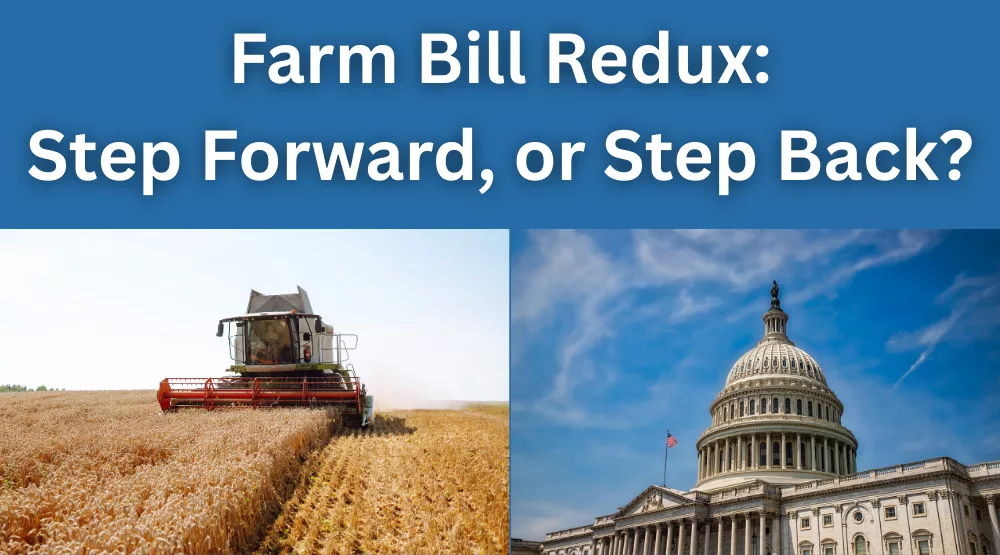
There was some good news for farmers across the U.S. when the government shutdown ended, as the 2018 Farm Bill was extended for another year.
The package of spending bills fully funds the USDA for fiscal year 2026 and includes the extension of farm programs and authorities, not covered in the One Big Beautiful Bill Act, that were set to expire on Dec. 31.
This extension maintains most existing programs, including commodity programs such as Price Loss Coverage and Agriculture Risk Coverage, conservation programs such as the Conservation Reserve Program, and nutrition assistance programs like SNAP.
U.S. Sen. John Boozman (R-Ark.), chairman of the Senate Ag Committee, noted several farm policy revisions were contained in the One Big Beautiful Bill that included enhanced risk management tools.
“Extending the Farm Bill and the U.S. Grain Standards Act gives us more time to finalize these programs essential to farmers, ranchers and rural America.”
Extension ‘Not Enough’
Not every organization representing farmers was happy with the extension, however.
The National Sustainable Agriculture Coalition says the bill maintains level funding for the Sustainable Agriculture Research & Education (SARE), Organic Transitions and Farming Opportunities Training and Outreach programs.
But it cuts funding for conservation technical assistance by nearly $100 million and reduces funding for several other programs, including Grazing Lands Conservation Initiative.
The Farm Bill extension extends the Conservation Reserve Program (CRP) but fails to provide critical funding for the CRP-Transition Incentive Program, which will no longer be able to offer incentives for landowners who rent or sell their land to beginning farmers and ranchers who commit to using sustainable grazing practices, resource-conserving cropping systems, or transitioning to organic production.
The extension also fails to extend payment limits for the Environmental Quality Incentives Program (EQIP) and the Conservation Stewardship Program (CSP), removing any cap on the total cost-share a single operation can receive through EQIP and CSP.
Coupled with the removal of Adjusted Gross Income (AGI) eligibility requirements in this summer’s reconciliation package, “this paves the way for very large operations to consume disproportionate amounts of conservation dollars,” said Mike Lavender, NSAC Policy Director Lavender.
“Taken together, these bills make it harder for a wide variety of family farmers to enhance their productivity and protect natural resources and bias federal conservation programs towards serving the largest operations first and foremost.”
The National Young Farmers Coalition was also critical of the extension because the bills rescinds unspent conservation operations funding intended for conservation, meaning that these funds can no longer be spent.
The extension eliminates payment limits for EQIP and CSP (formerly at $450,000 and $200,000, respectively), paving the way for some of the nation’s largest producers to use up valuable conservation dollars disproportionately.
“This deal ends a historic shutdown, but it does not end uncertainty many farmers face. A one-year Farm Bill extension and underfunded appropriations package are not enough to secure the future of U.S. agriculture,” the NYFC said.
E-15 Looms
Ohio farmer and National Corn Growers Assn. President Jed Bower said most growers are relieved with the extension, but they also see this as an “inflection point.
“We are approaching year’s end, and, despite opportunities to do so, Congress has not voted on legislation that would allow consumers across the country to access E15 year-round.
“Passage of this legislation would bolster the nation’s energy security, save drivers money at the pump and help corn growers considerably by increasing demand. We strongly urge Congress to pass this legislation right away and will continue our meetings with members of Congress to call for action.”
Caleb Ragland, president of the American Soybean Assn. and a farmer in Kentucky, said growers, “need the federal government to get to work delivering much-needed farmer assistance and advancing other priorities that will help grow demand for U.S. soy,” such as finalizing biofuels regulations and strengthening trade opportunities.