By Dusty Sonnenberg, CCA, Field Leader, a project of the Ohio Soybean Council and Soybean Checkoff
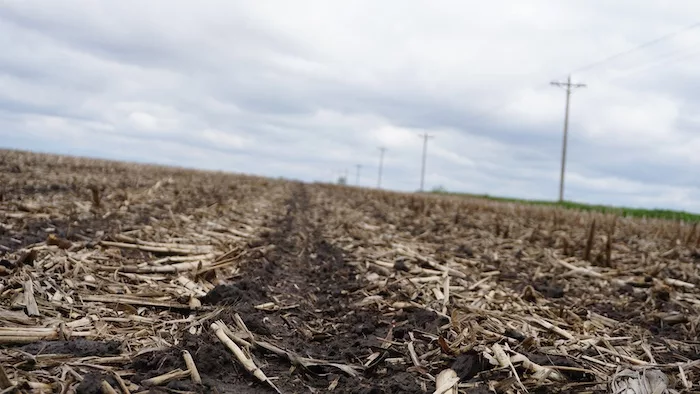
As harvest rolls on across the Buckeye state, many farmers are asking if it is too late to plant cover crops. One of the biggest risks with late-planted fall cover crops is failure to establish a stand, often due to insufficient soil moisture. Given the calendar date and extremely dry conditions in many areas, concerns about cover crop germination and emergence are valid.
Sjoerd Willem Duiker, Ph.D., CCA, is a professor of soil management and applied soil physics at Penn State University. His work has focused on no-till systems, including diverse crop rotations and cover crops to improve soil health and crop productivity.
Duiker says dry soil conditions will affect planting decisions.
“If precipitation is expected in the coming days, you can plant your cover crop now,” Duiker said. “However, if rains tarry, it becomes increasingly questionable to plant winter-killed species or those that must be planted now to be winter hardy. It may be better to go with one or two cover crop species that have good winter hardiness and plenty of time before their latest recommended fall seeding date. These species also tend to have larger seeds and can be planted a bit deeper than normal in dry soil to access moisture and slow their emergence.”
The Midwest Cover Crops Council is a network of producers, landowners, researchers, industry leaders, agencies, extension staff, and government stakeholders working to facilitate widespread adoption of cover crops across the Midwest.
There are various methods of planting cover crops depending on the capabilities of the grower. The most common methods include broadcast seeding without incorporation, broadcast seeding with shallow incorporation, drill seeding, and row crop planting. Each has a unique fit in different situations. Given the late time period and the dry soil conditions, each method should be evaluated for potential benefits and drawbacks.
Broadcast seeding without incorporation involves broadcast seeding the cover crops using a variety of spreading equipment. This could include aerial application, air seeders, or equipment with spinners or pendulum spreaders. Cover crops could be combined with dry fertilizer prior to application. Seeding rates should be increased to account for poor seed-to-soil contact, seed predation, and residue interference.
The Midwest Cover Crops Council makes the following recommendations.
- Increase seeding rate by 20% to 50% more than drilled rates to achieve adequate stands.
- Good soil moisture at seeding and 0.5 to 1 inch of rainfall after seeding will improve germination and establishment. Compacted or crusted soils may reduce establishment.
- For aerial seeding, weight limitations may make large seeds and/or high seeding rates too costly to be practical. Mixing in a small-seeded cover crop can help to keep costs low with a reasonable stand (i.e. mix turnip into oats). Wind, equipment, calibration, height above ground, and speed affect the uniformity of seed distribution. Contact your local agriculture pilot for details on cost, weight limits and distribution. Consult state or regional agricultural aviation associations or the National Agricultural Aviation Association to find aerial seeding pilots.
- Be aware that small-seeded cover crops (grasses, radishes) germinate better from aerial/broadcast seeding than large-seeded cover crops (cowpeas, winter peas) due to seed placement and cracking.
- For late fall broadcast seeding, winter cereal grains tend to be more successful.
- Broadcasting a mix of cover crop species can be difficult as different seed sizes will spread differently and may create bands in the spread pattern.
Broadcast seeding with shallow incorporation is a popular method as it allows farmers to cover acres more quickly than with a drill and still improve the seed-to-soil contact. This method involves broadcast seeding the cover crop onto the soil surface after the cash crop has been harvested and then using shallow or light tillage to incorporate the seed. This method has been combined into a single operation with air-seeders mounted to vertical tillage tools, harrows, and rotary hoes.
The Midwest Cover Crops Council has several recommendations for broadcast seeding with incorporation.
- Make sure there is adequate soil moisture and that seed is not buried too deep.
- Be aware that rainfall after seeding helps, but is not as critical as with aerial seeding or broadcasting on the surface.
- Due to differences in seed size and density, check distribution and spreading when seeding cover crops to minimize uneven stands.
- Increase seeding rate 10% to 20% more than drilled rates to achieve adequate stands.
The other method is drill seeding. This method uses a seed drill to plant the cover crop after the cash crop is harvested. Minimizing soil disturbance by using no-till drills has additional benefits to soil health.
When using this method, the Midwest Cover Crops Council has the following reminders.
- Be aware that drilling cover crop seed improves seed-to-soil contact, but hard soils, soil compaction, soil crusting, or inadequate soil moisture may still reduce seed germination and establishment.
- When planting mixes, distributing large and small seeds between the main-seed box and small-seed box (if available) can prevent seed segregation and improve seed placement.
- See the Cover Crops Field Guide or consult the selector tool for recommended drilled seeding depths and seeding rates for each species.
- Take time to adequately set up the drill for good seed depth placement and spacing. Read your seed drill owner’s manual or consult a dealer for cover crop seeding rate settings. It is always a good idea to calibrate your drill and it is worth the extra time to calibrate for mixes. If possible, check the rate by turning gears manually in the shop or on a hard surface, and then collecting and weighing the seed output. Penn State University Extension (extension.psu.edu) has a useful article about drill calibration titled, “Calibration of Grain/Seed Drills.”
- Read your planter owner’s manual or consult a dealer for cover crop seeding rate settings. Planters may require special seed plates, cup holders, brushes, or planter modifications to adequately plant cover crop seed, depending on the type and size of seed selected.
- Additional disks for the seed meters are becoming available for several brands of planters to meter a broader range of cover crop species.
- Through the use of guidance and precision planting systems, the relationship between cover crop and cash crop placement as well as seeding rates can be optimized.
Seeding cover crops using a row crop planter involves using a row crop planter after the cash crop has been harvested. Varying row widths are used, including split row planters. Row crop planters generally result in the best cover crop establishment due to good seed-to-soil contact, good depth control, and consistent seed spacing. This method often requires 10 to 50 percent less seed than drilling. Minimizing soil disturbance by using no-till planters has additional benefits to soil health.
The Midwest Cover Crops Council has recommendations for seeding cover crops using a row crop planter.